In a recent Washington Post article, Democrat and Obama Economist, Jared Bernstein, along with another lesser known writer said, simply from its title "Yet another inconvenient truth for its opponents: Obamacare is not ‘killing jobs’". Of course, in the article, they point to facts that support their claim.
Others have pointed out that jobless claims this year have been at 42-year lows despite this being the same year that the employee mandate kicked in. So, how can it be said that ObamaCare is costing jobs?
The problem is, that jobs are being lost in a way that is not obvious from the employment reports. As of 2014, 34% of the workforce, or 53 million employees, are contracted labor; up from just 7% of the workforce or 10 million workers in 2005. And, up 11 million workers or almost 25% in just one year, from 42 million in 2013. The real inconvenient truth is that employees are being converted to contractors as employers maneuver to avoid federal and state mandates like matching FICA payments, salaried overtime requirements, and, oh yes, Obamacare.
Also, be aware that when an independent contractor (freelancer) is laid off, he/she is not eligible for unemployment insurance. Additionally, 4% of our workforce are involuntarily working part-time. That's almost 50% higher than the traditional 2.7%. This despite the supposed lowering of the unemployment rate to 5%. The only rational explanation for this is that employers are avoiding the 50 full time employees rule of ObamaCare by converting full time jobs to part time.
References:
Yet another inconvenient truth for its opponents: Obamacare is not ‘killing jobs’: https://www.washingtonpost.com/posteverything/wp/2015/11/09/yet-another-inconvenient-truth-for-its-opponents-obamacare-is-not-killing-jobs/
How Businesses Are Handling the Obamacare Employer Mandate: http://www.entrepreneur.com/article/239039
Freelancer: https://en.wikipedia.org/wiki/Freelancer
53 million Americans are freelancing, new survey finds: https://www.freelancersunion.org/blog/dispatches/2014/09/04/53million/
US jobless claims fall 7K, revisit 42-year lows - CNBC.com: http://www.cnbc.com/2015/10/15/us-jobless-claims-fall-7k-revisit-42-year-lows.html
Table A-8. Employed persons by class of worker and part-time status: http://www.bls.gov/news.release/empsit.t08.htm
Showing posts with label jobless claims. Show all posts
Showing posts with label jobless claims. Show all posts
Monday, December 21, 2015

Monday, October 5, 2015
A Decade's Low Unemployment Claims: Not a Good Thing!
Last Thursday, the average of unemployment insurance claims was the lowest since Nixon was in Office; at least according to one headline. Of course, this is even more outstanding when you consider the fact that the workforce was 40% smaller when Nixon was in office.
So, why should I be concerned over what seems to be such great news?
The reason is that, as of a year ago, 34% of our workforce were freelancers or independent contractors. That's more than 53 million workers in 2014; almost double the 27 million freelancers in 2006 when they represented 18% of a smaller labor force of 151 million workers. And, for sure, the number today is even higher than last year's 34%. But, a critical point point to make is that these workers are not eligible for unemployment compensation whenever their services are no longer needed by a company.
Thus, we would probably have higher unemployment claims today if it weren't for the fact that a full one-third of our workforce is now self-employed.
Sadly, this is a growing trend as companies try to avoid the heavy burden of higher employment costs such as the employer mandate of ObamaCare; higher minimum wages in 29 states than the federal $7.25 an hour; and, Obama's new overtime rule for salaried workers.
It is now estimated that 40% of the workforce will be forced into a role of self-employment by 2020. Not a good thing for the American worker and their families. Thanks to over regulation of businesses, job security is vanishing in this country,.
References:
Jobless claims average hasn’t been this low since Richard Nixon: http://www.marketwatch.com/story/average-jobless-claims-havent-been-this-low-since-richard-nixon-2015-10-01
One in Three U.S. Workers Is A Freelancer: http://blogs.wsj.com/atwork/2014/09/04/one-in-three-u-s-workers-is-a-freelancer/
40% of America's workforce will be freelancers by 2020: http://qz.com/65279/40-of-americas-workforce-will-be-freelancers-by-2020/
How many freelancers are there? In 2006?: http://freelancersmovement.org/how-many-freelancers-are-there/
Labor Force Size By Year: http://www.dlt.ri.gov/lmi/laus/us/usadj.htm
State Minimum Wages | 2015 Minimum Wage by State: http://www.ncsl.org/research/labor-and-employment/state-minimum-wage-chart.aspx
Obama's new overtime rules: How they'd work and who they'd affect: http://www.latimes.com/business/la-fi-obama-overtime-rules-explainer-20150630-htmlstory.html
Saturday, November 29, 2014
Jobless Claims Spiking...Should We Worry?
Back in September, I wrote a blog titled: Beware of Jobless Claims Below 300,000. In it, I showed that, historically, when claims fall below 300,000, a recession is almost sure to follow.
Well, interestingly enough, we just had a big spike in jobless claims which are now back above 300,000. So, the question is: Is this jump signalling the possible start of a recession. The reason I say this, is because it is rare to see such a big jump in layoffs before a big holiday like Thanksgiving. Normally, employers do everything possible to avoid giving people notices at those time. It can be a heartless thing to do.
With that in mind, please look at this chart from the people at Zero Hedge:

Now, look at the historical Jobless Claims from St. Louis Federal Reserve:
Note, the similarity in the spike in claims just before the start of each recession.
This doesn't mean that a recession is necessarily imminent. Usually it takes a few weeks to develop, but if jobless claims continue to develop an upward trend, it may be that this latest number is the canary in the coal mine.
One last thing. Normally, the claims number that follows a holiday will be low because (1) claims offices are only open a few days in that reporting period and (2) because less people are available during holidays to file claims. Therefore, next week's jobless number should fall dramatically. But, if not, we could be seeing the start of a new recession.
References:
Initial Jobless Claims Spikes Above 300k To 3-Month Highs, Biggest Miss In 11 Months: http://www.zerohedge.com/news/2014-11-26/initial-jobless-claims-spikes-above-300k-3-month-highs-biggest-miss-11-months
FRED: 4-Week Moving Average of Initial Claims: http://research.stlouisfed.org/fred2/graph/?id=IC4WSA,
Well, interestingly enough, we just had a big spike in jobless claims which are now back above 300,000. So, the question is: Is this jump signalling the possible start of a recession. The reason I say this, is because it is rare to see such a big jump in layoffs before a big holiday like Thanksgiving. Normally, employers do everything possible to avoid giving people notices at those time. It can be a heartless thing to do.
With that in mind, please look at this chart from the people at Zero Hedge:

Now, look at the historical Jobless Claims from St. Louis Federal Reserve:
 |
| Click on chart to zoom in |
This doesn't mean that a recession is necessarily imminent. Usually it takes a few weeks to develop, but if jobless claims continue to develop an upward trend, it may be that this latest number is the canary in the coal mine.
One last thing. Normally, the claims number that follows a holiday will be low because (1) claims offices are only open a few days in that reporting period and (2) because less people are available during holidays to file claims. Therefore, next week's jobless number should fall dramatically. But, if not, we could be seeing the start of a new recession.
References:
Initial Jobless Claims Spikes Above 300k To 3-Month Highs, Biggest Miss In 11 Months: http://www.zerohedge.com/news/2014-11-26/initial-jobless-claims-spikes-above-300k-3-month-highs-biggest-miss-11-months
FRED: 4-Week Moving Average of Initial Claims: http://research.stlouisfed.org/fred2/graph/?id=IC4WSA,
Monday, September 29, 2014
Beware of Jobless Claims Below 300,000
Every week, the Federal government releases a report of how many Americans have filed for first-time unemployment benefits in the prior week. Typically called the "Jobless Report" or "Claims Report", it is closely watched because, logically, claims going lower is a good thing. It means that fewer and fewer employers are laying workers off.
More closely watched than the actual number of first time claimants is the 4-week moving average of claims because they tend to bounce around from week to week and, without the averaging, it is too difficult to detect an actual trend; either upward or downward. This week, the moving average was at 293,000.
The problem with the average being below 300,000 is that, historically and very oddly, this has resulted in a soon-to-be bottoming out of claims which precedes a sharp rise. What is worse, is that a recession soon followed Proof of this is shown in the following chart accessed from the Federal Reserve's Economic Database (aka FRED):
As you can see, recessions (the shaded vertical areas on the chart) typically end with a peaking of jobless claims. Then, over time, the number slowly falls to some level just below 300,000 before rising, until again, there is an actual recession. For example, in September of 1982, the claims signaled the end of that recession at 641,750 filings. Over the next 7+ years, the average dropped out at 289,750 in January of 1989 with a sharp uptick that resulted in another recession that began in September of 1990. Then jobs claims again peaked in March of 1991; only to bottom out in April of 2000 with 269,750 claims before quickly rising to the beginning of another recession in February of 2001. Of course, the last "Great Recession" followed a bottoming of claims in February of 2006 with an average of 289,750.
So, there is definitely a very repeatable pattern of claims peaking; then, bottoming out; followed by a sharper rise and, ultimately a recession.
How low we will go and how fast we achieve it in this current trek below 300,000 is anyone's guess. But, one this is sure, if history repeats itself, lower claims are not such a good thing.
References:
FRED: 4-Week Moving Average of Initial Claims: http://research.stlouisfed.org/fred2/graph/?id=IC4WSA,
U.S. jobless claims up less than expected, point to firming labor market: http://www.reuters.com/article/2014/09/25/us-economy-jobless-idUSKCN0HK1E420140925
More closely watched than the actual number of first time claimants is the 4-week moving average of claims because they tend to bounce around from week to week and, without the averaging, it is too difficult to detect an actual trend; either upward or downward. This week, the moving average was at 293,000.
The problem with the average being below 300,000 is that, historically and very oddly, this has resulted in a soon-to-be bottoming out of claims which precedes a sharp rise. What is worse, is that a recession soon followed Proof of this is shown in the following chart accessed from the Federal Reserve's Economic Database (aka FRED):
|
| Click on chart to zoom in |
So, there is definitely a very repeatable pattern of claims peaking; then, bottoming out; followed by a sharper rise and, ultimately a recession.
How low we will go and how fast we achieve it in this current trek below 300,000 is anyone's guess. But, one this is sure, if history repeats itself, lower claims are not such a good thing.
References:
FRED: 4-Week Moving Average of Initial Claims: http://research.stlouisfed.org/fred2/graph/?id=IC4WSA,
U.S. jobless claims up less than expected, point to firming labor market: http://www.reuters.com/article/2014/09/25/us-economy-jobless-idUSKCN0HK1E420140925
Monday, June 9, 2014
Good News: Weekly Job Losses Are at Pre-Recession Levels. But...
Last Thursday, weekly jobless insurance claims came in at 312,000. That coupled with previously reported claims has pretty much solidified the fact that we are now at pre-recession levels for first-time workers collecting unemployment insurance; as noted by this chart from the folks at ZeroHedge.com:
Unfortunately, this trend may be short lived.
This month it was reported that the economy failed to grow in the first quarter; actually shrinking by one percent. Should this be repeated in the second quarter, it could officially signal another recession. But, as most economists will tell you, unemployment is usually a lagging indicator; meaning that, if we do slide into another recession, it will take management another 6 months or so to lay enough people off for the weekly claims number to be negatively impacted.
Now, there is a monthly report that could give us insight into future job losses. That report is the Job-loss notification as prepared by the firm of Challenger, Gray, and Christmas. In short, the Challenger Report takes advantage of a Federal law -- the Worker Adjustment and Retraining Notification Act or simply the WARN Act -- which mandates that any company, with 100 employees or more, must publicly report, at least 60 days in advance, any possible cuts or layoffs. This month, Challenger's ongoing report looked liked this:
As you can clearly see, except for February, March and August of 2013, the reported job cut announcements stayed comfortably below 46,000; and, even hitting nice lows in December 2013 and March 2014. If you could visually trend that data, you can see that there is actually a nice downward slope but, in May there was a spike that was almost as severe as the one in February of 2013. And, to me, this upward spike is consistent with the fact that corporations saw a $213 billion loss of profits in the first quarter of this year and were now, in May, adjusting down their labor forces so as regain or protect any further loss.
Challenger, itself, disclaims the fact that job reduction announcements don't necessarily result in immediate cuts. After all, their data represents a 60-day notification that may take months to fully implement. For that reason, many economists don't have too much confidence in the report. However, if you look at the following, Challenger does do a pretty good job in giving some advance notice:
Of particular note on this chart, the Challenger data showed a rise of recession-era job cut notifications a full 3 months prior to the actual peaking in claims. While the charting is not as tight as it was in the months prior to the "peak," the trend is obviously still there.
All I'm saying is that particular attention should be paid to the June Challenger report. It could very well tell us if the leveling-off in jobless claims will continue or, if instead, we are at the verge of another recession.
References:
Warn Act: http://en.wikipedia.org/wiki/Worker_Adjustment_and_Retraining_Notification_Act
May US Challenger layoffs 52,961 vs 40,298 prior: http://www.forexlive.com/blog/2014/06/05/may-2014-us-challenger-layoffs-data-report-5-june-2014/
 |
| Click on image to zoom |
This month it was reported that the economy failed to grow in the first quarter; actually shrinking by one percent. Should this be repeated in the second quarter, it could officially signal another recession. But, as most economists will tell you, unemployment is usually a lagging indicator; meaning that, if we do slide into another recession, it will take management another 6 months or so to lay enough people off for the weekly claims number to be negatively impacted.
Now, there is a monthly report that could give us insight into future job losses. That report is the Job-loss notification as prepared by the firm of Challenger, Gray, and Christmas. In short, the Challenger Report takes advantage of a Federal law -- the Worker Adjustment and Retraining Notification Act or simply the WARN Act -- which mandates that any company, with 100 employees or more, must publicly report, at least 60 days in advance, any possible cuts or layoffs. This month, Challenger's ongoing report looked liked this:
 |
| Click to zoom |
Challenger, itself, disclaims the fact that job reduction announcements don't necessarily result in immediate cuts. After all, their data represents a 60-day notification that may take months to fully implement. For that reason, many economists don't have too much confidence in the report. However, if you look at the following, Challenger does do a pretty good job in giving some advance notice:
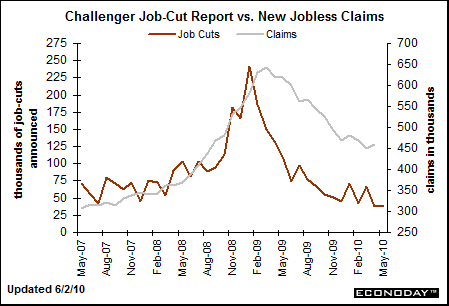 |
| Click on image to zoom |
All I'm saying is that particular attention should be paid to the June Challenger report. It could very well tell us if the leveling-off in jobless claims will continue or, if instead, we are at the verge of another recession.
References:
Warn Act: http://en.wikipedia.org/wiki/Worker_Adjustment_and_Retraining_Notification_Act
May US Challenger layoffs 52,961 vs 40,298 prior: http://www.forexlive.com/blog/2014/06/05/may-2014-us-challenger-layoffs-data-report-5-june-2014/
Friday, February 28, 2014
Psst! Job Losses Are On The Rise Again!
Ever since the employment situation hit rock bottom in 2010, the number of weekly jobless claims has steadily fallen. That is until August of 2013. At that juncture, the decline of job losses just bottomed out. Now, it appears that joblessness is again on the rise:
Obviously, the trend is negative. I could speculate and say its because of ObamaCare. Or, it could be a signal that the economy is slowing again and that we might be headed for another recession. Whatever the reason, the trend is months long and moving decidedly upwards. That's too long for it to be brushed off as some kind of statistical fluke.
 |
| Click to Enlarge |
Thursday, July 26, 2012
Jobless Claims Fall Sharply On Seasonal Adjustments
This morning, jobless claims fell by 35,000 after rising by 36,000 in the previous week. The Boston Globe (Boston.com) said this: "benefits dropped by 35,000 last week, a figure that may have been distorted by seasonal factors". The operative word in that statement is "distorted". Then, the "Globe" went on to say: "Applications surged two weeks ago, reversing a big drop the previous
week. But economists caution that the government struggles every July to
account for temporary summer shutdowns in the auto industry." In this case, the operative word is "struggles".
The problem with the government tinkering with the jobless claims number by using "seasonal" adjustments is that it is too open to tinkering for political reasons. But, more importantly, in a day of widespread computerized data management, it seems impossible to believe that we are still having to estimate claims based on samplings and on seasonal adjustments. Theoretically, there's no reason why the government couldn't have the actual numbers; on any day; and, in real time. Why aren't all this nation's claims offices being locked into a single database?
The other problem I have is the concept of seasonal adjustments being singularly done for the auto industry. These adjustments are probably not needed anymore. They are hangovers from the days when the auto industry was the major employer in the country and at a time when almost every car sold was made here. And, every year, the Big Three (Ford, General Motors, and Chrysler), for competitive reasons, would do a complete or major redesign of cars. This, in turn, necessitated long shutdowns of the manufacturing facilities for retooling; every July. The laid off employees would then apply for unemployment benefits. Also, today, many of our so-called American autos are made in places like Canada and Mexico.
Today, those major redesigns just don't occur with any regularity. For example, the PT Cruiser, which was in production from 2001 to 2010, changed very little in all those years. The Chevy Cruze and Volt, which share the same body style and frame, have not changed for the last three years. Furthermore, automobile manufacturers are no longer following the tradition of introducing their "all new models" in the Fall of every year. You can buy the "all new" 2013 Nissan Altima; right now. And, the Altimas are either made in Smyrna, Tenn. or in Canton, Miss. and I'm quite sure that the government didn't seasonally adjust when those plants were shut down for retooling; early this year.
The point that I'm trying to make is that these "seasonal adjustments" make no sense anymore; and, quite simply, they are as the Globe said: distortions.
Boston.com story: http://www.boston.com/business/markets/2012/07/26/jobless-claims-drop/kRT7wGdwrxQkRrtbkVgLDP/story.html
Subscribe to:
Posts (Atom)


 Posts