Showing posts with label recession. Show all posts

Wednesday, April 19, 2017

Could Dems Hang A Recession Around Trump's Neck by 2018?

Thanks to the work of Ben Carlson in 2015 at "A Wealth of Common Sense" (referenced below) we have this extremely interesting graphic:
As you can see, the median time between recessions since 1929 is 4 years and 2 months.  The longest time between recessions is 10 years from 1990 to 1991.

By June, this country will have gone 8 years without a recession. The primary reason for this is that the Federal Reserve has treated those 8 years as if we were in a recession by keeping Fed Funds Rates at historically low levels.  But, in December 2015 the Federal Reserve began raising rates and there is no indication that they won't continue to do so because they're now responding to the growing inflation they're seeing in the economy.

Raising the Fed Funds Rate will have a negative impact by making it more expensive to borrow money.  Credit card debt, car loans, and mortgages will all become more expensive.  The problem  is that the economy isn't that strong and might not be able to support higher interest rates.  The Atlanta Federal Reserve is with the GDPNow estimates that the economy will grow at a meager 0.6% in the first quarter.  Well below consensus estimates, as you can see from this graphic:


What this all means is that we could see another recession before or during the 2018 elections and the Democrats are sure to pounce on this and blame Trump and the Republicans; arguing that Obama never had a recession during both terms;  something that uniformed voters are sure to swallow hook, line, and sinker.

References:

Source of 1st Graphic: http://awealthofcommonsense.com/2015/02/when-will-the-u-s-have-its-next-recession/

Fed Funds Rate History: Highs, Lows and Chart With Major Events: https://www.thebalance.com/fed-funds-rate-history-highs-lows-3306135

GDPNow: https://www.frbatlanta.org/cqer/research/gdpnow.aspx?panel=1


Friday, January 13, 2017

Obama's Economy in One Chart

At almost every opportunity, Barack Obama touts his record on the economy.  In fact, at his final press conference as President, he said this:
As I was preparing to take office, the unemployment rate was on its way to 10 percent. Today it is at 4.6 percent, the lowest in nearly a decade. We've seen the longest streak of job growth on record, and wages have grown faster over the past few years than at any time in the past 40.
Of course, the implication of that statement is that he, and he alone, saved the country.  That, without him, we would still be in recession.  But, guess what?  From the Federal Reserve's perspective, we pretty much still are.  The primary job of the Federal Reserve (our central bank) is to keep our economy stable and growing at a reasonable clip.  When the economy is overheating, the Federal Reserve increases its prime lending rate (the Fed Funds Rate) to make borrowing more expensive, and thus, retard economic (buying) activity.  On the other hand.  When the economy is in recession, the Fed Funds lending rate is lowered to stimulate economic activity by making borrowing cheaper and more attractive.  With that in mind, note this chart of Fed Funding rates (prime interest rates) over the last 65 years:

Click on Chart to Enlarge or Select Link Below
What this clearly shows, is that the Federal Reserve has kept its lending rates at the lowest levels in the last 65 years; and, for an unheard of period of time.  Still, almost 7-1/2 years past the end of the recession, rates are still below any other rates on the chart.  More importantly, this graph refutes Obama's claims of job and wage growth.  If those claims were really true, the economy would be firing on all cylinders and the Federal Reserve would be forced to raise interest rates to keep the economy from overheating due to too much buying activity.

However, just like most of Obama's claims, there are few facts to support them.


References:

Transcript: Obama’s end-of-year news conference on Syria, Russian hacking and more: https://www.washingtonpost.com/news/post-politics/wp/2016/12/16/transcript-obamas-end-of-year-news-conference-on-syria-russian-hacking-and-more/?utm_term=.3e6ad3f0b6fd

Source of Chart: https://fred.stlouisfed.org/series/FEDFUNDS

Video: Federal Funding Activity Explained:  https://www.youtube.com/watch?v=iK91Lq2Jz2Q

pb


Monday, June 6, 2016

The Downward Trend in Job Creation

Ever since last Friday's May jobs report was released, various economists/analysts have been quick to say that "one month isn't a trend" and this may just be a "fluke" or a "one-off" situation.  The Labor Secretary says the miss is all about 40,000 Verizon workers who are on strike.  Besides the fact that he's inflating the number by 4,000, adding in 36,000 workers would only show that May's numbers would still be low at 74,000 and 61,000 jobs; respectively.  That's half of what April's numbers were, and almost one-fourth of last year's job creation.

Now, I don't know what report those commentators are looking at, but the decline in job creation extends back a year.  Just look at this snap shot from Table B, page 5 of the May Employment Situation Report:


The top line number is Total Non-Farm job's creation which includes governmental.  The lower line is for the Private Sector Non-Farm job creation.  But, in either case, there has been a substantial decrease from the 273,000 or 256,000 jobs that were created a year ago.  And, this month's numbers are a substantial drop from the trend that had developed in the prior two months.

This is why I join a lot of analysts who believe we are heading for a negative labor market contraction  -- maybe as early as next month -- that would indicate a recession.

As far as those commentators, who think this is only a one-off situation, my only guess is that they are trying to soft-peddle this report to either protect Barack Obama's approvals or protect Hillary Clinton's run for the Presidency. Obviously, a recession would be beneficial to Trump running as a successful businessman. 

References:

Labor Secretary Thomas Perez warned that it's important not to overreact to a single bad jobs report: http://finance.yahoo.com/news/us-economy-may-jobs-report-thomas-perez-191936901.html#

Employment Situation Summary Table B. Establishment data, seasonally adjusted: http://www.bls.gov/news.release/pdf/empsit.pdf

A Business Recession Looms: http://www.realclearpolitics.com/articles/2016/06/04/a_business_recession_looms_130771.html

Friday's bad jobs report is good news for Donald Trump: http://www.businessinsider.sg/bad-jobs-report-donald-trump-2016-6/#.V1L--uS9X-s

36,000 Verizon workers go on strike - Apr. 13, 2016 - CNN Money: http://money.cnn.com/2016/04/13/technology/verizon-strike

Thursday, July 23, 2015

Increasing Disinflation and the Federal Reserve is Helpless Against It

While none of us like paying higher prices for things, most economists agree that an inflation rate between 2 and 3 percent is a good thing because it shows that there is normal consumer demand for products and services.

When inflation goes above 3 percent, the economy is running too hot and those in poverty and people on fixed incomes are being hurt by high prices.  In this case, our central bank, the Federal Reserve, would step in and force higher interest rates.  Thus, the money supply becomes constricted and, in theory, an overheated economy will contract enough to get back into that 2-3% sweet spot.

One the other hand, when inflation is below 2%, it shows that consumer demand is too low; usually because of tepid or low wage growth. Then, sellers of products and services must compete more fiercely to attract customers by slashing prices or keeping prices low.  Businesses that can't lower or hold prices would typically go under. In this situation, the Federal Reserve would normally lower interest rates to kick start a weak or weakening economy in an attempt to keep it from falling into recession and to stem any job losses and business closures.

To that latter paragraph, here is this ten-year chart from the site usinflationcalculator.com:


Since 2011, when inflation hit a peak of 3% following the 2007-2009 recession, each successive year thereafter has seen disinflation (a decline in the rate of inflation) to the point that, now, in 2015, inflation is actually slightly negative.  Economists call this condition deflation. Essentially, American wages have stagnated to a point that consumers are unable to buy at the same levels as the year before.  This explains why dozens of retailers are being forced to close stores.  McDonald's will close 700.  Walgreens 200.  Staples, OfficeMax, and Office depot are closing a combined total of nearly 600 stores.  Radio Shack has gone belly-up and will close 1784.  With all of these store closings, plus hundreds more from other retailers not listed here (see link below), this year is beginning to look like the start of a recession.

So, what can the Federal Reserve do to avoid one?  Absolutely nothing. Since the beginning of the 2007-2009 recession, the Reserve has been holding interest rates between zero and 1/4 of a percent. Therefore, there's no room to lower them in order to stimulate the economy.  In fact, insanely, it appears that the Federal Reserve might actually raise interest rates. If I'm right, this action would only exacerbate disinflation because it will do the very opposite of what's needed.


References:

Chart Source: Current US Inflation Rates: 2005-2015: http://www.usinflationcalculator.com/inflation/current-inflation-rates/

2015 Store Closing Roundup: Radio Shack, Wet Seal, Sears, Target, etc.: http://retailindustry.about.com/od/USRetailStoreClosingInfoFAQs/fl/All-2015-Store-Closings-Stores-Closed-by-US-Retail-Industry-Chains_2.htm

Fed leaves interest rates unchanged - CNBC.com: http://www.cnbc.com/2015/06/17/fed-leaves-interest-rates-unchanged.html

If the Fed raises interest rates, what's your move?: http://www.news-gazette.com/news/business/2015-07-20/if-fed-raises-interest-rates-whats-your-move.html


Tuesday, May 26, 2015

Price Deflation: Why We Should Be Worried

There hasn't been much talk about the fact that, in three of the first four months of 2015, inflation was a negative.  In the latest report, annualized inflation was pegged at a negative 2-tenths of a percent. Deflation, even as small as this, is quite rare.  The only other time we have seen it in the last 35 years (see USInflation.org below) was from March to October 2009 in the wake of the Great Recession.  This can only happen when businesses sense a widespread slowdown in the buying of goods and services and, as a result, they either hold prices or lower them. Retailers, especially, will tend to reduce prices by running sales to attract more customers. Some will even use loss leaders -- products marked down below cost -- to attract more foot traffic to their stores. 

If this is truly indicative of a national slowdown in sales, then it could be an indicator that we are in some form of recession. We already know that, in the first quarter, the economy  only grew by two tenths of a percent.  Quite frankly, I am surprised that we haven't had another recession since 2009.  Wages today, when adjusted for inflation, are the lowest they've been since 1995.


The average American has seen 20 years of improvements in their buying power completely erased; and, there is no indication that wages will increase to previous highs until after  many years of slow growth.  Thus, without wage growth there will be reduced buying to the extent that inflation will turn negative and a recession could ensue.


References:

US Inflation by Year: http://usinflation.org/us-inflation-rate/

St. Louis Federal Reserve: Real Median Household Income: http://research.stlouisfed.org/fred2/series/MEHOINUSA672N

US economy stalled in Q1; Fed expected to pause on rate: http://news.yahoo.com/us-economy-barely-grew-0-2-pace-first-005149797.html

March job gains 126,000; miss 248,000 forecast - USA Today: http://www.google.com/url?sa=t&rct=j&q=&esrc=s&source=web&cd=3&cad=rja&uact=8&ved=0CCoQFjAC&url=http%3A%2F%2Fwww.usatoday.com%2Fstory%2Fmoney%2Fbusiness%2F2015%2F04%2F03%2Femployment-report-march%2F70859842%2F&ei=UvBIVenUIouZoQTX54H4Aw&usg=AFQjCNGcoNCz4mLioIFQe-veWE-kmUOtdw&sig2=Ddekzo3oVqsU3SFK3rThzA&bvm=bv.92291466,d.cGU


Monday, March 16, 2015

Is a Strong U.S. Dollar Making Our Economy Sick?

Unless you follow the stock market, you are probably not aware that the U.S. dollar has been on a literal tear when measured against a "market basket" of six currencies such as the Euro, the Japanese Yen, the British Pound, etc.


As you can see from the above Bloomberg chart, back in July, the dollar could only buy about 80% of that "market basket" of other currencies.  Today,  the dollar is strong enough to buy 100%.  That's a 25% improvement in the buying power of the dollar.  As a result, the American consumer should see lower prices for imported goods; assuming the retailers are willing to pass those cost savings onto the consumer and not just take them as increased profits.

While, lowered import prices might sound like a good thing, it isn't if you are a U.S. producer who must compete against them.  Foreign cars will be cheaper against those made in this country.  Imported fruits, vegetables, seafood, and meats will crowd-out similar U.S. products in the marketplace.  Thus, this could cost jobs, limit profits, and also reduce the tax base that it is needed to run the country.  In addition, U.S. manufacturers would be more tempted to move their operations overseas in order to sell more cheaply back home.  That, too, would definitely cost jobs and reduce tax revenues.

But, while other countries imported products become cheaper, our exported products become more expensive to sell overseas.  In theory, if the U.S. dollar is 25% stronger against the Euro, this means that any product made in the U.S. -- like a Harley-Davidson motorcycle or a Caterpillar tractor  -- is now 25% more expensive to buy in Europe.  That fact may price some Europeans out of the market for those items.  So, all over the world, our products are getting more expensive and this, in turn, will hurt the taxable profits of our multinational companies.  As a result, layoffs could ensue.

Our fourth quarter economic growth was a weak 2.2%.  Because of the factors involved with a strong dollar, such as lower profits, tax losses, and layoffs, the first quarter of this year and each quarter, there after, may be even weaker.

References:

U.S. Dollar Index: http://en.wikipedia.org/wiki/U.S._Dollar_Index

DOLLAR INDEX SPOT Exchange Rate: http://www.bloomberg.com/quote/DXY:CUR/chart

Dollar gallops to fresh highs; stocks fall: http://www.reuters.com/article/2015/03/13/us-markets-global-idUSKBN0M902620150313

Strong Dollar Squeezes U.S. Firms - WSJ: https://www.google.com/search?q=us+companies+hurt+by+strong+dollar&ie=utf-8&oe=utf-8#safe=off&q=Strong+Dollar+Squeezes+U.S.+Firms+-+WSJ

The economy grew 2.2% in the fourth quarter - USA Today: http://www.usatoday.com/story/money/business/2015/02/27/fourth-quarter-gdp-revision/24087197/

Strong Dollar And Weak Global Economy Could Cause U.S. Recession: http://www.forbes.com/sites/mikepatton/2015/01/27/low-oil-prices-could-send-economy-into-recession/


Saturday, November 29, 2014

Jobless Claims Spiking...Should We Worry?

Back in September, I wrote a blog titled: Beware of Jobless Claims Below 300,000. In it, I showed that, historically, when claims fall below 300,000, a recession is almost sure to follow.

Well, interestingly enough, we just had a big spike in jobless claims which are now back above 300,000.  So, the question is: Is this jump signalling the possible start of a recession.  The reason I say this, is because it is rare to see such a big jump in layoffs before a big holiday like Thanksgiving.  Normally, employers do everything possible to avoid giving people notices at those time.  It can be a heartless thing to do.

With that in mind, please look at this chart from the people at Zero Hedge:

Now, look at the historical Jobless Claims from St. Louis Federal Reserve:
Click on chart to zoom in
Note, the similarity in the spike in claims just before the start of each recession.

This doesn't mean that a recession is necessarily imminent. Usually it takes a few weeks to develop, but if jobless claims continue to develop an upward trend, it may be that this latest number is the canary in the coal mine.

One last thing.  Normally, the claims number that follows a holiday will be low because (1) claims offices are only open a few days in that reporting period and (2) because less people are available during holidays to file claims.  Therefore, next week's jobless number should fall dramatically.  But, if not, we could be seeing the start of a new recession.

References:

Initial Jobless Claims Spikes Above 300k To 3-Month Highs, Biggest Miss In 11 Months: http://www.zerohedge.com/news/2014-11-26/initial-jobless-claims-spikes-above-300k-3-month-highs-biggest-miss-11-months

FRED: 4-Week Moving Average of Initial Claims: http://research.stlouisfed.org/fred2/graph/?id=IC4WSA,


Monday, September 29, 2014

Beware of Jobless Claims Below 300,000

Every week, the Federal government releases a report of how many Americans have filed for first-time unemployment benefits in the prior week.  Typically called the "Jobless Report" or "Claims Report", it is closely watched because, logically, claims going lower is a good thing.  It means that fewer and fewer employers are laying workers off.

More closely watched than the actual number of first time claimants is the 4-week moving average of claims because they tend to bounce around from week to week and, without the averaging, it is too difficult to detect an actual trend; either upward or downward.  This week, the moving average was at 293,000.

The problem with the average being below 300,000 is that, historically and very oddly, this has resulted in a soon-to-be bottoming out of claims which precedes a sharp rise.  What is worse, is that a recession soon followed  Proof of this is shown in the following chart accessed from the Federal Reserve's Economic Database (aka FRED):

Click on chart to zoom in
As you can see, recessions (the shaded vertical areas on the chart) typically end with a peaking of jobless claims. Then, over time, the number slowly falls to some level just below 300,000 before  rising, until again, there is an actual recession.  For example, in September of 1982, the claims signaled the end of that recession at 641,750 filings.  Over the next 7+ years, the average dropped out at 289,750 in January of 1989 with a sharp uptick that resulted in another recession that began in September of 1990. Then jobs claims again peaked in March of 1991; only to bottom out in April of 2000 with 269,750 claims before quickly rising to the beginning of another recession in February of 2001.  Of course, the last "Great Recession" followed a bottoming of claims in February of 2006 with an average of 289,750.

So, there is definitely a very repeatable pattern of claims peaking; then, bottoming out; followed by a  sharper rise and, ultimately a recession. 

How low we will go and how fast we achieve it in this current trek below 300,000 is anyone's guess. But, one this is sure, if history repeats itself, lower claims are not such a good thing.

References:

FRED: 4-Week Moving Average of Initial Claims: http://research.stlouisfed.org/fred2/graph/?id=IC4WSA,

U.S. jobless claims up less than expected, point to firming labor market: http://www.reuters.com/article/2014/09/25/us-economy-jobless-idUSKCN0HK1E420140925

Wednesday, September 17, 2014

Are We Really Better Off Since Obama Took Office?

In front of adoring crowds at one of his all-too-many campaign style events, President Obama has claimed that "By almost any measure, we are better off since I took office" or that America is stronger under his watch.

The problem with such statements is that they are factually untrue when looking at the broader state of our union.

Sure, the President can claim that overall unemployment is down from where it was when he took over the reins of government in January 2009.  But, to get there, overall unemployment rose to a rate of 10% in the first year-and-a-half of his presidency.  Something that the so-called "stimulus" was supposed to avoid by promising that the unemployment rate wouldn't go above 8%. Even now, 5 years passed the end of the official end of the recession, this country still has an unemployment rate that is a full point above pre-recession levels.

Our major cities have extraordinarily high unemployment rates.  Chicago, Obama's home town, is still at 8.0%; and, that's just recently down from a January 2014 rate of 9.6%.  Detroit, now in bankruptcy, had an unemployment rate of  17.7% in July.  A city like Atlantic City, that depends heavily on Americans spending leisure-time money, is suffering from cash-strapped tourists unable to indulge in what they have to offer. The casinos are closing and the unemployment rate sits at 13.7%. More worrisome is the fact that our three largest cities -- Los Angeles, New York, and Chicago -- are dangerously close to following Detroit into bankruptcy.

The Gross Domestic Product (GDP) is stuck at a 5-year growth rate of about 2%. This is, at least, the worst recovery since World War II and, some say in the history of the United States when using alternate methods of calculating GDP.
Then there's the overall economic health of America.  For 5 straight years the median incomes of this country have fallen and income inequality has risen to a record high.  Half the jobs created under this President's watch were low income/low paying.  When he took office, only 30 million Americans were on food stamps.  Today, that number is 47 million; a 56% increase.  Similarly, only 38 million Americans were living in poverty.  Today, that number is a record 47 million and has stood at 15 percent of the population for the last 2 years. Thus, as the population grows, so does the amount of people left in poverty.

Of course, the real elephant in the room is the amount of debt that Obama has left us with; a number that only gets worse by the day.  At the beginning of his first term, the federal debt was $10.6 trillion.  Today, it is closing in on $18 trillion; just $250 billion from the current number (as of this writing) of $17.756 trillion. A number that, for the first time in this nation's history, is greater than the total annual economic output of the country.  Of those advanced economies in the world, only Portugal, Italy, Ireland, Greece and Spain can claim debt levels above their economic output. All of which are near bankruptcy and on the brink of bringing the European Union to its knees.

When we see people standing behind President Obama and nodding in agreement that things are better, you have to wonder what planet they're from.  Most other Americans (74% in one poll) still think that we never recovered from the recession.  And, in so many ways, they're right.

References:

By almost any measure, we are better off since I took office: http://www.realclearpolitics.com/video/2014/07/10/obama_by_almost_every_measure_we_are_better_off_than_when_i_took_office.html

Obama claims US is 'stronger' than 'when I first came into office' as economy weakens, debt soars, America loses global influence and border crisis deepens: http://www.dailymail.co.uk/news/article-2722926/Obama-claims-US-stronger-I-came-office-economy-weakens-debt-soars-America-loses-global-influence-illegal-immigrants-flood-border.html

Half Of The Jobs Created During The Recovery Were Low-Paying: http://thinkprogress.org/economy/2013/05/14/2008591/jobs-recovery-low-paying-minimum-wage/

Chicago Unemployment Rate Falls to 8.0%: http://www.worldbusinesschicago.com/news/chicago-unemployment-rate-jul2014

Detroit Unemployment Rates:  https://ycharts.com/indicators/detroit_mi_unemployment_rate

Unemployment rises in most US states in July: http://www.detroitnews.com/article/20140818/BIZ/308180072

 Another Atlantic City Bust: Trump Plaza Closes: http://abcnews.go.com/US/wireStory/trump-plaza-4th-atlantic-city-casino-shutdown-25528499

3 huge cities flirting with bankruptcy: http://money.msn.com/investing/post--3-huge-cities-flirting-with-bankruptcy

Obama’s economic recovery: officially the worst in US history: http://poorrichardsnews.com/post/41366829334/obamas-economic-recovery-officially-the-worst-in-us

Median Income Falls For 5th Year, Inequality At Record High: http://www.huffingtonpost.com/2013/09/17/median-income-falls-inequality_n_3941514.html

47 million Americans on food stamps: http://img.washingtonpost.com/blogs/wonkblog/files/2013/09/SNAP-participants.jpg

That’s rich: Poverty level under Obama breaks 50-year record: http://www.washingtontimes.com/news/2014/jan/7/obamas-rhetoric-on-fighting-poverty-doesnt-match-h/?page=all

America's Poverty Rate Stuck At 15 Percent For Second Straight Year: http://www.huffingtonpost.com/2013/09/17/poverty-america-census_n_3940812.html

 74% said we are still in a recession: http://patch.com/new-hampshire/concord-nh/is-the-recession-over-yet#.VBR1qmNAVLU

U.S. Federal Debt Exceeds GDP: http://jamesviser.com/?p=995


Saturday, June 28, 2014

Despite Huge Drop in GDP, Economists Still See Better Days. Really?

When it was reported that the economy shrank nearly 3% in the first quarter, most economists -- the same ones who were completely caught off guard by the downward revised 3% number -- seem
 to think its still on track to be positive; claiming that the first quarter was a one-off anomaly due to weather, lower healthcare spending, and a decline in exports. 

The problem with this thinking is that, just one day after the dismal first quarter GDP was announced, another disappointing number, consumer spending, signaled even more trouble in the 2nd quarter.  In May, the second month of the 2nd quarter, consumer spending came in at half of what those same economists were predicting, at an abysmal 0.2% percent growth.  This after, April had literally shown no growth.  Since consumer spending makes up 70% of the calculated GDP number, its hard to believe that the 2nd quarter GDP will be anything but lackluster or, worst case, another negative number; thus, signalling a recession.  If that happens, the weather can't be blamed for the lack of consumers being holed-up in their homes, not buying products or seeing their doctors.

Unless spending comes in like gang busters in June, this economy is showing the clear signs that the consumer has reached a tipping point and incomes have not kept up with inflation.  As a result, people may be putting off buying big ticket items, spending less on leisure, entertainment, other discretionary items, or even seeing their doctors less regularly because they are simply so cash-strapped that they can't afford to pay the deductibles.  As history has proven time and time again, the lack of consumer spending is a primary reasons for recession.

Therefore, should anyone believe all those "happy times" economists who now seem to think that the first quarter was just a fluke?

References:

Economists brush off dire GDP: ‘This is a blip’: http://thehill.com/policy/finance/210563-economists-brush-off-dire-gdp-this-is-a-blip

Consumer Spending in May Was Disappointingly Weak: http://abcnews.go.com/Business/wireStory/consumer-spending-02-percent-24313555

What is Economic Recession? - Definition, Causes & Effects: http://education-portal.com/academy/lesson/what-is-economic-recession-definition-causes-effects.html#lesson

Cutting Through The Fog: The Economy Shrinks By 2.9%: Recession Is Now A Statistical Possibility: http://cuttingthroughthefog.blogspot.com/2014/06/the-economy-shinks-by-29-recession-is.html

Thursday, June 26, 2014

The Economy Shrinks By 2.9%: Recession Is Now A Statistical Possibility

Yesterday, the Bureau of Economic Analysis announced a shocking contraction of the economy -- as measured by Gross Domestic Product (GDP).  In this latest revision, the economy "shrank" at an annualized rate of 2.9%.  This was the third revision of the first quarter economic activity that was originally predicted to "grow" by 2.5%.

Never in the history of the U.S. has a contraction this large been outside the realm of a full-blown economic recession.  So, it is hard to believe that the second quarter of this year will snap back enough -- growing by at least 3% -- to avoid putting us into the technical definition of recession: Two consecutive quarters of economic contraction.

In this blog, I have predicted that ObamaCare would push us into recession in 2014.  I have also noted that retailers are signalling economic woes for 2014.  And, now, we have some additional evidence that the consumer might have to further pull back on any discretionary spending that would otherwise drive the economy.  In May, consumer prices grew at the highest rate in 15 months at 0.4%.  This despite the fact that wages are stagnant.  More importantly, essential consumables were up even higher.  Electricity rates were up 2.3% in May. Food was up 1/2 of a percent.  And, if the drought continues in the Southwest, food prices will continue to soar.  Further, Obama's crackdown on coal will force electricity providers to further raise rates in order to be compliant with his latest EPA mandates.

The bottom line is that Obama's constant meddling in the economy is now rearing its ugly head in what could be a potential recession.  Things like forcing employers to pay overtime for salaried workers only results in higher costs to consumers and, consequently, consumer's wallets shrink and they can't spend as much on the discretionary items that would otherwise drive our economy.  When someone has to pay more for something they need to live such as electricity, other optional things, like dining out, are cut and the economy starts to contract.

Right now, I just can't see the country avoiding another recession.

References:

U.S. Economy Shrinks by Most in Five Years: Final Revision for 1st-Quarter GDP Shows 2.9% Contraction: http://online.wsj.com/articles/u-s-gdp-contracted-at-2-9-pace-in-first-quarter-1403699600

GDP Disaster: Final Q1 GDP Crashes To -2.9%, Lowest Since 2009, Far Below The Worst Expectations: http://www.zerohedge.com/news/2014-06-25/gdp-disaster-final-q1-gdp-crashes-29-worst-2009-far-below-worst-expectations

Cutting Through The Fog:  Will ObamaCare Push Us Into Another Recession In 2014?: http://cuttingthroughthefog.blogspot.com/2014/01/will-obamacare-push-us-into-another.html

Cutting Through The Fog: Retailers Are Signalling Economic Woes For 2014: http://cuttingthroughthefog.blogspot.com/2014/05/retailers-are-signalling-economic-woes.html

Consumer prices rise sharply in May: http://www.usatoday.com/story/money/business/2014/06/17/consumer-prices-may/10642375/

Weak Wages Pose Threat to Liftoff for Economy: http://online.wsj.com/articles/consumer-spending-fell-0-1-in-april-1401453354

Obama to order businesses to hike overtime pay for salary workers: http://www.washingtontimes.com/news/2014/mar/12/obama-order-businesses-hike-overtime-pay-salary-wo/

pb


Monday, June 9, 2014

Good News: Weekly Job Losses Are at Pre-Recession Levels. But...

Last Thursday, weekly jobless insurance claims came in at 312,000.  That coupled with previously reported claims has pretty much solidified the fact that we are now at pre-recession levels for first-time workers collecting unemployment insurance; as noted by this chart from the folks at ZeroHedge.com:
Click on image to zoom
Unfortunately, this trend may be short lived.

This month it was reported that the economy failed to grow in the first quarter; actually shrinking by one percent.  Should this be repeated in the second quarter, it could officially signal another recession.  But, as most economists will tell you, unemployment is usually a lagging indicator; meaning that, if we do slide into another recession, it will take management another 6 months or so to lay enough people off for the weekly claims number to be negatively impacted.

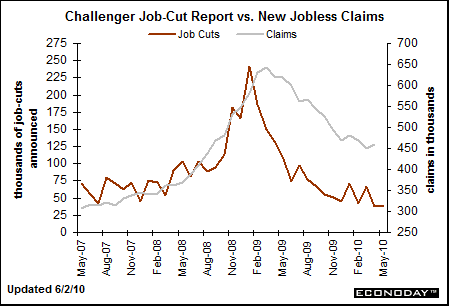
Now, there is a monthly report that could give us  insight into future job losses.  That report is the  Job-loss notification as prepared by the firm of Challenger, Gray, and Christmas.  In short, the Challenger Report takes advantage of a Federal law -- the Worker Adjustment and Retraining Notification Act or simply the WARN Act -- which mandates that any company, with 100 employees or more, must publicly report,  at least 60 days in advance, any possible cuts or layoffs.  This month, Challenger's ongoing report looked liked this:

Click to zoom
As you can clearly see, except for February, March and August of 2013, the reported job cut announcements stayed comfortably below 46,000; and, even hitting nice lows in December 2013 and March 2014.  If you could visually trend that data, you can see that there is actually a nice downward slope but, in May there was a spike that was almost as severe as the one in February of 2013.  And, to me, this upward spike is consistent with the fact that corporations saw a $213 billion loss of profits in the first quarter of this year and were now, in May, adjusting down their labor forces so as regain or protect any further loss. 

Challenger, itself, disclaims the fact that job reduction announcements don't necessarily result in immediate cuts.  After all, their data represents a 60-day notification that may take months to fully implement.  For that reason, many economists don't have too much confidence in the report.  However, if you look at the following, Challenger does do a pretty good job in giving some advance notice:

Click on image to zoom
Of particular note on this chart, the Challenger data showed a rise of recession-era job cut notifications a full 3 months prior to the actual peaking in claims. While the charting is not as tight as it was in the months prior to the "peak," the trend is obviously still there. 

All I'm saying is that particular attention should be paid to the June Challenger report.  It could very well tell us if the leveling-off in jobless claims will continue or, if instead, we are at the verge of another recession.

References:

Warn Act: http://en.wikipedia.org/wiki/Worker_Adjustment_and_Retraining_Notification_Act

May US Challenger layoffs 52,961 vs 40,298 prior: http://www.forexlive.com/blog/2014/06/05/may-2014-us-challenger-layoffs-data-report-5-june-2014/

Wednesday, May 21, 2014

Retailers Are Signalling Economic Woes For 2014

In the first quarter of this year, the nation's economy, as measured by Gross Domestic Product (GDP), grew at a barely measurable rate of one-tenth of one percent. That was a 93% miss from the 1.5% that the economists were originally projecting.  In defense of this horrible number, the Obama Administration blamed the lack of economic growth on low consumer spending; all because of the bad weather in the Northeast and Midwest in January through March of this year.

However, having lived in the Midwest for many years, the forecast of a bad storm actually forces store shelves to be emptied.  People buy things they otherwise might not buy; like snow blowers, generators, space heaters and a whole host of other products.  They stock up on food and water.  And, after the storm has passed, consumers replenish what they used and typically buy the things they weren't able to   during the storm.  So, typically, the economic impact is not that significant; especially since most of the rest of the country is unaffected by any regional activity.

The problem with the "bad weather" excuse is that it ignores a deeper problem that is hurting our economy.  That problem that consumers aren't buying like they used to. The major retailers such as Wal-Mart, Kroger, Target and Macy's are all seeing changes in buying habits.  People aren't splurging on non-essential products.  In fact, they also aren't buying as much food. Wal-Mart, despite having lower grocery pricing than their competitors, has consistently seen a drop in grocery revenues.  Last quarter, grocery sales, among all the stores that were in operation a year or more, dropped nearly 1%.

Going forward, every retailer is warning that their earnings are at risk this year due to a slow down in consumer spending.  Since consumer spending makes up 70% of GDP, any drop could cause the economy to stall and, as a result, fall into another recession.  If the next revision of the current GDP growth of 0.1% goes negative in a couple of weeks, it could signal the first of two quarters of negative growth which, by definition, is a recession.

References:

Target echoes warnings about cautious consumer patterns: http://www.ktvu.com/videos/business/economy/target-echoes-warnings-about-cautious-consumer/v9dRG/

Wal-Mart is hurting for shoppers: Wal-Mart woes deeper than winter snow: http://money.cnn.com/2014/05/15/investing/wal-mart-weather-earnings/

Wal-Mart's biggest problem: Its customers: http://www.cnbc.com/id/101680657

Kroger...cautious in its earnings guidance for the year, citing uncertainty around the economy: http://supermarketnews.com/retail-amp-financial/kroger-marks-10-years-positive-comps

First-Quarter U.S. Economic Slump Looking Uglier by the Day: http://www.bloomberg.com/news/2014-05-06/first-quarter-u-s-economic-slump-looking-uglier-by-the-day.html

Friday, February 28, 2014

Psst! Job Losses Are On The Rise Again!

Ever since the employment situation hit rock bottom in 2010, the number of weekly jobless claims has steadily fallen.  That is until August of 2013.  At that juncture, the decline of job losses just bottomed out.  Now, it appears that joblessness is again on the rise:
Click to Enlarge
Obviously, the trend is negative. I could speculate and say its because of ObamaCare.  Or, it could be a signal that the economy is slowing again and that we might be headed for another recession.  Whatever the reason, the trend is months long and moving decidedly upwards.  That's too long for it to be brushed off as some kind of statistical fluke.

Saturday, January 25, 2014

Will ObamaCare Push Us Into Another Recession In 2014?

No one can actually predict when a recession will occur or how long it will last.  But, in more than 150 years of tracking our economy, recessions have occurred, on average, every 5 years.  In more modern times, they have tended to occur every 6 to 7 years; and, we are already 6 years and almost 2 months past the start of the last one in December of 2007.

Most recessions occur when inflation outpaces the rate at which the average consumer's disposable incomes increase; forcing most to pull back on buying any or all non-essential goods and services. Thus, the economy contracts.  Other times, however, recessions are spawned by some major, economic-impacting event such as the Crash of '29, the OPEC Oil embargo, 9/11, or, most recently, the burst of the housing bubble.

Thanks to PolitiFact, we have a nice scorecard on Obama for things like the growth in disposable income and inflation.  According to that report, disposable incomes, after falling in 2009, rose 1.5% from 2009 to May 2012; a yearly average of  only six-tenths of one percent (.6%).  At the same time, overall inflation averaged 2.7%; or, 4-1/2 times faster than disposable incomes. More importantly, essential items like food and gasoline have risen much faster than overall inflation. 

Click on image to zoom
So, it is apparent that a primary cause of any recession -- inflation faster than wage growth -- has been firmly in place since 2009.

But, another significant economic-impacting event -- the continued roll-out of ObamaCare -- is hovering like a black cloud over this already weak economy; and, it is a "cloud" that is already causing a slowdown in hiring and wages to lag even further.  According to the recent December jobs report, only 74,000 jobs were created; the lowest in three years.  But, more importantly, during the 3-months that ObamaCare was being rolled out, the average hourly wage only increased by about a quarter of one percent; from $24.11 in October to $24.17 in December.  That was half as fast as the rate at which wages rose in the first 9 months of the year.  Is this because of ObamaCare or just a coincidence?

I guess we'll have to wait until January 30 when the GDP report for the fourth quarter comes out to see if the October roll out of ObamaCare hurt economic growth.  If it is substantially less than the projected 2.5% growth, we could be seeing the start of another recession. Further, the U.S. stock markets are tumbling on a assumed slow-down in world economic activity.


References:

Politifact's Obama Economic Scorecard: http://www.politifact.com/truth-o-meter/article/2012/jun/01/scorecard-economy-obama/

December Employment Report, Table 3-B, Average Hourly Earnings: http://www.bls.gov/news.release/empsit.t19.htm

 Econbrowser: Recession in 2006-07?: http://www.econbrowser.com/archives/2005/08/recession_in_20.html


Tuesday, December 31, 2013

Raising The Minimum Wage Hurts America's Youth

If you listen to President Obama, raising the minimum wage is nothing but a win-win situation.  It will pull people out of poverty and strengthen the middle class.  But, whenever the Federal government injects itself into business activities, there are many more losers than there are winners in the process.  And, when it comes to raising the minimum wage, one of the biggest losers is youth employment.

The reason for this is simple.  A higher minimum wage results in unemployed adults (those age 24 and above) being more willing to compete with unemployed youths (those16 to 24 years of age) for entry-level job openings. In turn, employers are more likely to hire adults with proven work records versus young people with little or no work experience.

To prove my point, you need only look at a couple of charts.  The first chart is that of the Civilian Unemployment rate for the years 2007 through and including all of 2011. (Note: the chart and its data are extracted from FRED - the Federal Reserve's economic database. The red notations are mine.).


In the world of economics,  the measurement of unemployment rates is considered a "lagging" indicator.  This means that, when there is an economic downturn, like a recession, it takes a few months into the recession before employers actually realize that their businesses are being hurt and they need to start laying people off.  Then, when a recession ends, there is a similar lag before employers start rehiring again and the unemployment rate declines. On this chart, I have noted these "lags" in red.  But, there's something odd about this chart.  In May of 2007, the unemployment rate uncharacteristically rose prior to the recession; moving from a low of 4.4% to 5% before leveling off in late 2007. 

To understand what was happening in 2007, you need to look at a similar chart of youth unemployment; which is a subset of the above chart.


Now, unlike the prior chart, I've included 2006 data to show just how flat the Youth Unemployment Rate was in the year prior to 2007.  But, in 2007, there was a dramatic increase; months before the recession hit.  The sole reason behind this was the passage and implementation of the Fair Minimum Wage Act of 2007 where the minimum wage went from $5.15 an hour to $5.85 in 2007; upped again to $6.55 an hour in 2008; and, again, in 2009 to the current rate of $7.25/hour.

Further proof that adults have been literally "stealing" entry-level jobs away from our nation's youth comes from how slow youth unemployment has recovered in comparison to overall unemployment.  In 2010, both youth unemployment and overall unemployment rates topped out.  Since then, general unemployment has been lowered to a 7% rate from its high of 10.1%; a 31% improvement.  On the other hand, youth unemployment has only moved downward from a height of 18.4% to the current rate of 16.5%; a mere 10.3% improvement. 

The problem with sustained high youth unemployment is the fact that society, in general, is jeopardized.  For one, idle youths due to high unemployment rates have resulted in a 40% rise in gang membership in the period 2009 to 2012; as reported by the FBI.  And, I'm quite sure that trend didn't abate in 2013.

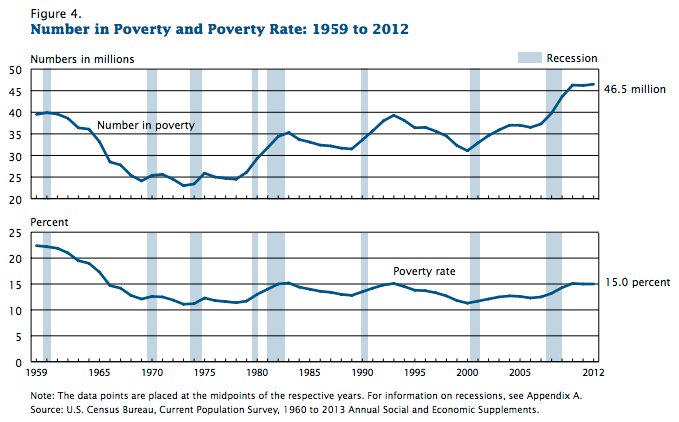
Additionally, social programs like Social Security and Medicare are highly dependent on a broad base of younger workers paying into these systems in order to support the high cost of retiring workers.  Without younger workers in the workforce, the two programs could go bankrupt a lot earlier than projected.  More importantly, the increase in the minimum wage and, the sustained high rate of youth unemployment, may be creating a permanent underclass of marginally employable workers or totally unemployable workers who will be stuck in poverty for their whole lives.  Just the opposite of Obama's belief that raising the minimum wage will pull people out of poverty.  To that point, the high youth unemployment rate may be one of the primary reasons why the record high number of people in poverty, 46.5 million, hasn't come down one iota since 2010.  This at a time when general unemployment has improved by more than 30%:
Besides what I've shown above, there have been dozens of research studies that have proven that raising the minimum wage costs jobs and hurts the economy; but, liberals like the President, and other activists, continue to ignore the truth.

Monday, June 25, 2012

The Continuing Lie That Bush And The GOP Policies Created the Great Recession


If there's one thing that Democrats have gleaned from World War II Nazis, it's their firm belief in those famous words of Nazi propagandist Joseph Goebbels: "If you tell a lie big enough and keep repeating it, people will eventually come to believe it."  Nothing can be more true to that statement  than President Obama and his surrogates blaming Bush and the GOP for the economic mess we find ourselves in today.    

The fact is, that the 2007 Recession had its genesis in something that the Democrat-controlled Congress and Jimmy Carter passed into law in 1977.  That something was the Community Reinvestment Act or CRA.  Under the law, banks were forced to provide a certain percentage of their loans to low-income families within the community they served.  If not, they would lose Federal support for their banking operations such as FDIC or federally-provided loans in something called overnight lending.  Failure to meet the law also put banks into a position where they wouldn't get federal approval for expansions or mergers.  So, the bottom line was that banks were being forced to take on risky loans. 

When Clinton took office, he went even further with the CRA; requiring banks to provide even more community-centered low income loans.   But, while the original requirements of the law were doable, the new Clinton mandates were almost impossible because most people in that low-income category didn't have any savings; leastwise, enough savings to put 20% down on a home so that they could qualify for a mortgage.  So, one of the first things mortgage lenders did to meet the stricter guidelines of the CRA was to lessen the down payment requirements.  Eventually, that morphed into the no-money down loans that resulted in home ownership in the U.S. rising from 68% in 1993 to almost 94% by the time the housing bubble broke in 2007. 

In giving out all these low income mortgages with no-money down, the banks knew they were putting themselves at extreme risk.  To offset that risk, they bundled loans into trade-able securities and in investment products called Credit Default Swaps.  And we can thank Bill Clinton, again, for the banks ability to do that.  That's because in 1999, Clinton signed into law the Gramm–Leach–Bliley Act which gave banks the ability to create marketable securities and act as insurance companies and stock brokers; all under one roof. Unfortunately, the banks, themselves, now acting as stock brokers, were dumb enough to buy these risky investments from each other.  So, in 2007, when the housing bubble broke, the banks found themselves with a lot of worthless securities and the whole banking system was in trouble and had to be bailed out with programs like TARP.

Now, to be fair, the Gramm–Leach–Bliley Act was a Republican led initiative. But, usually presidents get the blame for something because they're the  one's who sign bills into law and who have the right to veto any bad law that Congress comes up with.  Clinton had no such reservations on that law and, subsequently, he is clearly responsible for its enactment.

Now, I'm sure that those on the left would point to Bush's push for increased home ownership.  But, Bush didn't pass any laws or relax any requirements that forced banks into providing more loans.   If anything, he is to blame for not taking the actions that would have stopped the low-income mortgage debacle.

Lastly, the housing collapse and banking failure had many more peripheral causes and players than noted above.  However, rather than make things complex I purposely drilled down on the CRA as the primary reason for the Great Recession.  As I have clearly shown, Democrats are easily to blame; not the GOP  and certainly not George W. Bush.  But, the lie continues.

Monday, May 7, 2012

A Socialist President? What Are The French Thinking?

Well, if you don't know by now, Nicolas Sarkozy lost the top job in French politics.  In his place will be an avowed socialist: François Hollande.  Now, if this newly minted socialist President gets his way, my guess is that it won't be long before France wishes they had Sarkozy back, because every economic plan that Hollande has for France is an economy killer.

For one, Hollande plans not to just raise the taxes on the rich, but, instead, he's clearly stated that he wants to "soak the rich".  If you make a million euros or more a year, he plans a 75% tax.  For those making 150,000 euros or more, the tax will be 45%.  Executive pay will be mandatorily limited to 20 times that of the pay of the average worker.  He will increase the Value Added Tax (VAT) on everything people buy to help pay for his new social programs.  He also plans to arbitrarily hire 60,000 additional teachers.  And, the retirement age with full pension benefits will be lowered from 62 to 60 years of age for those working at least 41 years.

Sarkozy lost because the French economy was floundering.  But, there is nothing in the Hollande plan for  that will make the French economy any better. Just more taxes and more spending.  Socialism doesn't work.  It hasn't worked in Venezuela and it won't work in France.  All that will happen is that the wealthy and some businesses will leave the country.  With earlier retirements, pension expenses will eat the country alive. With higher VAT's, consumer spending will be slowed and the economy along with it.  France is already in recession. Hollande will only exacerbate that harsh economic reality.

Tuesday, September 6, 2011

Five Reasons Why Our Economy Won't Recover Any Time Soon

As I have stated before, our economy is 70% driven by consumer spending; and, if in any way, the consumer is forced to spend less of their income on discretionary items, the economy will suffer. To that, I present five reasons why I think the consumer is significantly absent from our economy and why our economy will continue to falter.

1. Unabated Declines in Home Values and a Resulting Higher Savings Rate. Prior to the recession, most Americans saw the rapidly increasing value of their homes as a measure of their wealth. As a consequence, people were only saving about 2% of their income towards retirement. But, when home values collapsed, Americans started to save an increasing amount of their money. Today, the savings rate has nearly trebled from that 2007 rate of 2%. This means that 4% of the average consumer's paycheck is no longer being spent on all those "extra" spending items that would normally help drive the economy.

2. A Continually Weakened Dollar and the Resulting Inflation. Over the last 2-1/2 years, Obama and the Federal Reserve have spent trillions of dollars in money we just don't have. All of it having to be borrowed. As a consequence, the dollar's value has dropped significantly. But, when the dollar is devalued like that, the price we pay for imported goods rises sharply. As a country, we are heavily dependent on imported products in our daily lives. For example, when Obama took office, oil was at $36.15. Just before the so-called Arab Spring, oil had already risen to just above $89 a barrel. Then came the Arab Spring and it jumped to $120 a barrel. Contrary to stimulating the economy, all that government spending is actually depressing the economy by forcing the average consumer to spend an increasing amount of their paycheck to cover inflated prices; leaving less to spend on those discretionary items that would help our economy grow. Many low income consumers are being forced to forgo the luxuries of things we consider essentials; like new clothes. Many Americans have had to cut back on a lot of previous expenditures. For example, recent satellite and cable company reports show the consumer is leaving these services. Something that had never before happened.
However, inflation doesn't just end with import prices. Domestic prices also rise when the dollar is devalued. First, any increases in oil prices affects food and transportation prices because both those areas are so energy intensive. Also, when the dollar is devalued, our domestically produced goods become cheaper to sell on an export basis. This, then, creates a higher demand for U.S. produced products. With this higher foreign demand, we then find ourselves competing worldwide for many of our own, home-grown products. The result is simple: Increased demand means higher prices. Once again, the consumer finds more and more of their paycheck going to higher prices.

3. Regressive Increases in State and Local Taxes and Fees. While the Federal Government may not have increased taxes since the recession started, state and local governments have been busily hiking taxes and fees in their effort to fight off massive deficits. But, in doing so, they have been crippling the consumer by, once again, diverting money away from the economy. In Illinois, alone, the state income tax was upped by 67%. But, the increasing of taxes, especially in a weak economy, only makes the economy weaker. Instead of raising tax revenues, the result is the opposite effect with the consumer becoming less active.

4. Oppressive Government Regulation. The Obama Administration has certainly been the most prolific regulator in U.S. history; with thousands of pages of new regulation being issued each year. From health care to the environment to financial transactions, all these new regs are just adding up to increased costs that will ultimately be passed on to the consumer. ObamaCare hasn't stemmed the rapid rise in health care costs. Instead, it appears to have accelerated cost increases. The EPA's pending crack down on carbon emissions, are only going to make energy more costly for all of us; starting in January. The Interior Department's hold on domestic oil drilling will just make oil even more costly going forward. And, the supposed consumer financial protection will create higher transactional costs for the banks which will result in lower interest on our savings accounts and increased fees for other banking activities. Like it or not, regulation is another form of tax that the consumer will ultimately have to pay. Again, taking money away from the economy.

5. Continued Debilitating High Unemployment. There are 15 million unemployed workers in this country. On top of that, there are 8 million temporary workers; most of which would prefer a full-time job. Then, you have about 10 million workers who are totally discouraged from even looking for a job. All in all, you have about 21% of this nations workforce who are just limping along and who are not being full-time consumers. That means that 1 out of every 5 employable workers are not spending the kind money that would be needed to grow our economy.

Next Thursday, President Obama will take another swipe at trying to grow the economy and create jobs. But, unless he can address all of the above issues, we will see no improvement from this very psychological recession: a recession that isn't technically defined as such but, one that many Americans feel just the same.

Monday, June 20, 2011

To Obama: The Bump In Our Economic Road Is Not A Bump And It Was Clearly Predictable

If you listen to Obama and his soon-to-be-leaving chief economics adviser, Austan Goolsbee, the rise in last month's unemployment rate is just a bump in the road in an economy that they believe to be recovering. But, from my perspective -- and based on the facts that I will present -- that "bump" is more than just a bump. Instead, the rise in the unemployment rate was representative of a 2010 slowdown in the entire economy; and, a slowdown that was easily seen coming. All one had to do is simply look at the track of the nation's Gross Domestic Product (GDP) since the 4th quarter of 2009 to know that our economy wasn't firing on all cylinders. What's worse, the rapid recovery that had been previously seen in Obama's first year in office was actually being destroyed throughout 2010 and now, again, in 2011 as more and more stimulus funds were being dished out; creating massive amounts of national debt and a heavily devalued U.S. dollar. As a result of the dollar's fall, there has been rising inflation in both food and energy costs. As a consequence, this inflation was draining the consumer of their discretionary spending money that would otherwise be put to use in non-food/energy purchases and which would effectively fuel our economy back to a healthy recovery. This is a common problem with any Keynesian-style stimulus in an economy that imports far more than it exports and in one that gets 70% of its economic activity from consumer spending. In fact, the spending policies of Obama and the Federal Reserve have resulted in a 21% loss in our dollar's value in less than 2-1/2 years. In all of the 10 years prior to the Obama presidency, the dollar only lost 17% despite the billions being spent on two wars and the billions spent in the post-9/11 beef-up in our nation's security in federal buildings and in the formation of Homeland Security and the TSA.

To support my conclusions, I need only to present two charts:

Chart 1. Real GDP Reporting by Quarter from a negative 6.8% GDP in the 4th Quarter of 2008 to a positive 5% growth in the 4th Quarter of 2009. A Linear Regression Trend Line is overlaid to reflect the "steepness" of that recovery.

As you can clearly see from the trend line on the above chart, the economy was very much on the mend with GDP improving in each quarter of 2009. Also, you should note that there was nothing done by the Obama Administration in the first half of 2009 that would account for this easily seen economic reversal in that same year. After all, the initial stimulus funds didn't start going out the door until August of 2009. Furthermore, much of that stimulus funding wasn't actually applied to the economy until well past that date due to project delays associated with having to rebid many projects as Federal projects (requiring federal work rules and union labor) and due to the lack of either permits from local or state governments or, when applicable, project approval from the EPA. Recently, President Obama, himself, referenced those delays when he uttered these now-infamous words while some members of his Job Council just laughed: “Shovel-ready was not as ... uh ... (as) shovel-ready as we expected.”

Chart 2. Real GDP Reporting by Quarter from the 4th Quarter of 2009 at a 5% growth rate to the 1st Quarter of 2011 were the economy had slowed down to only 1.8% growth. Again, a Linear Regression Trend Line is applied; this time, to reflect the slowdown.


Obviously, the Stimulus didn't work. We actually had better performance in 2009 before any stimulus spending was ever applied. Once again, Keynesian economics has failed to produce the expected results. It failed during the Great Depression under FDR where Europe recovered much faster without Keynesian spending. It failed in the so-called "Lost Decade" (now 2 decades) in Japan where Keynesian-style stimulus was also tried a number of times to kick-start their economy. In fact, I'm not aware of any instance where the demand-side application of Keynesian economics has ever really worked. That's because Keynesians falsely assume that the economy is like some simple windup toy that can be given a few turns on the winding key (through massive government spending) and the economy will, like magic, take off again. But, this fact has never been proven to work. Yet, liberals/progressives just keep trying to make it work; over and over, again, and to no avail. They just can't help themselves. That's because they all believe that John Maynard Keynes had handed them the greatest gift that a liberal or progressive could have ever received: A macro-economic theory that gives them a license to spend, spend, and spend, again, without a care about the debt and the subsequent inflation they are creating!

And, when they are through creating massive deficits, they just want to raise taxes again to fix the mess they created. History saw this ugly fact in 1937 under FDR when taxes were raised and, as a result, the economy took another nose dive after looking like it just might be recovering. Obama has already stated that he wants to tax the millionaires and billionaires who make more than $200,000 for unmarried filers and $250,000 for those married and filing jointly to reduce the massive deficits he has created. If so, I think we'll easily see 1937 all over again.