Showing posts with label consumer spending. Show all posts

Sunday, February 1, 2015

The Paradox of Weak Retail Sales & Durable Goods and the Surprising Consumer Strength In GDP

The Reuters headline on the latest GDP report was: "US economy cools in fourth quarter, but consumer spending shines."

What that headline refers to is these two sentences regarding consumer spending from the summary section of the fourth quarter Gross Domestic Product (GDP) report for the last quarter of 2014:
Real personal consumption expenditures increased 4.3 percent in the fourth quarter, compared with an increase of 3.2 percent in the third. Durable goods increased 7.4 percent, compared with an increase of 9.2 percent.
I have difficulty understanding where all this growth came from in personal consumption and durable goods purchases.  That's because separate monthly reports on retail sales and durable good orders tell a completely different story.

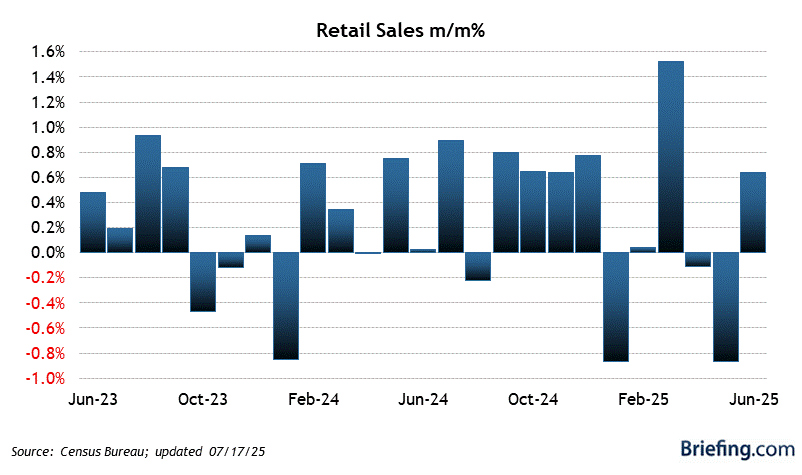
First, let's take a look at a chart of the percent of increase/decrease from month-over-month for retail sales (which is a component of personal consumption expenditures).
From this graphic, you can see retail sales fell by nearly a full percentage point in December.  In the prior two months, which rounds out the fourth quarter, month-over-month increases were both less than 1/2 percent each. In essence, retail sales for the fourth quarter, when averaged, were actually down slightly.  So, if consumer spending at the cash register was so weak, how is it that overall consumption was able to come in at an increase of 4.2% from the previous quarter?   Well, the only real explanation is that all the other consumables that don't make up retail sales -- like healthcare and insurance on your house and car -- had to have seen some serious inflation in the fourth quarter.  But, that too is in conflict with this statement on inflation in the same GDP report:
The price index for gross domestic purchases, which measures prices paid by U.S. residents, decreased 0.3 percent in the fourth quarter, in contrast to an increase of 1.4 percent in the third.
As the report states, there was no inflation because gross prices actually fell; and, that fact alone makes is even harder to explain the 4.2% increase in consumption.

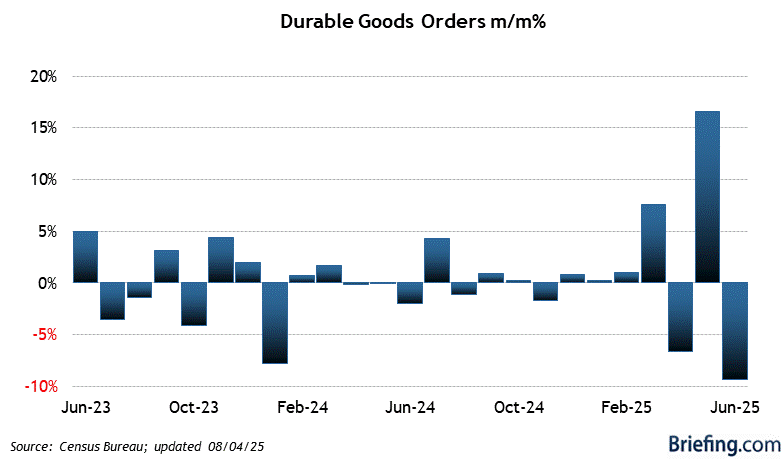
Then, there's the durable goods order increase of 7.4%.  So you understand, durable goods are things we or companies buy that last a long time.  Things like aircraft and appliances like refrigerators or stoves.  But, again, this huge increase doesn't jive with individual monthly reports on durable goods orders growth.
 
As you can easily see, every monthly change in durable goods orders was negative from August through December.  Call me crazy, but it is a little hard to add up a bunch of negatives and get a positive 7.4%.

In my mind, the only reason that this report wasn't negative for GDP growth was because of the hard-to-believe strength in personal consumption and durable goods ordering.  Now, the people who put this report together have 3 more months to revise their data.  Could it be that this report was purposely "adjusted" this first time around so as not to embarrass their boss, Barack Obama, after he made such a big thing of the economy in the State of the Union address?  We'll see if future revisions are downward.
 
References:

US economy cools in fourth quarter, but consumer spending shines: http://www.reuters.com/article/2015/01/30/us-usa-economy-idUSKBN0L30BC20150130

Gross Domestic Product: Fourth Quarter and Annual 2014 (Advance Estimate): http://www.bea.gov/newsreleases/national/gdp/gdpnewsrelease.htm

Obama heralds economic recovery in State of the Union: http://www.msnbc.com/msnbc/obama-heralds-economic-recovery-state-the-union-address
 

Friday, January 16, 2015

What the December Retail Sales Drop Is Saying....and Its Not Good

For weeks, we have been told that falling gasoline prices should put more money in the pockets of the consumer.  Money that could then be spent elsewhere.  However, that conventional wisdom ignores all  other factors that influence consumer spending such as indebtedness, inflation, income, job security and, the need to save.  That conventional wisdom was certainly dashed when the December Retail Sales Report was released by the Commerce Department.

Despite the drop in gasoline prices, retail sales fell nearly a full percent to -.9%.  This quickly caused the stock market to sell off by more than 300 points.  The consensus of economists was that the sales number would be tempered by lower oil prices but, that overall sales would rise one-tenth of a percent with consumers spending more in the all-important Christmas month.  Instead, the consumer spending -- less gasoline  -- was also negative; down 4-tenths of a percent.

So, why did the economist's get it so wrong?  Well, simply, they are ignoring other past reporting that shows that there is weak consumer spending; not only in this country but worldwide.

The first sense that international  spending was on the rocks came from the China Export Report for November.  By far, China is the world leader in exports.  So, when the growth in exports in November comes in by half of what was expected, it says a lot about what is happening in the other world economies.

In our own country, import prices dropped.  Excluding oil, imports of all other items fell by 2-tenths of a percent in November.  A fact that was a repeat of the two previous months.  While some of this had to do with a strengthening U.S. dollar, which makes imports less expensive to buy in this country,  the drop does still indicate a slowing consumer demand.

Also, we saw a substantial drop in credit card debt in November.  This too shows that the consumer is probably concerned about their financial health or job situation and not willing to splurge the savings they are seeing from falling gasoline prices.

Lastly, December unemployment showed that hourly wages fell by 5 cents.  At the same time, food prices have been soaring this year.  These two facts, together, are probably making the consumer quite nervous and, as a result, he or she is not willing to spend but, instead, reduce their debt or save.  In either case, retail sales should have been expected to fall.

References:

U.S. Retail Sales Reflect Consumer Caution Despite Lower Gas Prices: https://www.google.com/search?q=U.S.+Retail+Sales+Reflect+Consumer+Caution+Despite+Lower+...&ie=utf-8&oe=utf-8

China faces more pressure as Nov imports shrink unexpectedly, exports slow: http://www.reuters.com/article/2014/12/08/us-china-economy-trade-idUSKBN0JM04U20141208

List of countries by exports: http://en.wikipedia.org/wiki/List_of_countries_by_exports

Credit Card Debt Dropped Significantly in November:  http://www.lowcards.com/credit-card-debt-dropped-significantly-november-29871

The "Bad" of the December Employment Report: The Average Worker Loses Purchasing Power: http://cuttingthroughthefog.blogspot.com/2015/01/the-bad-of-december-employment-report.html

Food Prices Are Soaring And Washington Doesn't Care: http://thefederalist.com/2014/07/08/food-prices-are-soaring-and-washington-doesnt-care/ 


Wednesday, December 24, 2014

Really? The Fastest Growth In GDP Since 2003?

In the latest iteration of Gross Domestic Product (GDP), we were told that the economy grew at 5% in the third quarter of this year.  This coupled with a 4.6% growth in the second quarter apparently gives us the fastest economic growth since 2003.

But, let me ask you this.  Do you feel like, financially, you are living in the best of times in the last 11 years?  Probably, not. 

So, why does the GDP growth look so good?  The answer is simple. Nearly a half trillion dollars in extra growth is being added to the GDP numbers each quarter that wasn't being counted in 2003.  That's because, beginning with the 2nd quarter of last year, the folks who calculate the GDP each quarter, the Bureau of Economic Analysis, started adding in the value of intellectual property -- the costs of research and development of new products, and the costs of buying copyrighted material such a movie scripts, books, songs, etc.  Previously, those costs were merely counted as intermediate business expenses that were ultimately rolled up into the final cost of the product and not counted as part of the GDP.

To understand that this is a significant change, let me use the example of a fictional publishing company who spends $100,000 to buy the rights to print an author's book.  In the past, that $100,000 was just written off as a business expense and the real value of it was enumerated in the GDP when the book was sold.  Today, under the new and creative accounting for intellectual property, that $100,000 cost is added to the GDP up front.  Then, subsequently, the book's sales are also added to the GDP when they occur.  This sure seems like some kind of double counting. Doesn't it?

Many believe this trickery adds a full one percent to the GDP growth each quarter.  So, last quarter's growth was probably only 4% -- not 5% -- when the old method of accounting was used.  Similarly, the 4.6% growth in the second quarter would have been 3.6%.  However, this new method of calculating the GDP certainly gives President Obama bragging rights regarding the growth of the economy being the fastest since 2003.

Lastly, in my opinion,  the best measure of the health of the economy is what you and I are spending.  And, last quarter, Americans only spent at an increased rate of 2.5%; well behind a supposed overall growth of  5%.  What's worse is that the  consumer is taking on record amounts of credit debt while increasing their spending.  Not a good thing.  What really drove the growth in GDP was a 9.9% growth in government spending and 8.9% increase in business investment (which includes intellectual property).

References:

The U.S. economy grew at its quickest pace in 11 years in the third quarter, the strongest sign yet that growth has decisively shifted into higher gear: http://www.cnbc.com/id/102291457

GDP: Does Lady Gaga Count?: http://www.econlife.com/gdp-does-lady-gaga-count/

GDP Revisions Make Recovery Look Better, Recession Not as Bad: http://blogs.wsj.com/economics/2013/07/31/gdp-revisions-make-recovery-look-better-recession-not-as-bad/

U.S. consumer credit up a record amount in July: http://blogs.marketwatch.com/capitolreport/2014/09/08/u-s-consumer-credit-up-a-record-amount-in-july/

With GDP growing strongly, Republicans' economic dilemma gets more complicated: http://www.washingtonpost.com/blogs/plum-line/wp/2014/12/23/with-gdp-growing-strongly-republicans-economic-dilemma-gets-more-complicated/

pb


Friday, November 28, 2014

Don't Believe The Hype Over The 3.9% Growth In GDP

Apparently, the economy -- as measured by the Gross Domestic Product (GDP) -- grew by an unexpected 3.9% in the third quarter.  Coupled with 4.6% in the second quarter, this is the best growth in back-to-back quarters in 10 years.  But, there is a serious problem with both of these numbers. The fact is, that the consumer spending is a lot weaker than those numbers would imply.

You see, about 70% of any GDP calculation comes from what you and I spend.  While this last quarter looks rather hot with a 3.9% growth rate, the consumer spending only grew by 2.2%.  In an even hotter second quarter at 4.6%, consumer spending only rose by 2.5%. Simply, consumer activity is tepid and that's not good.  It shows that lagging incomes, high rates of poverty, and higher prices for food and energy are taking a toll.

There is also another number that makes up the GDP and that indicates a lack of consumer spending: Imports.  We are a nation who is heavily dependent on imported goods.  Yet, last quarter they fell seven tenths of a percent.  Proving the demand for imported goods has also slowed.

This begs the question, if 70% of GDP is household spending and that was weak, where did all the growth come from.  Well, you can thank our war with ISIS.  Military spending jumped 16%;  and overall, federal spending jumped 9.9%.  Business spending, too, had a hefty impact; growing by 7.1%, but it is always heavier in the third quarter as manufacturers rev up production of goods prior to the holiday season. 

Personally, I think that all the business spending may be for naught.  Especially, if the consumer continues to lag behind.  It may just be the case that the consumer is the Grinch that stole this Christmas.

References:

U.S. Third-Quarter GDP Revised Up to 3.9% Growth: http://online.wsj.com/articles/u-s-third-quarter-gdp-revised-up-to-3-9-advance-1416922352

U.S. GDP Grew 4.6% In Second Quarter 2014, Up From Earlier Estimates: http://www.forbes.com/sites/samanthasharf/2014/09/26/u-s-gdp-grew-4-6-in-second-quarter-2014-up-from-earlier-estimates/

What Are the Components of GDP?: http://useconomy.about.com/od/grossdomesticproduct/f/GDP_Components.htm

New data shows Americans' incomes still stagnant after recession: http://www.reuters.com/article/2014/09/16/us-usa-economy-poverty-idUSKBN0HB1LN20140916

If There’s No Inflation, Why Are Prices Up So Much?: http://business.time.com/2013/03/12/if-theres-no-inflation-why-are-prices-up-so-much/

Thursday, July 31, 2014

Four Stories: Four Worrisome Signs That Our Economy Is In Trouble

When it comes to measuring the state of the economy, we know that 70-to-71% is driven by what you and I spend.  Therefore, in order for it to remain healthy and growing, the consumer must be increasingly active.  That activity, first and foremost, must come from increases in their incomes.  That brings us to the first story.

Just recently, the Bureau of Labor Statistics reported that real worker incomes -- incomes adjusted for inflation -- actually fell in June of 2014 when compared to June 2013.  While the drop is small -- 40 cents per work week or about $21 per worker per year -- the impact is fairly large when rolled up against 155 million workers; equaling a loss of a total of $3.2 billion in consumer buying power.  In other words, $3.2 billion that won't be spent to drive the economy.  More importantly, the economy could suffer even more by the "psychological" impact of lower wages.  That loss of $21 per year is an average.  So, some workers had a much larger loss of buying power.  If even a small percentage of employees feel they are behind the eight ball on salary and, as result, cut back a lot of discretionary spending, it could seriously hurt the economy.

Proof of the lack of consumer spending comes from another story.  Our major retailers are expected to close hundreds of stores in the U.S. as their retail sales continue to fall.  CNBC even called it a "Tsunami" of store closures. This is a sure sign that the shopper is backing away from spending.  Also, these closures mean a loss of jobs and, eventually, higher unemployment.

Then, there is this concern.  Last month's employment report showed an overall increase of 404,000 workers.  Of this, 275,000 temporary help jobs were created.  Simply, that means that almost 70% of the jobs created in June were low paying and temporary.  Whether this fact was because employers are making adjustments to cope with low business activity or because of their attempts to circumvent the 2015 mandates of ObamaCare, it is possibly another reason why wages have fallen. Again, there is a negative psychological impact when a worker can only find part time work.  It results in a lack of confidence and, more likely, another reason not to spend money on non-essentials.

Lastly, a recent report from the Urban Institute showed that 35% of American's face debt collection.  A fact that proves that they have been living beyond their incomes for quite some time. To put it simply, 35% of Americans could have their credit ratings adversely impacted.  As a result, it could affect their chances of getting or holding a job when wage garnishment is threatened. It could also mean that millions may not be able to buy a house or rent an apartment; or, purchase an automobile; or, get any further credit cards or loans for emergency situations.  Having a third of the population in financial trouble, is a formula for disaster which could greatly impact economic growth.

Of course, just yesterday, the economy was said to have grown by 4% in the second quarter.  However, this is a preliminary number; subject to 3 more revisions.  The question then becomes whether or not that 4% will hold or fall in the same way that the first quarter had positive growth in its preliminary number; only to go negative and stay negative after that initial number's release. As far as consumer spending was concerned, non-big ticket items matched the growth of the first quarter at 2.5%.  But, understand that much of that growth was due to extremely high prices for food; driven by the drought and bad weather. Energy prices also drove up spending, but consumer spending for services fell by half from the first quarter.  What really drove that supposed 4% growth in the second quarter was the fact that imports fell (normally, a higher import number is a negative drag on our economy).  But, a drop in imports may be a sign that consumers aren't buying much of the goods we normally get from China, Indonesia, Mexico, etc. and, that business upped their inventory of products in anticipation of future sales.  Whether or not those replenished inventories will sell in the future with what appears to be a cooling of buying activity seems to be unlikely. In essence, the consumer didn't really contribute to the growth of the economy in the second quarter.

References:

Real Incomes: June 2014: http://www.bls.gov/news.release/realer.t01.htm

A 'tsunami' of store closings expected to hit retail: http://www.cnbc.com/id/101353168

June 2014: Employment Situation Report: Table A: http://www.bls.gov/news.release/empsit.a.htm 

Study: 35 percent in US facing debt collectors: http://hosted.ap.org/dynamic/stories/U/US_DEBT_STUDY?SITE=AP&SECTION=HOME&TEMPLATE=DEFAULT&CTIME=2014-07-29-00-12-33

U.S. Second-Quarter GDP Expands at 4.0% Rate: http://online.wsj.com/articles/second-quarter-gdp-expands-at-4-0-rate-1406723867?mod=asia_home

Q2 GDP Surges 4%, Beats Estimates Driven By Inventories, Fixed Investment Spike; Historical Data Revised: http://www.zerohedge.com/news/2014-07-30/q2-gdp-surges-4-beats-estimates-driven-inventories-fixed-investment-spike-historical

Saturday, June 28, 2014

Despite Huge Drop in GDP, Economists Still See Better Days. Really?

When it was reported that the economy shrank nearly 3% in the first quarter, most economists -- the same ones who were completely caught off guard by the downward revised 3% number -- seem
 to think its still on track to be positive; claiming that the first quarter was a one-off anomaly due to weather, lower healthcare spending, and a decline in exports. 

The problem with this thinking is that, just one day after the dismal first quarter GDP was announced, another disappointing number, consumer spending, signaled even more trouble in the 2nd quarter.  In May, the second month of the 2nd quarter, consumer spending came in at half of what those same economists were predicting, at an abysmal 0.2% percent growth.  This after, April had literally shown no growth.  Since consumer spending makes up 70% of the calculated GDP number, its hard to believe that the 2nd quarter GDP will be anything but lackluster or, worst case, another negative number; thus, signalling a recession.  If that happens, the weather can't be blamed for the lack of consumers being holed-up in their homes, not buying products or seeing their doctors.

Unless spending comes in like gang busters in June, this economy is showing the clear signs that the consumer has reached a tipping point and incomes have not kept up with inflation.  As a result, people may be putting off buying big ticket items, spending less on leisure, entertainment, other discretionary items, or even seeing their doctors less regularly because they are simply so cash-strapped that they can't afford to pay the deductibles.  As history has proven time and time again, the lack of consumer spending is a primary reasons for recession.

Therefore, should anyone believe all those "happy times" economists who now seem to think that the first quarter was just a fluke?

References:

Economists brush off dire GDP: ‘This is a blip’: http://thehill.com/policy/finance/210563-economists-brush-off-dire-gdp-this-is-a-blip

Consumer Spending in May Was Disappointingly Weak: http://abcnews.go.com/Business/wireStory/consumer-spending-02-percent-24313555

What is Economic Recession? - Definition, Causes & Effects: http://education-portal.com/academy/lesson/what-is-economic-recession-definition-causes-effects.html#lesson

Cutting Through The Fog: The Economy Shrinks By 2.9%: Recession Is Now A Statistical Possibility: http://cuttingthroughthefog.blogspot.com/2014/06/the-economy-shinks-by-29-recession-is.html

Monday, June 2, 2014

Ominous Consumer Spending Problems In the First Quarter GDP Numbers?

According to some supposedly expert economists and the White House, the economy contracted by 1% in the first quarter of 2014 because of the severe weather in those three months.  Thus, keeping consumers huddled in their homes.  Not buying the things that would have otherwise driven the economy.

But, consumers didn't stop buying in the first quarter.  Spending was actually up 3.1%.  Albeit, this was down from what CNBC said was "brisk" spending of 3.3 percent in the previous quarter.  So, its a little hard to believe that the consumer was absent due to weather.

What the report does show is something that I warned about in a previous post,  Retailers Are Signalling Economic Woes For 2014.  Despite the fact that consumer spending was up, corporate profits declined by $213 billion dollars in the same quarter.  What these contradictory facts show is that the consumer is being forced to pay higher prices for essential items like food, clothing, energy, and, especially, healthcare; thus reducing the amount of discretionary spending that would have normally driven corporate profits.

Thus, the consumer is at a recessionary tipping point where he or she can't afford to buy the kind of items that would cause the economy to expand.  This is what happens when you have a combination of stagnated wages and soaring prices for essential items like food and energy.  That is why I believe that weather had nothing to do with the first quarter slowdown of the economy, and, that is why I also believe that the second quarter will also contract; thus sending us into recession.

References:

Frigid winter takes toll as US GDP contracts for first time in 3 years: http://www.cnbc.com/id/101713801

National Income and Product Accounts Gross Domestic Product: First Quarter 2014 (Second Estimate) Corporate Profits: First Quarter 2014 (Preliminary Estimate): http://www.bea.gov/newsreleases/national/gdp/gdpnewsrelease.htm

Food prices soar as incomes stand still: http://www.cbsnews.com/news/food-prices-soar-as-incomes-stand-still/

Electricity Price Index Soars to New Record at Start of 2014; U.S. Electricity Production Declining: http://cnsnews.com/news/article/terence-p-jeffrey/electricity-price-index-soars-new-record-start-2014-us-electricity

Will ObamaCare Push Us Into Another Recession In 2014?: http://cuttingthroughthefog.blogspot.com/2014/01/will-obamacare-push-us-into-another.html

Wednesday, May 21, 2014

Retailers Are Signalling Economic Woes For 2014

In the first quarter of this year, the nation's economy, as measured by Gross Domestic Product (GDP), grew at a barely measurable rate of one-tenth of one percent. That was a 93% miss from the 1.5% that the economists were originally projecting.  In defense of this horrible number, the Obama Administration blamed the lack of economic growth on low consumer spending; all because of the bad weather in the Northeast and Midwest in January through March of this year.

However, having lived in the Midwest for many years, the forecast of a bad storm actually forces store shelves to be emptied.  People buy things they otherwise might not buy; like snow blowers, generators, space heaters and a whole host of other products.  They stock up on food and water.  And, after the storm has passed, consumers replenish what they used and typically buy the things they weren't able to   during the storm.  So, typically, the economic impact is not that significant; especially since most of the rest of the country is unaffected by any regional activity.

The problem with the "bad weather" excuse is that it ignores a deeper problem that is hurting our economy.  That problem that consumers aren't buying like they used to. The major retailers such as Wal-Mart, Kroger, Target and Macy's are all seeing changes in buying habits.  People aren't splurging on non-essential products.  In fact, they also aren't buying as much food. Wal-Mart, despite having lower grocery pricing than their competitors, has consistently seen a drop in grocery revenues.  Last quarter, grocery sales, among all the stores that were in operation a year or more, dropped nearly 1%.

Going forward, every retailer is warning that their earnings are at risk this year due to a slow down in consumer spending.  Since consumer spending makes up 70% of GDP, any drop could cause the economy to stall and, as a result, fall into another recession.  If the next revision of the current GDP growth of 0.1% goes negative in a couple of weeks, it could signal the first of two quarters of negative growth which, by definition, is a recession.

References:

Target echoes warnings about cautious consumer patterns: http://www.ktvu.com/videos/business/economy/target-echoes-warnings-about-cautious-consumer/v9dRG/

Wal-Mart is hurting for shoppers: Wal-Mart woes deeper than winter snow: http://money.cnn.com/2014/05/15/investing/wal-mart-weather-earnings/

Wal-Mart's biggest problem: Its customers: http://www.cnbc.com/id/101680657

Kroger...cautious in its earnings guidance for the year, citing uncertainty around the economy: http://supermarketnews.com/retail-amp-financial/kroger-marks-10-years-positive-comps

First-Quarter U.S. Economic Slump Looking Uglier by the Day: http://www.bloomberg.com/news/2014-05-06/first-quarter-u-s-economic-slump-looking-uglier-by-the-day.html

Monday, February 24, 2014

Five Years Later...Why the Stimulus And Keynesian Economics Failed

Remember this chart:
This is what Obama's economic advisers predicted would happen with or without the passage of the $787 billion Stimulus Package (aka the American Recovery and Reinvestment Act of 2009).  Of course, implied in that chart is that economic activity, as measured by our Gross Domestic Product (GDP), would also return to normal levels by the First Quarter of 2014.

The plain fact is that real unemployment did even worse than Obama's "Without Recovery Plan" with the peak unemployment rate hitting 10.1% in 2010.  Today, when it should be at 5%, we are still struggling at 6.6%.  When Obama took office there were 155.2 million workers in the labor force.  Despite the fact that nearly 7.5 million new workers should have entered the workforce over the last 5 years, the number has only inched up to 155.4 million. That 7.5 million, euphemistically called discouraged workers, have just given up looking for work.  As a result, they are no longer counted as being in the workforce. So much for "real" job creation.

And, GDP?  Well, its seen the worst recovery since the Great Depression with an average of about 1.97% growth per year since the recession ended in 2009.   Normally, growth should be 50% greater than that; at 3% or higher. Obviously, the stimulus didn't work as promised; and, even today, three-quarters of Americans still think we are in a recession.

While there are several reasons why Obama's Keynesian-Style Stimulus Package failed, the primary reason lies in the false belief that, when the economy slips into recession as a result of slack consumer spending, that lack of spending can be made up by increasing government expenditures.  But, this is just ridiculous.  The simple fact is that consumers don't spend like governments.  They don't build roads or bridges and they don't spend their money fixing them.  So, instead of stimulating the existing parts of our economy that are in the process of dying off, the Keynesian stimulus winds up  stimulating a subset of the economy that had nothing to do with the reason that the economy faltered in the first place.  What's worse, most of these projects have a low labor cost to materials and equipment costs ratios.  That is why you wind up with statistics that show that, at the very least, it cost the taxpayers $185,000 for each job that was supposedly created.

Another problem with using federal and state construction projects as a means of trying to stimulate the economy is the fact that any spending and job creation will always be short lived.  If the project is 1 month long or 3 years long, that part of the economy that is being stimulated will only benefit as long as the project is still alive. Once its over, so are the jobs and so is the spending.

Lastly, there's the argument by the Democrats that every dollar spent returns $1.50 in economic activity.  To some extent that's true, but $1.50 is an average.  Depending on how labor intensive the  effort is, the returns will range between 70 cents (a loss) and $1.90.  Heavy construction projects are more towards 70 cents than anywhere near $1.50 because the labor costs are so low relative to the overall cost of the project.  Thus, the potential for any true economic expansion is lost. More importantly, the stimulus is a drag on everyone's wallet because deficit spending devalues all the dollars that are in the economy.   This weak dollar effect means that things will cost more; especially imported items.  For example, oil, which is priced worldwide on the basis of the strength or weakness of the U.S. dollar, has dramatically risen since 2009.  The result has been that gasoline prices rose from $1.74/gallon in 2009 to the current rate of $3.63. This is despite the fact we are now awash in new, domestic oil as a result of fracking and other new technologies. In contrast, natural gas, which is not traded in terms of the value of the dollar, has seen its prices fall from $12.49 a cubic ton to $9.40 from 2009 to 2012.  All because of fracking.

Despite whatever spin the White House puts on the stimulus results, it was nothing but a failure and, I think, definitive proof that Keynesian economics is simply another tool for left-wing politicians to grow the government and redistribute wealth.

References:

The Worst Four Years Of GDP Growth In History: Yes, We Should Be Worried: http://www.forbes.com/sites/realspin/2013/04/12/the-worst-four-years-of-gdp-growth-in-history-yes-we-should-be-worried/

As Obama starts sixth year, 74 percent say US still in recession: http://www.foxnews.com/politics/2014/01/22/fox-news-poll-as-obama-starts-sixth-year-74-percent-say-us-still-in-recession/

White House Says The Stimulus Cost Per Job is $185,000; not $278,000: http://www.nationalreview.com/campaign-spot/271107/white-house-nuh-uh-stimulus-jobs-only-cost-185k-each

Politifact: Every Dollar of Spending Returns Between $0.70 & $1.90 in Increase Economic Activity: http://www.politifact.com/truth-o-meter/statements/2010/jul/27/jeanne-shaheen/lawmaker-claims-unemployment-benefits-boost-econom/

A Scorecard on the economy under Obama: http://www.politifact.com/truth-o-meter/article/2012/jun/01/scorecard-economy-obama/

Thursday, November 29, 2012

A Rosy GDP Report With A Lot Of Sour Notes

Simply looking at the headlines, one might think that the reported 3rd quarter GDP growth of 2.7% means that the economy is growing again after having languished at 1.7% last year.  But, if you look at the truly "key" numbers that underlie that report, there's some very worrisome facts.

First, there's two consumption numbers that are extremely weak: (1) Consumer Spending and (2) Business Investment and Spending.  Consumer spending, which typically drives 70% off our economy, was adjusted downwards from a previously reported 2% to only 1.4%.  Business investment, which generally helps drive the non-consumer portion of the economy, went from a previously reported drop of 1.3% to a newly reported decline of 2.2%.  On top of that, businesses spent 2.7% less on equipment and software than they did in the previous quarter.   Put these numbers all together and it paints a clear story that people and businesses are not buying the things that would normally drive the economy.  If this continues, we are definitely headed for a recession.

The only reasons that the report was as rosy as it was reported is because business inventories grew (without having any buyers); exports increased (because the dollar continues to be weak); and government spending jumped a whopping 9% from the previous quarter.   None of those things are either good for economic growth or would signal any sustainable growth in GDP going forward.   The bottom line is this GDP report was actually a bad report and the fact that the stock market isn't going bonkers over it just proves that.

--- MarketWatch: Third-quarter growth revised up to 2.7%: Inventories, exports boost growth, but consumer spending softer: http://www.marketwatch.com/story/third-quarter-growth-revised-up-to-27-2012-11-29


Thursday, April 19, 2012

Keynesian Economics: Planting Apple Trees and Expecting Oranges

In the past, I have always argued that it was the devaluation of the dollar that kept Keynesian fiscal stimulation from truly pulling any economy out of a recession.  I still believe that to be true because massive spending and the resulting weak dollar adversely affect consumer spending.  Then, just last week, I had an epiphany (of sorts) that better explains why Keynesian fiscal stimulation, like the Obama Stimulus Plan, is ineffectual.  It all has to do with apples-and-oranges spending. So, let me explain.

Keynes, like almost every other economist, believed that an economy is driven by two sources of demand (aka spending):  (1) the Private Sector (made up of consumer and business spending) and (2) the Public Sector (made up of spending by federal, state, and local governments).  Further, he correctly believed that recessions are typically caused by a slowdown in private sector spending.  But, where he gets it wrong is in his belief that the federal government should increase spending through work-projects to compensate for the loss of private sector demand. However, the spending for federally-sponsored work projects is nothing like the loss of either consumer or business spending.  Federal projects involve buying massive amounts of things like concrete, asphalt, sand, gravel, steel, etc. along with purchasing heavy equipment to build roads, bridges, airports, or whatever.  Consumers typically spend their money locally on things like entertainment, food, clothing, TV's, and so on.  Five guys, filling potholes, twenty miles away from a restaurant struggling to stay in business isn't going to save that restaurant and its employees from unemployment.  This is why Obama's stimulus hasn't "really" made a single dent in the number of unemployed.  Further, because most federal work programs are so material and equipment intensive, the amount of jobs being created is actually miniscule.  Therefore, no amount of federal projects can truly offset the loss of jobs in the private sector. And, when the project is over or when the stimulus funds dry up, the federally-supported workforce goes back to being unemployed.

In a nutshell, Keynesian fiscal stimulus fails to stimulate the specific sectors of the economy that need to be stimulated to pull the economy out of recession.  And, if the economy does improve while Keynesian stimulus is being applied, its only because the economy is correcting on its own.


Friday, January 27, 2012

2011 Economic Growth Nearly Half That Of 2010

While stumping for reelection, the President likes to hype that fact that the economy has been improving under his stewardship. Unfortunately, this morning's data on economic growth throws a lot of ice cold water on his personal and politically-driven viewpoint that he has somehow turned the economy around.

For the 4th quarter of 2011, the Gross Domestic Product of the United States only grew by 2.8% with the final, annualized growth rate for 2011 calculated to be 1.7%. That's nearly half the meager growth we saw in 2010 where the annualized GDP growth rate was only 3%. And, even that 3% growth in 2010 was horrible when you consider the fact that you need at least 2.5% growth in GDP to account for both population growth and inflation.

In effect, the economy actually contracted last year when you assume the 2.5% benchmark as minimum growth standard. And, I wouldn't count on 2012 being any better. That's because the consumer will continue to be hurt by higher prices for food, energy, clothing, health care, and eduction. All this at a time when wage increases are minimal, at best. And, if the consumer can't drive the economy, that 70% of our normal economic growth that will be marginalized.

Sunday, July 31, 2011

Obama's Indirect Tax Through Keynesian Economics

Even this tax-and-spend President has agreed that raising taxes during a weak economic period is a bad idea because it would further exacerbate an already languishing economy. But, indirectly, that's exactly what he and his previous completely Democrat-controlled Congress did through a massive "stimulus" spending program.

John Maynard Keynes, certainly the pure consciousness of Keynesian economic theory, correctly assumed and stated that the total aggregate demand (spending) in any economy is a direct result of the spending activity by (1) the public sector (state, local, and federal governments) and (2) the private sector (consumers and business). Further, he theorized that "if" private sector demand fell during an economic downturn, the economy could be righted, again, by simply increasing the amount of spending by the public sector; and, thus, offsetting any loss of demand in the private sector. In theory, it seems so elegantly simple and logical. Thus, we have the basis of "stimulative" spending that almost every Democrat believes to be the key to good recession-beating economics.

But, what Keynes (and the Democrats) totally missed the boat on, is the fact that all that stimulative spending would severely devalue our currency. In fact, in the last 2-1/2 years, the the U.S. dollar has lost more of its value against a market-basket of other key currencies than it had in the 15 years prior to Obama taking office. And, in an economy, like ours, which is so dependent on consumer spending and with a consumer who is so dependent on imported goods, this is pure economic poison.

In our economy, the consumer reigns king; normally representing about 70% of our total economic activity. The remaining 30% is comprised of a combination of public sector and private business spending. So, if, in any way, you hamper the consumer's ability to spend money by diverting a bigger chunk of their paycheck to either higher or new taxes or through higher prices, the economy would be doomed to falter; a fact that we are now seeing after having spent trillions to supposedly "stimulate" the economy.

The reality is that the consumer's paycheck has been under assault by the continuing devaluation of the dollar; which, in turn, has driven import prices higher and higher. In fact, in the last Import Price Report, the "average" of all import prices rose 13.6% -- year over year -- while the American paycheck has remained fairly stagnant. As a result of this inflation, the American consumer has seen their gasoline expenses double under Obama's watch; with the "average" 2-car family now paying about $2000 more per year. (Please note: The doubling of gasoline prices is only partly driven by the dollar's loss in value. The rest of the price inflation is due to the speculation that future demand could outstrip supply; eventually making world oil prices skyrocket. The demand side of this speculation is also being driven by the increasing need for oil by some rapidly emerging economies such as China and India. In addition, the instability in the Middle East could result in supply shortages. Also, there are foreseen supply limitations in this country due to Obama's anti-drilling policies; especially since America, with only 5% of the world's population, uses 25% of world's entire oil supplies.)

On top of higher oil prices, the consumer has seen their average food bill rise by almost 30% since 2009. That's because much our nation's food bill is for imported products. For example, 70% of our seafood comes in from other countries. Most all of the nation's fresh, off-season fruits and vegetables are imported. Even that morning caffe latte is dependent on coffee being brought in from places like Columbia. In addition, food prices are also very sensitive to rising energy prices. That's because gasoline and diesel fuels and electricity are heavily involved in every aspect of food production and in the delivery to market. While I have not been able to determine an exact number, my guess is that an average family of four has seen their food bill rise by at lease $2200 a year since the value started dropping in 2009.

Also, in a surprising way, domestically grown foods and food products are seeing prices rise as a result of the devalued dollar. That's because, as the dollar weakens, our farm goods and our manufactured goods actually become cheaper; overseas. That may seem like a good thing; and, for the most part, it is. But, it also has an adverse effect by increasing the demand for all those now-cheaper American farm goods that are supply-limited due to the fixed available acreage that can be dedicated to that products production. In effect, as our products get cheaper overseas, we find ourselves competing with the rest of the world for our own farm products. As a result, the extra demand -- given effects of the Law of Supply and Demand --- causes prices to rise domestically. Sometimes, farmers, seeing a more lucrative opportunity for an exporting farm good, will switch crops to a more attractive and profitable exportable product. When this happens, a supply-void occurs for the farm product being abandoned. As a result, that product, too, will see its prices rise as supplies decline.

The bottom line is that the stimulus package, by virtue of a weakened dollar, is actually having the opposite of its intended effect because it, for the most part, hurts the primary driver of the economy: the American consumer. Added to this, consumer spending is being further eroded by all the new taxes and increases on existing taxes that are being applied by individual state, county, and local governments across this country, as those governments try to push back against their rising deficits. But, as in the case of the weakened dollar, raising taxes just causes the economy to decline even further; thus, conversely, causing deficits to increase from an economy that gets even weaker.

I believe that the adverse effects of the stimulus spending (and taxes) can be clearly seen in the chart (below) which shows that our economic activity declined as more and more stimulus money (and taxes) is applied:

Prior to the application of any stimulus funds, the economy was actually on the mend as noted by this chart of Gross Domestic Spending:

Visually, there is an obvious change in our economy's direction as the stimulus money rolls out. The chart above clearly shows how the economy was recovering and, if left alone without stimulus funds, it would probably be doing fine right now. Instead, we are on the verge of going negative; once again.

I just think the economy would have been better served by reducing the amount of Federal spending; not increasing it. In that way, import prices would have actually fallen because the dollar would have strengthened. This, then, would have promoted increased consumer activity and that would have resulted in renewed hiring instead of the increased unemployment we have now. While it is a fact that exporting corporations might have been hurt by strengthening the dollar -- making their products more expensive in the world marketplace -- that fact could have been easily mitigated by reducing the corporate tax rate. Furthermore, Congress could have helped stimulate corporate business activity by passing legislation that would have allowed multinational companies to return profits back to the U.S. without any penalty of Federal taxation. Right now, those profits would not only be taxed in the foreign country in which they were earned, but also by the U.S government; should any of those profits be returned to this country. As a result, much of those funds are used to help the economies of the countries of origin and not the United States.
Thursday, August 5, 2010

A Summer Of Recovery? Really?

At a time when Obama and Biden are sliding in front of every camera imaginable hyping their fairy-tale pre-election campaign slogan of a "Summer of Recovery", the economic situation only appears to be worsening.

In one report after another, we find a worsening situation. The last consumer confidence, and spending reports have clearly shown that people are worried and less willing to spend. The foreclosure rate is even higher than it had been during the last year. Housing prices are falling on a more widespread basis with 75% of major cities now reporting valuation losses. And, as in the case of last Friday morning's report, the production growth in the country is slowing once again. Now, with this morning's unemployment insurance claims, we see another jump in a number that should be falling if we were truly in a recovery.

But, in speech after speech, this President and the Vice President would have you believe everything is rosy. This disconnect is why Obama and Congress' approval ratings are diving to new lows. The people just aren't buying it. If the deterioration continues to be as rapid as it has appeared to be in the last two months, the Democrats are in for even bigger loses than are expected right now. Therefore, I have to agree with Biden that the Democrats will "shock" us in the Fall; except the shock will be greater than expected and the opposite of what our silly VP seems to think.

pb

Tuesday, December 1, 2009

A Black Friday With Red Showing

Last Friday, the post-Thanksgiving shopping day also known as Black Friday, was being closely watched to see if the American consumer was back in the shopping game. While, overall, the number of shoppers was greater than last year, the preliminary numbers show that people spent 8% less, and that's a problem (Click to See Full Story: "UPDATE 4-US shoppers spent less over Black Friday weekend").

Consumer spending has to be strong to bring the country back out of recession. 70 percent of all sales activity comes from the consumer. That spending creates jobs. It creates jobs at the retail outlets and for the manufacturers and suppliers of the goods that they are buying.

As long as people are concerned about the economy, taxes, losing value in their homes, and, possibly losing their jobs, they're not going to participate in spending. That's something that our politicians don't seem to understand. On Thursday, Obama has his jobs summit. Hopefully, he will hear a chorus of voices saying that very same thing. But, my guess is that those voices will fall on his deaf ears because this President will never stop or even take a breather in his quest to push job killing plans for higher taxes, Cap and Trade, and health care reform.

Wednesday, November 18, 2009

Totally Upside Down On Job Creation

Yesterday, the report on Industrial Production in this country came in at a meager rise of one-tenth of one percent with manufacturing operations actually declining (Click to See Full Story: "Industrial output growth slows"). The only increase was seen in the demand for utilities; such as electricity and natural gas.

This is a worrisome number because it indirectly reflects that consumer spending and business expansion are almost non-existent. We can't recover from this recession without those two factors being in play. This poor showing for Industrial Production is consistent with the reality that Consumer Credit and Spending keeps falling; a fact that I keep reporting on. My latest commentary on Consumer spending issues was on November 7th when I wrote the blog posting: The Bad Econ Report That Nobody's Talking About.

Right now, there is at least one proposal in Congress to provide tax credits to those companies who hire additional people (Click to See Full Story: "US senator unveils tax credit for jobs"). This is pure stupidity. Companies hire people on the basis of increased business activity. Not the other way around. They aren't going to take on any new salary and the associated employee benefits load so they can save one-fifth of that expense by getting a small, 2-year tax credit. That fails first year accounting principals. But, this is so typical from people who don't understand business and who never ran a company or never created a job.

Our President will be having a Jobs Forum with, supposedly, small business leaders and large business CEO's. The goal will be to determine what can be done to create jobs. To me, this forum should have taken place months ago. But, instead, Obama met 22 times with his friend, the leader of the SEIU labor union, to set out his labor-oriented economic plans. Again, Obama's meeting with labor to figure out how to create jobs is just as back-asswards as Senator Feingold's plan of giving a tax credit for hiring new people. That's why unemployment is going through the roof.

A company like Microsoft wasn't created by a bunch of laborers who were just standing around and who needed or wanted jobs. That company grew out of an idea for a product and the "demand" that followed the implementation of that idea resulted in the hiring of thousands of employees. Simply speaking: No demand.. no jobs! My guess is that is what Obama will consistently hear in his little Jobs Forum. And, this isn't hardly some advanced principal of economics. It is inherent in the very cornerstone of economics: The Law of Supply and Demand. But, I'm guessing that Obama never covered that particular topic when he was busy studying constitutional law. Or, was it something that he covered when he was training ACORN personnel how to legally force Banks to give risky low-income earner loans?

Friday, March 6, 2009

When Will This Recession End?

Recessions are natural processes in any free market economy. They usually happen when severe "excesses" build up. You can compare them to a forest that is overgrown with excessive dead wood, leaves, and dry underbrush. At some juncture, a lightning strike will take it out so that the forest can grow anew and without all that dangerous tinder.

The formation of "this" recession wasn't just the housing market and the bunch of toxic home loans. There was an excess in spending in America with no savings and a massive increase in credit card debt. Too much credit gave this country the purchasing power that it wasn't entitled too. All these things placed high levels of demand on the housing and consumer markets; which, in turn, resulted in higher and higher valuations of our homes and massive increases in the number of stores for consumer items. To top all that off, our Federal government, too, was living off of borrowed money through deficit spending.

Recessions end when the excesses are purged. For this recession to really end, all those excesses must somehow be shed from our economy. Unfortunately, the Obama administration would prefer to delay the inevitable by propping up failing companies and toxic assets with bailout money after bailout money. Bush did this too, but nothing to the extent that we are now seeing in the Obama administration. Worse yet, one of the excesses that is seriously growing out of control with this administration is the dramatic increase in government spending and deficits.

Somewhere along the line, the chickens will literally have to come home to roost. Companies with too much debt and falling sales will have to be allowed to fail and reorganize or go under due to bankruptcy. People in homes that they can't afford have to be shed from the system. Corporations in trouble will have to automatically adjust excessive pay and benefits, and government spending has to get under control.

People are already lowering their credit card debt through reduced consumer spending and savings. That's a good thing. But, our governments at the local, state, and federal levels still haven't come to grips with this economy and aren't willing to reduce spending and move away from the notion that governments are the mommys and daddys of the people. And, that's a very bad thing.

Normally, recessions work themselves out in about 16 to 20 months. That's why a lot of economists believe that no action may actually result in a faster recovery. But, we know that politicians won't let that happen. Politicians always have to look like they are doing something; even if the something is doing more harm than good.

All of the above then brings us to answering the question that was posed in the title of this blog entry.

I think we are creating an even harder row to hoe than need be, because of too much bleeding-heart government intervention. It's that simple. The Federal spending is too targeted to easing pain and is not focused on the real factors that will get this country moving again. Most everything that is being done is a band aid to treat the symptoms and will not force a real cure. I see an emotional response to people being out of work and people losing their homes and not a rational response to the "why" that is driving all this economic blood letting. The "why" is lack of consumer spending and the overall lack of credit availability for both people and business.

A perfect example of this is the auto companies. While the Federal government is pouring billions into saving those companies, the people who could really save those companies, the consumers, aren't buying cars. They're not buying them from GM, Ford, or Chrysler, and their not buying them from Toyota, Nissan, or Mercedes, either. While there are structural problems in the U.S. auto companies that are making them insolvent, the lack of consumer activity is just exacerbating those problems. If the consumer was back in the game, the downward slide of those auto companies would be greatly lessened.

The broad base of consumers are in retreat and the Stimulus package will only benefit a small fraction of that consumer base. It is literally designed to directly benefit union workers in automotive manufacturing, light and heavy construction, through-high school educators, law enforcement and fire fighting personnel. All of this is simply political payback and will have no effect on getting the workers in the service industries or other areas of manufacturing to start buying things. There will be some benefit to the workers in the support areas of building materials and in raw materials such as concrete and asphalt; but, in the overall scheme of things, that will be minuscule. All the union jobs in this country combined, still only add up to less than 13 percent of the active workforce . That means that the Stimulus Package is really ignoring 86 percent of the total workforce.

Even when this country starts to stabilize, there's going to be a big tax debt to pay off. Further, all that debt that was and is being accumulated will only devalue our currency and force the cost of imported goods to rise rapidly; and, the buying of imported goods makes up the bulk of this country's consumer activity. We have literally become a "Buy Chinese" country. This will be the start of rampant inflation. This will force wage pressures; and, the resulting compensation for wages falling behind prices will only push prices even higher. Wage inflation is one of the most difficult aspects of inflation to control. Traditionally, it is wage inflation that refuses to abate in any inflationary recovery as workers try to match their wages with the higher cost of things. Wage inflation only dissipates when wages and prices have reached some broadly acceptable equilibrium.

I think we're headed in the same direction that Japan was with their lost decade or longer of stagnation and inflation. I've read and listened to many a commentary and I am consistently hearing a chorus of concern about what is being done. These people aren't politically motivated or have a love-bias towards Obama. Most, I think, are actually Democrats. These are people who are realists and who have lived through the Carter recession and have done a lot of research into the Great Depression and what was done in the 1990's in Japan.

Now, to be fair, it is possible that the influx of spending in those concentrated areas of economy such as infrastructure rebuilding will actually have a "spreading" effect as predicted by all those academics who seem to be advising Obama. However, academics aren't hardly noted for being attuned to business or the realities of our economy. It's easy to make theoretical predictions without any economic impact on your own personal financial situation. Its extremely rare to find an academic who's theoretical work has actually benefited themselves financially. That's the problem I see with Obama. Too much theory and not enough practicality. And, that's just my opinion.

Saturday, February 28, 2009

Numbers Are What You Make Of Them

Since he's been in office, Mr. Obama has been wildly throwing numbers around like pancakes at a Church breakfast bazaar. Or, like the bets at a roulette table!

Just recently, in his joint address to Congress, Obama said that his people (and, he does have people!) have already identified nearly $2 trillion in cuts against Federal spending. In that case, he is talking about a 10-year number. The real cut number is probably well south of $200 billion a year. Then, that number is floated upwards by applying some very optimistic assumptions on the time value of money to get to that final $2 trillion number. Those assumptions include some optimal inflation and economic growth influences that would have been applied if that spending had remained in effect over a 10-year period. The problem with that is that politicians always love to use the best case scenario. In presenting their numbers to the public, they generally assume that inflation will be contained; that the Gross Domestic Product (GDP) will grow at better than historical averages; the recession will be over in short order; and, that Congress won't balk at any of the spending cuts that Obama is proposing.

Projecting 10 years of economic activity is like trying to predict the exact point of landfall for a hurricane when it is still 3 weeks out from shore. A perfect example of how imprecise this exercise can be, came on Friday. Just a month ago, the GDP growth for this country was pegged at a negative 3.8% for the Fourth Quarter. This take at the GDP of this country was called the "initial" number. The secondary "look-see" (the "preliminary" number) was release on Friday and the GDP growth number was revised substantially downwards to a negative 6.2% (See Full Story: "Meltdown 101: Why would a GDP revision be so huge?"). My guess is that the "final" number, to be released a month from now, will be even worse.

The reason that Obama used a 10 year, $2 trillion number was because, I think, he knew that he would be unloading a $1.75 trillion deficit number for this year. The $1.75 trillion number is somewhat psychologically tempered if people are inclined to remember the $2 trillion in cuts from his speech of two days prior.

Then, as part of that same budget presentation on Thursday, he says he will cut deficit spending (note: not the deficit) in half by 2013. 2013 is four years from now. I think he used that number for a variety of political and less-than-transparent reasons. The first deception has to do with what year of deficit spending he's talking about. His "deficit spending-in-half projection" uses the baseline of last year's deficit; which is already known to be about one trillion dollars. It completely ignores the new deficit projection of $1.75 trillion; a much higher number to halve. Second, 2013 is a budget year that is a full year past his first term in office. I think that Team Obama intentionally picked that particular date in the future because Obama will be able to sidestep from being pinned down on it as a campaign issue during his 2011-2012 run for reelection. Third, he uses that date in time because, by his own people's calculations, the deficit will start to rise, again, in the years beyond 2013 when the full effect of his spending plans start to kick in.

For a guy who constantly preaches transparency, this is just a lot political B.S. He uses apples and oranges comparisons; and, in doing so, tries to hide things. When it is convenient, he will use a one year number. Another time, he'll throw out an optimistic 10-year number. Then, again, he will hide a much greater 10 year deficit number, by saying he'll halve the deficit in 4 years; when, just 6 years later, the deficit will be even higher than it is today. To the people who can't see through this or don't understand the accounting that is being used, he is able to use these numbers on unquestioned basis. And, our national media is so into bed with him that they neglect to do their job in picking things apart.

This is the same kind of B.S. that his team was able to pull off with the Stimulus Package. All you have to do is go to www.recovery.gov to see the deception. On that site there is a bar chart which gives the false impression that tax cuts make up the bulk of the Stimulus Package. However, nothing could have been further from the truth. In reality, tax cuts are outweighed in that bill by a factor of two to one. Tax cuts are only a third of the entire bill.

The same deception took place throughout the Obama campaign when our prince of transparency claimed that 95 percent of Americans would get a tax cut under his tax plan. That too was a kind of it-depends-on-the-definition-of-what-is-is lie, because he, once again, bundled apples and oranges buy claiming that FICA tax (the payroll tax for Social Security) was the same as income tax. Further, he never took into consideration that 5 percent of America, at that time, was out of work and pays no FICA taxes at all.

Other than the last year in office when the deficit ballooned as a result of all those bailouts funds, the Bush Administration was always pessimistic about reducing the deficits of post 9/11. However, time and time, again, the numbers always came in better than projected. In the case of Obama, I think all the numbers are a sham and are being excessively overstated. He is playing fast and loose with his calculations in order to sell an extremely expanded role of government. Those who have looked at his recent deficit projections don't see any way he will cut the deficit by half by 2013. Even if you took all the income away from the top 5 percent of wage earners in this country and, then, applied the $200 billion that is his claimed spending cuts, you can't reduce the deficit in half. It is impossible even under the best of circumstances.

I think that Team Obama is front loading all these programs by using deceptive numbers, so that when the truth finally does come out, the framework for the complete socialization of this country will be so set in concrete that any retreat from that inevitability will be totally impossible. It is an ever narrowing road that started with FDR's using of the cover of Depression to lay the first bricks. Then, LBJ used the cover of racial turmoil and the division over the Vietnam war to lay down even more bricks in our trek towards socialism. And, finally, the very liberal agenda of the Obama Administration is now set to use the current economic turmoil to slam the final door on what was once a true capitalistic society. Just my opinion.

Image by John Wardell (Netinho)'s photostream on Flickr with Creative Commons Licensing. Some rights retained. (Click to View Other Works).

Thursday, February 12, 2009

Retail Sales Up?

For the first time in seven months, retail sales, from December to January, increased by 1% (See Full Story). This was also the biggest jump in monthly sales numbers in the last 14 months.

Before too many people get all excited and think that this means that we are on the brink of coming out of our economic doldrums, it is important to understand what that number is really saying and to also put it into a broader context of another number: Consumer Credit.

First, the retail sales number is a comparison of gross dollar volumes from a month prior. It is not some kind of units sold number. Nor, is it a measure of how much money you or I are spending each month.

We already knew from last week's consumer credit number (as released by the Federal Reserve), that people aren't swiping their credit cards and buying all kinds of new stuff (See Full Story). So, to have a retail sales number that has increased may only mean that the retailers have finally found pricing and inventories levels that match their current level of sales activity; and, they are no longer deeply slashing prices to get the product off their shelves. Simply speaking, prices are stabilizing to meet the reduced purchasing activity of this depressed economy.

We have already seen this in gasoline prices. Despite the slipping demand, gasoline prices are rising again. That's because the retailers and the refiners have found some equilibrium in the supply and the delivery of their product. At the local gas station, inventory levels have bottomed out to a point where they can properly estimate and meter the amount of gasoline deliveries they need to match the reduced sales activity. Similarly, the refineries are now in a position to accurately measure demand and they are shutting down portions of their refining operations so that they don't overproduce and lose money. The fact that prices are rising just means that refiners and the local gasoline outlets have somewhat overshot this adjustment. Without any further increases in demand, prices should fall again as this process of fine tuning deliveries and inventory levels continues to properly match the level of sales. However, you shouldn't expect any big drop in gasoline prices. The adjustment of pricing will probably only be in the magnitude of 2 or 3 percent; or, a few pennies. Further, we are approaching the summer driving season and demand (and prices) are sure to go up.

All this is "not" to say that Retail Sales isn't a good measure of our economy. But it is just one number out of many measurements that should be taken into consideration. Everything has to be put into context. I would say that, if we see consumer credit starting to expand, a rise in retail sales could be a significant indicator that our economy is improving. But, to me, one without the other is just a hollow and false indication.

Tuesday, February 10, 2009

Obama's Elkhart Indiana Show

Yesterday, Mr. Obama had a campaign-style, town hall meeting in Elkhart, Indiana. The selection of Elkhart was very intentional and extremely "showboaty" because this city has the highest unemployment in the country; due to their primary dependence on the manufacturing of recreational vehicles (RV's). Their unemployment rate is above 15 percent. If you've happened to look at RV's lately (and I have been for weeks now), you will find that prices are being slashed by the dealers to unload their inventories of both new and used models on their lots. Many aren't taking any more 2009 vehicles than their dealer contracts mandate; and, almost all are still working off of large inventories of 2008 models. It sort of sounds like the auto industry's problems; but, on steroids.

The Elkhartarians that were interviewed after the town hall meeting seemed to be very optimistic about what the President said his plan was doing to save and regain their jobs. However, I'm not sure what they think is specifically in his stimulus plan that would actually get people back to buying RV's. Certainly, there are no credit assurances in that plan that would make getting an RV loan more available or affordable. While some workers in this country may be able to maintain or get work in all those shovel-ready projects, as defined in the Obama stimulus plan, all those projects are all supposed to be done within 19 months. But, there's no job guarantees beyond 19 months to warrant someone going out to buy something as non-essential to their survival as an RV.

If anyone read the Drudge Report yesterday morning, the top, red lettered headline noted that the amount of money in this stimulus package could pay off 90% of all the mortgages in this country. The entire Federal Budget for 2007 was $2.7 trillion and, with this stimulus plan, we are literally spending 1/3 of what that budget and spending was (Click to see 2007 Federal spending breakdown). We could literally give every single taxpayer in this country a 4 month tax holiday for that amount of money; and, I think, there would be more stimulus in that kind of action than what is in the currently planned, pork spending (not stimulus) bill. And, believe me, the folks in Elkhart, Indiana would probably get a bigger boost, that way, than in the fixing up of some old Federal Buildings in Washington D.C. In fact, you could give everyone making less than $200,000 or $150,000 a year a full-year's tax holiday and still have money left over for a lot of Obama's pet, green projects. A tax holiday would have to be more stimulative than handing out of a measly $500 tax rebate check as defined by Obama and the Democrats. With a program of tax holiday's, I think there could be a real possibility of some having enough money in hand to buy an RV. Of course, the problem with a tax holiday is that those silly people getting the holiday might actually spend that money on what they need and what they might want and not what Barack Obama and the Democrats want them to spend their money on.

Barack Obama is absolutely the Schmoozer-In-Chief. He got his partisan crowd together in Elkhart and, then, smoothly convinced that crowd that his stimulus plan was going to get their jobs back. But this is just a continued extension of campaign rhetoric and his electioneering smooth talk lacks any real and discernible management skills. My bet is that, if he went back to Elkhart a year from now, things wouldn't be any better for the RV industry. In fact, I'll bet things will be significantly worse. The same will probably be true 2 or 3 years from now. There is nothing that this stimulus plan will do to get the broader job market back to work. It won't alleviate the fears of people working in the non-stimulus driven construction arena and make them feel anymore secure in their jobs. And, my guess is that all non-essential spending, like buying RV's, will continue to be on hold until the economy is, once again, healthy and growing and jobs become plentiful.

Now, I may be wrong and, for this country's sake, I hope I am; but, that's the way I see it right now.

Please note: While a massive $900 billion tax holiday might be stimulative, I am concerned about the long-term possibility of the uncontrolled inflation that may follow that kind of spending and the spending in the current stimulus plan. I would prefer that the government guarantee/insure credit to stimulate the economy without the massive cash outlays. The costs would be substantially less and would be more targeted to stimulative much-needed consumer spending. More importantly, the potential of long-term inflation would be greatly lessened. The problem with inflation is that the Federal Reserve's only real mechanism to fight it is to raise interest rates. That in itself is inflationary. I still believe that Greenspan's months of consecutive interest rate increases in 2005 and 2006 setup a situation where the holder's of Adjustable Rate Mortgages got caught with substantial annual rate adjustments that they were incapable of paying for. If rate increases had been slower and over a period of years and not months, things might have been better. Certainly, Greenspan's Federal Reserve actions weren't the only reason for the housing credit market collapse. Government mandated, low-income housing expansion was also at fault. And, also at fault, was the private sector's sharing of toxic mortgages by bundling them, securitizing them, and, then, trading them around the globe in some false belief that spreading the risk is minimizing the risk. As we all know now, the risk was more like quicksand and the whole world-wide credit market collapsed into it.