Socialists always believe that government is the best way to control the destiny of mankind. They believe that without complete government control over people's lives, income inequality will rule and that the rich will get richer and the poor, poorer.
Such was the case in Venezuela. Hugo Chavez in 1998 -- when elected President -- was to turn Venezuela into a socialist utopia with the working class and the poor finally enjoying a better life in a country he felt only served the rich. All of this would would be based on a revolutionary movement that he founded in 1982 called the "Revolutionary Bolivarian Movement-200".
Properties were seized and given to the poor. He took control of the media and the supreme court to insure that there was no insurrection while he did what he needed to do to bring Marxism to his country. He even managed to make himself "El Presidente" for life. Even though Chavez died young in 2013, his dream was continued by his successor President Maduro -- his former Vice President.
Today, Venezuela is an economic mess. There is no food on store shelves. Even toilet paper is in short supply. Inflation is completely out of control, and this year is expected to exceed 700%; well up from last year's 180% and 172%. That means that prices went up 1000% in just 3 years. Not exactly the ideal inflation rate of 2 to 3%. Because the country is so dependent on oil export revenues, the extreme fall in oil prices has further crippled its economy.
On top of everything else, electricity is in short supply because they were too dependent on hydro-electric power, This, in a country that is awash with oil. In order to conserve electricity, government workers have recently had their workweek cut to two days -- Thursday and Friday. As it is, the country's 2 million government workers had already had the workday slashed to 6 hours. This latest move by Maduro means that the government workers will only work 12 hours a week. This simply means that the country will fall into more turmoil as government services are even more severely curtailed.
Once again, this proves that Socialism does not work. And, I believe that Venezuela will again see another upheaval that will overturn the Chavez-designed Marxist government; and, it could be a violent revolution. The truth is, it may be too late to do anything to fix the country since it has been damaged so much in the last 18 years. The legacy of Hugo Chavez is that Venezuela may wind up being the poorest country in South America. Just the opposite of his original utopian dream.
References:
Hugo Chavez: https://en.wikipedia.org/wiki/Hugo_Ch%C3%A1vez
Revolutionary Bolivarian Movement-200: https://en.wikipedia.org/wiki/Revolutionary_Bolivarian_Movement-200
Nicolas Maduro: https://en.wikipedia.org/wiki/Nicol%C3%A1s_Maduro
Shortages in Venezuela - Wikipedia, the free encyclopedia: https://en.wikipedia.org/wiki/Shortages_in_Venezuela
Venezuela Inflation: http://www.tradingeconomics.com/venezuela/inflation-cpi
IMF Sees Venezuela Inflation Rocketing to 720 Percent in 2016: http://www.bloomberg.com/news/articles/2016-01-22/imf-sees-venezuela-inflation-rocketing-to-720-percent-in-2016
Venezuela enforces public sector leave on three weekdays: https://www.yahoo.com/news/venezuela-enforces-public-sector-leave-three-weekdays-230119339.html?ref=gs
U.S. concern grows over possible Venezuela meltdown - officials: http://www.reuters.com/article/us-venezuela-usa-idUSKCN0Y42MT
pb
Showing posts with label inflation. Show all posts
Showing posts with label inflation. Show all posts
Monday, May 16, 2016

Thursday, July 23, 2015
Increasing Disinflation and the Federal Reserve is Helpless Against It
While none of us like paying higher prices for things, most economists agree that an inflation rate between 2 and 3 percent is a good thing because it shows that there is normal consumer demand for products and services.
When inflation goes above 3 percent, the economy is running too hot and those in poverty and people on fixed incomes are being hurt by high prices. In this case, our central bank, the Federal Reserve, would step in and force higher interest rates. Thus, the money supply becomes constricted and, in theory, an overheated economy will contract enough to get back into that 2-3% sweet spot.
One the other hand, when inflation is below 2%, it shows that consumer demand is too low; usually because of tepid or low wage growth. Then, sellers of products and services must compete more fiercely to attract customers by slashing prices or keeping prices low. Businesses that can't lower or hold prices would typically go under. In this situation, the Federal Reserve would normally lower interest rates to kick start a weak or weakening economy in an attempt to keep it from falling into recession and to stem any job losses and business closures.
To that latter paragraph, here is this ten-year chart from the site usinflationcalculator.com:

Since 2011, when inflation hit a peak of 3% following the 2007-2009 recession, each successive year thereafter has seen disinflation (a decline in the rate of inflation) to the point that, now, in 2015, inflation is actually slightly negative. Economists call this condition deflation. Essentially, American wages have stagnated to a point that consumers are unable to buy at the same levels as the year before. This explains why dozens of retailers are being forced to close stores. McDonald's will close 700. Walgreens 200. Staples, OfficeMax, and Office depot are closing a combined total of nearly 600 stores. Radio Shack has gone belly-up and will close 1784. With all of these store closings, plus hundreds more from other retailers not listed here (see link below), this year is beginning to look like the start of a recession.
So, what can the Federal Reserve do to avoid one? Absolutely nothing. Since the beginning of the 2007-2009 recession, the Reserve has been holding interest rates between zero and 1/4 of a percent. Therefore, there's no room to lower them in order to stimulate the economy. In fact, insanely, it appears that the Federal Reserve might actually raise interest rates. If I'm right, this action would only exacerbate disinflation because it will do the very opposite of what's needed.
References:
Chart Source: Current US Inflation Rates: 2005-2015: http://www.usinflationcalculator.com/inflation/current-inflation-rates/
2015 Store Closing Roundup: Radio Shack, Wet Seal, Sears, Target, etc.: http://retailindustry.about.com/od/USRetailStoreClosingInfoFAQs/fl/All-2015-Store-Closings-Stores-Closed-by-US-Retail-Industry-Chains_2.htm
Fed leaves interest rates unchanged - CNBC.com: http://www.cnbc.com/2015/06/17/fed-leaves-interest-rates-unchanged.html
If the Fed raises interest rates, what's your move?: http://www.news-gazette.com/news/business/2015-07-20/if-fed-raises-interest-rates-whats-your-move.html
When inflation goes above 3 percent, the economy is running too hot and those in poverty and people on fixed incomes are being hurt by high prices. In this case, our central bank, the Federal Reserve, would step in and force higher interest rates. Thus, the money supply becomes constricted and, in theory, an overheated economy will contract enough to get back into that 2-3% sweet spot.
One the other hand, when inflation is below 2%, it shows that consumer demand is too low; usually because of tepid or low wage growth. Then, sellers of products and services must compete more fiercely to attract customers by slashing prices or keeping prices low. Businesses that can't lower or hold prices would typically go under. In this situation, the Federal Reserve would normally lower interest rates to kick start a weak or weakening economy in an attempt to keep it from falling into recession and to stem any job losses and business closures.
To that latter paragraph, here is this ten-year chart from the site usinflationcalculator.com:

Since 2011, when inflation hit a peak of 3% following the 2007-2009 recession, each successive year thereafter has seen disinflation (a decline in the rate of inflation) to the point that, now, in 2015, inflation is actually slightly negative. Economists call this condition deflation. Essentially, American wages have stagnated to a point that consumers are unable to buy at the same levels as the year before. This explains why dozens of retailers are being forced to close stores. McDonald's will close 700. Walgreens 200. Staples, OfficeMax, and Office depot are closing a combined total of nearly 600 stores. Radio Shack has gone belly-up and will close 1784. With all of these store closings, plus hundreds more from other retailers not listed here (see link below), this year is beginning to look like the start of a recession.
So, what can the Federal Reserve do to avoid one? Absolutely nothing. Since the beginning of the 2007-2009 recession, the Reserve has been holding interest rates between zero and 1/4 of a percent. Therefore, there's no room to lower them in order to stimulate the economy. In fact, insanely, it appears that the Federal Reserve might actually raise interest rates. If I'm right, this action would only exacerbate disinflation because it will do the very opposite of what's needed.
References:
Chart Source: Current US Inflation Rates: 2005-2015: http://www.usinflationcalculator.com/inflation/current-inflation-rates/
2015 Store Closing Roundup: Radio Shack, Wet Seal, Sears, Target, etc.: http://retailindustry.about.com/od/USRetailStoreClosingInfoFAQs/fl/All-2015-Store-Closings-Stores-Closed-by-US-Retail-Industry-Chains_2.htm
Fed leaves interest rates unchanged - CNBC.com: http://www.cnbc.com/2015/06/17/fed-leaves-interest-rates-unchanged.html
If the Fed raises interest rates, what's your move?: http://www.news-gazette.com/news/business/2015-07-20/if-fed-raises-interest-rates-whats-your-move.html
Thursday, July 9, 2015
If Greece Exits the European Union...
For the European Union, Greece, mired in debt, is very similar to a company with a losing operating division that is dragging down corporate profits. Even a not-so-smart CEO would divest themselves of that division. With Greece voting "no" on austerity programs to get themselves out of debt, the European Union (EU) probably has no other choice but to say "ta ta" to Greece and eject them from the free-market trade advantages of the "Union" and its common currency. This, rather than keep pouring money (loans) down a black hole of a country that can't get its own finances in order.
If Greece does return to its former currency, the drachma, its heavy debt will literally make it worthless in any trade with other countries. Any imported products that Greeks are incapable of producing or making themselves,will be priced through the roof. Inflation will be rampant and there will be severe shortages that are aggravated by hoarding. Don't forget, Greece's top import is motor fuels. What if prices are triple or more than what they are today? For sure, unemployment will also soar.
If the Greeks think they have it bad now with imposed austerity, just wait until they exit the European Union.
References:
No! Greek vote shocks Europe - Jul. 5, 2015 - CNN Money: http://money.cnn.com/2015/07/05/news/economy/greece-crisis-referendum-results/
Greek Imports: http://www.tradingeconomics.com/greece/imports
If Greece does return to its former currency, the drachma, its heavy debt will literally make it worthless in any trade with other countries. Any imported products that Greeks are incapable of producing or making themselves,will be priced through the roof. Inflation will be rampant and there will be severe shortages that are aggravated by hoarding. Don't forget, Greece's top import is motor fuels. What if prices are triple or more than what they are today? For sure, unemployment will also soar.
If the Greeks think they have it bad now with imposed austerity, just wait until they exit the European Union.
References:
No! Greek vote shocks Europe - Jul. 5, 2015 - CNN Money: http://money.cnn.com/2015/07/05/news/economy/greece-crisis-referendum-results/
Greek Imports: http://www.tradingeconomics.com/greece/imports
Tuesday, May 26, 2015
Price Deflation: Why We Should Be Worried
There hasn't been much talk about the fact that, in three of the first four months of 2015, inflation was a negative. In the latest report, annualized inflation was pegged at a negative 2-tenths of a percent. Deflation, even as small as this, is quite rare. The only other time we have seen it in the last 35 years (see USInflation.org below) was from March to October 2009 in the wake of the Great Recession. This can only happen when businesses sense a widespread slowdown in the buying of goods and services and, as a result, they either hold prices or lower them. Retailers, especially, will tend to reduce prices by running sales to attract more customers. Some will even use loss leaders -- products marked down below cost -- to attract more foot traffic to their stores.
If this is truly indicative of a national slowdown in sales, then it could be an indicator that we are in some form of recession. We already know that, in the first quarter, the economy only grew by two tenths of a percent. Quite frankly, I am surprised that we haven't had another recession since 2009. Wages today, when adjusted for inflation, are the lowest they've been since 1995.

The average American has seen 20 years of improvements in their buying power completely erased; and, there is no indication that wages will increase to previous highs until after many years of slow growth. Thus, without wage growth there will be reduced buying to the extent that inflation will turn negative and a recession could ensue.
References:
US Inflation by Year: http://usinflation.org/us-inflation-rate/
St. Louis Federal Reserve: Real Median Household Income: http://research.stlouisfed.org/fred2/series/MEHOINUSA672N
US economy stalled in Q1; Fed expected to pause on rate: http://news.yahoo.com/us-economy-barely-grew-0-2-pace-first-005149797.html
March job gains 126,000; miss 248,000 forecast - USA Today: http://www.google.com/url?sa=t&rct=j&q=&esrc=s&source=web&cd=3&cad=rja&uact=8&ved=0CCoQFjAC&url=http%3A%2F%2Fwww.usatoday.com%2Fstory%2Fmoney%2Fbusiness%2F2015%2F04%2F03%2Femployment-report-march%2F70859842%2F&ei=UvBIVenUIouZoQTX54H4Aw&usg=AFQjCNGcoNCz4mLioIFQe-veWE-kmUOtdw&sig2=Ddekzo3oVqsU3SFK3rThzA&bvm=bv.92291466,d.cGU
If this is truly indicative of a national slowdown in sales, then it could be an indicator that we are in some form of recession. We already know that, in the first quarter, the economy only grew by two tenths of a percent. Quite frankly, I am surprised that we haven't had another recession since 2009. Wages today, when adjusted for inflation, are the lowest they've been since 1995.

The average American has seen 20 years of improvements in their buying power completely erased; and, there is no indication that wages will increase to previous highs until after many years of slow growth. Thus, without wage growth there will be reduced buying to the extent that inflation will turn negative and a recession could ensue.
References:
US Inflation by Year: http://usinflation.org/us-inflation-rate/
St. Louis Federal Reserve: Real Median Household Income: http://research.stlouisfed.org/fred2/series/MEHOINUSA672N
US economy stalled in Q1; Fed expected to pause on rate: http://news.yahoo.com/us-economy-barely-grew-0-2-pace-first-005149797.html
March job gains 126,000; miss 248,000 forecast - USA Today: http://www.google.com/url?sa=t&rct=j&q=&esrc=s&source=web&cd=3&cad=rja&uact=8&ved=0CCoQFjAC&url=http%3A%2F%2Fwww.usatoday.com%2Fstory%2Fmoney%2Fbusiness%2F2015%2F04%2F03%2Femployment-report-march%2F70859842%2F&ei=UvBIVenUIouZoQTX54H4Aw&usg=AFQjCNGcoNCz4mLioIFQe-veWE-kmUOtdw&sig2=Ddekzo3oVqsU3SFK3rThzA&bvm=bv.92291466,d.cGU
Tuesday, May 19, 2015
The Big Lie: Obamacare Has Reduced Healthcare Inflation
As I have often stated, you can always find selected statistics to support any lie. One lie that I keep hearing from President Obama, Congressional Democrats, and a whole bunch of Democrat strategists is that ObamaCare has produced the lowest cost increase for healthcare in the last 50 years. The source was a speech that the President gave in November 2014 where he said:

As I pointed out, this chart has been little seen by the average American. This is because it shows that the reduction in spending started long before ObamaCare was even signed into law in 2010. Essentially, the drop in per-capita spending began in the Bush Administration in 2003; a full 6 years before Barack Obama was even in office and 7 years before ObamaCare became law. Also, note that 2013 has a uptick. So, the comment of "Health care inflation has gone down every year since the law passed" also doesn't hold water.
Disingenuously, Obama is trying to portray the Affordable Care Act as a inflation fighter when, in fact, this chart only shows that Medicare and Medicaid recipients aren't accessing the healthcare system as much as they were in 2003. In reality, healthcare inflation has not slowed one iota, as this chart of consumer prices for medical care from the Bureau of Labor Statistics data clearly shows:

It amazes me that this lie continues to this very day despite the fact that the Washington Post gave 3 Pinocchios to Obama for telling it in the first place. But, then, ObamaCare has always been a pack of lies from the President, his Administration, and the Democrats.
References:
Fact Checker: Obama’s claim that Obamacare has reduced health-care inflation ‘every single year’ since it was passed: http://www.washingtonpost.com/blogs/fact-checker/wp/2014/11/06/obamas-claim-that-obamacare-has-reduced-health-care-inflation-every-single-year-since-it-was-passed/
Graph: Consumer Price Index for All Urban Consumers: Medical Care: http://research.stlouisfed.org/fred2/graph/?id=CPIMEDSL,
"Health care inflation has gone down every single year since the law [the Affordable Care Act] passed, so that we now have the lowest increase in health care costs in 50 years–which is saving us about $180 billion in reduced overall costs to the federal government and in the Medicare program."In making that statement, he is apparently referencing this little-seen, per-capita spending chart for Medicare and Medicaid services:
As I pointed out, this chart has been little seen by the average American. This is because it shows that the reduction in spending started long before ObamaCare was even signed into law in 2010. Essentially, the drop in per-capita spending began in the Bush Administration in 2003; a full 6 years before Barack Obama was even in office and 7 years before ObamaCare became law. Also, note that 2013 has a uptick. So, the comment of "Health care inflation has gone down every year since the law passed" also doesn't hold water.
Disingenuously, Obama is trying to portray the Affordable Care Act as a inflation fighter when, in fact, this chart only shows that Medicare and Medicaid recipients aren't accessing the healthcare system as much as they were in 2003. In reality, healthcare inflation has not slowed one iota, as this chart of consumer prices for medical care from the Bureau of Labor Statistics data clearly shows:

It amazes me that this lie continues to this very day despite the fact that the Washington Post gave 3 Pinocchios to Obama for telling it in the first place. But, then, ObamaCare has always been a pack of lies from the President, his Administration, and the Democrats.
References:
Fact Checker: Obama’s claim that Obamacare has reduced health-care inflation ‘every single year’ since it was passed: http://www.washingtonpost.com/blogs/fact-checker/wp/2014/11/06/obamas-claim-that-obamacare-has-reduced-health-care-inflation-every-single-year-since-it-was-passed/
Graph: Consumer Price Index for All Urban Consumers: Medical Care: http://research.stlouisfed.org/fred2/graph/?id=CPIMEDSL,
Sunday, February 1, 2015
The Paradox of Weak Retail Sales & Durable Goods and the Surprising Consumer Strength In GDP
The Reuters headline on the latest GDP report was: "US economy cools in fourth quarter, but consumer spending shines."
What that headline refers to is these two sentences regarding consumer spending from the summary section of the fourth quarter Gross Domestic Product (GDP) report for the last quarter of 2014:
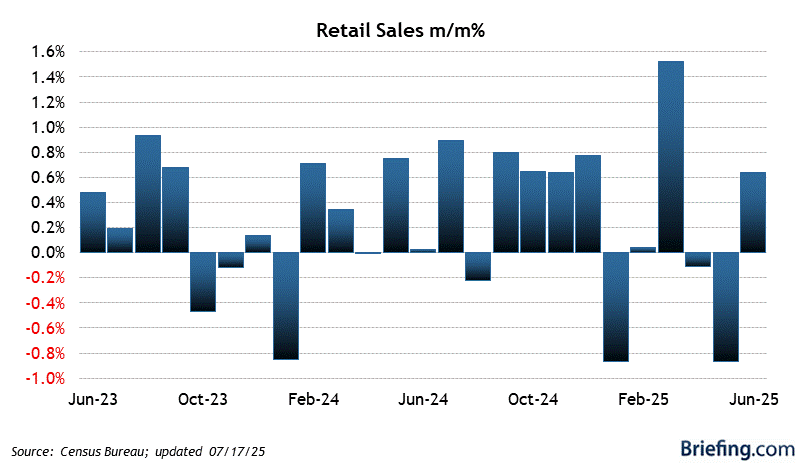
First, let's take a look at a chart of the percent of increase/decrease from month-over-month for retail sales (which is a component of personal consumption expenditures).
 From this graphic, you can see retail sales fell by nearly a full percentage point in December. In the prior two months, which rounds out the fourth quarter, month-over-month increases were both less than 1/2 percent each. In essence, retail sales for the fourth quarter, when averaged, were actually down slightly. So, if consumer spending at the cash register was so weak, how is it that overall consumption was able to come in at an increase of 4.2% from the previous quarter? Well, the only real explanation is that all the other consumables that don't make up retail sales -- like healthcare and insurance on your house and car -- had to have seen some serious inflation in the fourth quarter. But, that too is in conflict with this statement on inflation in the same GDP report:
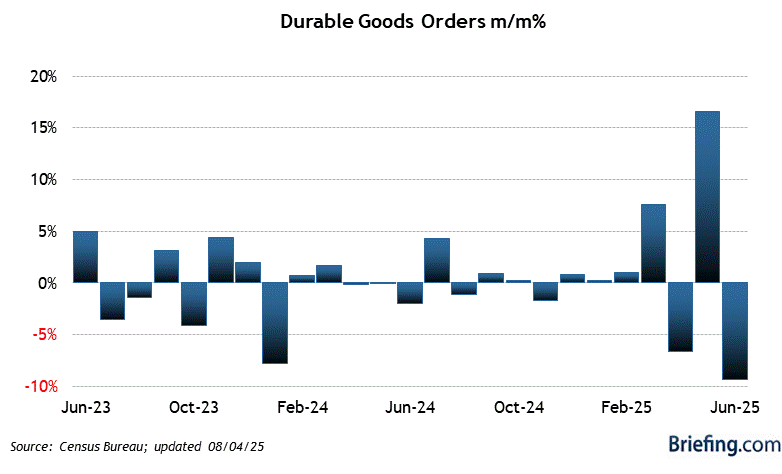
Then, there's the durable goods order increase of 7.4%. So you understand, durable goods are things we or companies buy that last a long time. Things like aircraft and appliances like refrigerators or stoves. But, again, this huge increase doesn't jive with individual monthly reports on durable goods orders growth.

As you can easily see, every monthly change in durable goods orders was negative from August through December. Call me crazy, but it is a little hard to add up a bunch of negatives and get a positive 7.4%.
In my mind, the only reason that this report wasn't negative for GDP growth was because of the hard-to-believe strength in personal consumption and durable goods ordering. Now, the people who put this report together have 3 more months to revise their data. Could it be that this report was purposely "adjusted" this first time around so as not to embarrass their boss, Barack Obama, after he made such a big thing of the economy in the State of the Union address? We'll see if future revisions are downward.
References:
US economy cools in fourth quarter, but consumer spending shines: http://www.reuters.com/article/2015/01/30/us-usa-economy-idUSKBN0L30BC20150130
Gross Domestic Product: Fourth Quarter and Annual 2014 (Advance Estimate): http://www.bea.gov/newsreleases/national/gdp/gdpnewsrelease.htm
Obama heralds economic recovery in State of the Union: http://www.msnbc.com/msnbc/obama-heralds-economic-recovery-state-the-union-address
What that headline refers to is these two sentences regarding consumer spending from the summary section of the fourth quarter Gross Domestic Product (GDP) report for the last quarter of 2014:
Real personal consumption expenditures increased 4.3 percent in the fourth quarter, compared with an increase of 3.2 percent in the third. Durable goods increased 7.4 percent, compared with an increase of 9.2 percent.I have difficulty understanding where all this growth came from in personal consumption and durable goods purchases. That's because separate monthly reports on retail sales and durable good orders tell a completely different story.
First, let's take a look at a chart of the percent of increase/decrease from month-over-month for retail sales (which is a component of personal consumption expenditures).
The price index for gross domestic purchases, which measures prices paid by U.S. residents, decreased 0.3 percent in the fourth quarter, in contrast to an increase of 1.4 percent in the third.As the report states, there was no inflation because gross prices actually fell; and, that fact alone makes is even harder to explain the 4.2% increase in consumption.
Then, there's the durable goods order increase of 7.4%. So you understand, durable goods are things we or companies buy that last a long time. Things like aircraft and appliances like refrigerators or stoves. But, again, this huge increase doesn't jive with individual monthly reports on durable goods orders growth.
As you can easily see, every monthly change in durable goods orders was negative from August through December. Call me crazy, but it is a little hard to add up a bunch of negatives and get a positive 7.4%.
In my mind, the only reason that this report wasn't negative for GDP growth was because of the hard-to-believe strength in personal consumption and durable goods ordering. Now, the people who put this report together have 3 more months to revise their data. Could it be that this report was purposely "adjusted" this first time around so as not to embarrass their boss, Barack Obama, after he made such a big thing of the economy in the State of the Union address? We'll see if future revisions are downward.
References:
US economy cools in fourth quarter, but consumer spending shines: http://www.reuters.com/article/2015/01/30/us-usa-economy-idUSKBN0L30BC20150130
Gross Domestic Product: Fourth Quarter and Annual 2014 (Advance Estimate): http://www.bea.gov/newsreleases/national/gdp/gdpnewsrelease.htm
Obama heralds economic recovery in State of the Union: http://www.msnbc.com/msnbc/obama-heralds-economic-recovery-state-the-union-address
Thursday, July 10, 2014
How Eating Breakfast Can Literally Make You Sick
Many nutritionists tell us that breakfast is the most important meal of the day because it kick-starts into our morning. But, lately, you may be feeling a little sick, or perhaps even a bit depressed after eating that All-American staple of eggs, bacon, toast and coffee. This may be because -- just since January 2013 -- the cost of that basic meal has risen by 24% overall; with coffee up 72% and bacon 42%.
Simply, you have to ask yourself this: Did I get a 24% raise last year to afford these breakfast increases? Probably not. And, it isn't just breakfast that has become expensive. All meals are costing you more. Because of this, you and I have less dollars in our pockets for other things and, as a result, overall consumer spending is hurt in the process; just another one of the reasons the economy contracted by 2.9% in the first quarter.
Reference:
Blistering food rally plays havoc with breakfast: http://www.ft.com/intl/cms/s/0/2ac2dbe6-adae-11e3-9ddc-00144feab7de.html#axzz36nZGcWjo
 |
| Click on image to enlarge |
Reference:
Blistering food rally plays havoc with breakfast: http://www.ft.com/intl/cms/s/0/2ac2dbe6-adae-11e3-9ddc-00144feab7de.html#axzz36nZGcWjo
Thursday, May 1, 2014
On The Minimum Wage Hike: Timing Is Everything
On the very day that the Senate Democrats are planning to make a show of voting for a $10.10 minimum wage, it was reported that the economy in the first quarter only grew by one-tenth of one percent. Just a tenth of a percent above dead stalled.
Yet, the Democrats feel obliged to further damage this already-fragile situation by hiking the minimum wage and, in so doing, force higher prices for a consumer base that has already seen its income decline for 5 straight years.
This, so 1/2 of one percent of our population or 1.6 million workers, can see their salary kicked up 41%. With this, the Democrats think they can stir up their political base as they approach the Fall elections. And the economy be damned as they ignore how complicit the last minimum wage increase was in making this the worst recovery ever.
Now, ask yourself this. Are you going to get a 41% wage hike so you can afford the inflationary prices caused by this latest increase? Are the working poor, those on welfare assistance, and those on fixed incomes going to benefit from it? No. This will only create further income inequality by weighing down those already at the bottom.
References:
April 30: $10.10 Wage Bill Set To Die In The Senate: http://thehill.com/homenews/senate/204766-1010-wage-bill-set-to-die
April 30: US economy slowed to 0.1 percent growth rate in Q1:
http://apnews.myway.com//article/20140430/us-economy-gdp-09b1567225.html
Median Income Falls For 5th Year, Inequality At Record High: http://www.huffingtonpost.com/2013/09/17/median-income-falls-inequality_n_3941514.html
Characteristics of a minimum wage worker: http://www.bls.gov/cps/minwage2012.htm
Yet, the Democrats feel obliged to further damage this already-fragile situation by hiking the minimum wage and, in so doing, force higher prices for a consumer base that has already seen its income decline for 5 straight years.
This, so 1/2 of one percent of our population or 1.6 million workers, can see their salary kicked up 41%. With this, the Democrats think they can stir up their political base as they approach the Fall elections. And the economy be damned as they ignore how complicit the last minimum wage increase was in making this the worst recovery ever.
Now, ask yourself this. Are you going to get a 41% wage hike so you can afford the inflationary prices caused by this latest increase? Are the working poor, those on welfare assistance, and those on fixed incomes going to benefit from it? No. This will only create further income inequality by weighing down those already at the bottom.
References:
April 30: $10.10 Wage Bill Set To Die In The Senate: http://thehill.com/homenews/senate/204766-1010-wage-bill-set-to-die
April 30: US economy slowed to 0.1 percent growth rate in Q1:
http://apnews.myway.com//article/20140430/us-economy-gdp-09b1567225.html
Median Income Falls For 5th Year, Inequality At Record High: http://www.huffingtonpost.com/2013/09/17/median-income-falls-inequality_n_3941514.html
Characteristics of a minimum wage worker: http://www.bls.gov/cps/minwage2012.htm
Monday, February 24, 2014
Five Years Later...Why the Stimulus And Keynesian Economics Failed
Remember this chart:

The plain fact is that real unemployment did even worse than Obama's "Without Recovery Plan" with the peak unemployment rate hitting 10.1% in 2010. Today, when it should be at 5%, we are still struggling at 6.6%. When Obama took office there were 155.2 million workers in the labor force. Despite the fact that nearly 7.5 million new workers should have entered the workforce over the last 5 years, the number has only inched up to 155.4 million. That 7.5 million, euphemistically called discouraged workers, have just given up looking for work. As a result, they are no longer counted as being in the workforce. So much for "real" job creation.
And, GDP? Well, its seen the worst recovery since the Great Depression with an average of about 1.97% growth per year since the recession ended in 2009. Normally, growth should be 50% greater than that; at 3% or higher. Obviously, the stimulus didn't work as promised; and, even today, three-quarters of Americans still think we are in a recession.
While there are several reasons why Obama's Keynesian-Style Stimulus Package failed, the primary reason lies in the false belief that, when the economy slips into recession as a result of slack consumer spending, that lack of spending can be made up by increasing government expenditures. But, this is just ridiculous. The simple fact is that consumers don't spend like governments. They don't build roads or bridges and they don't spend their money fixing them. So, instead of stimulating the existing parts of our economy that are in the process of dying off, the Keynesian stimulus winds up stimulating a subset of the economy that had nothing to do with the reason that the economy faltered in the first place. What's worse, most of these projects have a low labor cost to materials and equipment costs ratios. That is why you wind up with statistics that show that, at the very least, it cost the taxpayers $185,000 for each job that was supposedly created.
Another problem with using federal and state construction projects as a means of trying to stimulate the economy is the fact that any spending and job creation will always be short lived. If the project is 1 month long or 3 years long, that part of the economy that is being stimulated will only benefit as long as the project is still alive. Once its over, so are the jobs and so is the spending.
Lastly, there's the argument by the Democrats that every dollar spent returns $1.50 in economic activity. To some extent that's true, but $1.50 is an average. Depending on how labor intensive the effort is, the returns will range between 70 cents (a loss) and $1.90. Heavy construction projects are more towards 70 cents than anywhere near $1.50 because the labor costs are so low relative to the overall cost of the project. Thus, the potential for any true economic expansion is lost. More importantly, the stimulus is a drag on everyone's wallet because deficit spending devalues all the dollars that are in the economy. This weak dollar effect means that things will cost more; especially imported items. For example, oil, which is priced worldwide on the basis of the strength or weakness of the U.S. dollar, has dramatically risen since 2009. The result has been that gasoline prices rose from $1.74/gallon in 2009 to the current rate of $3.63. This is despite the fact we are now awash in new, domestic oil as a result of fracking and other new technologies. In contrast, natural gas, which is not traded in terms of the value of the dollar, has seen its prices fall from $12.49 a cubic ton to $9.40 from 2009 to 2012. All because of fracking.
Despite whatever spin the White House puts on the stimulus results, it was nothing but a failure and, I think, definitive proof that Keynesian economics is simply another tool for left-wing politicians to grow the government and redistribute wealth.
References:
The Worst Four Years Of GDP Growth In History: Yes, We Should Be Worried: http://www.forbes.com/sites/realspin/2013/04/12/the-worst-four-years-of-gdp-growth-in-history-yes-we-should-be-worried/
As Obama starts sixth year, 74 percent say US still in recession: http://www.foxnews.com/politics/2014/01/22/fox-news-poll-as-obama-starts-sixth-year-74-percent-say-us-still-in-recession/
White House Says The Stimulus Cost Per Job is $185,000; not $278,000: http://www.nationalreview.com/campaign-spot/271107/white-house-nuh-uh-stimulus-jobs-only-cost-185k-each
Politifact: Every Dollar of Spending Returns Between $0.70 & $1.90 in Increase Economic Activity: http://www.politifact.com/truth-o-meter/statements/2010/jul/27/jeanne-shaheen/lawmaker-claims-unemployment-benefits-boost-econom/
A Scorecard on the economy under Obama: http://www.politifact.com/truth-o-meter/article/2012/jun/01/scorecard-economy-obama/
Friday, July 13, 2012
Why The 40% Cadillac Health Plan Tax Will Utimately Hit Millions Of Middle Class People
Under ObamaCare, any individual health plan that costs $8,500 or more a year or, any family plan that is in excess of $23,000, will be hit with a massive 40% surcharge for being a so-called Cadillac plan. And, in typical Democrat fashion, ObamaCare has no automatic way of adjusting these threshold numbers for inflation. So, that means that, along with the AMT fix and doctor's fix, Congress will have to constantly pass legislation to adjust these numbers for inflation.
But, here's the thing. Last year, the Kaiser Foundation reported that the average cost to an employer for an individual health insurance plan was $5429. For, a family, it was $15,073. And, both these numbers were an increase of 9% from the previous year. But, last year's bump of 9% was, hopefully, a one-time event; primarily attributed to some of the mandates of ObamaCare. However, rates are still expected to rise by 5.8% per year through 2020. What that means is that, by 2019, just 6-1/2 years from now, the "average" employer-based insurance plan in America will automatically become a Cadillac plan; subject to a 40% surcharge. And, of course, that's an average of all employer plans. Some more costly plans, such as private insurance and those in states like New York, will reach "Cadillac" status much earlier than 2019.
How's that for one helluva Obama tax on the middle class!
Insurance cost source: http://www.kaiserhealthnews.org/stories/2011/september/27/employer-health-coverage-survey-shows-employer-spending-spike.aspx
Cost projections source: http://healthaffairs.org/blog/2011/07/28/u-s-health-spending-projected-to-grow-ercent-annually/
But, here's the thing. Last year, the Kaiser Foundation reported that the average cost to an employer for an individual health insurance plan was $5429. For, a family, it was $15,073. And, both these numbers were an increase of 9% from the previous year. But, last year's bump of 9% was, hopefully, a one-time event; primarily attributed to some of the mandates of ObamaCare. However, rates are still expected to rise by 5.8% per year through 2020. What that means is that, by 2019, just 6-1/2 years from now, the "average" employer-based insurance plan in America will automatically become a Cadillac plan; subject to a 40% surcharge. And, of course, that's an average of all employer plans. Some more costly plans, such as private insurance and those in states like New York, will reach "Cadillac" status much earlier than 2019.
How's that for one helluva Obama tax on the middle class!
Insurance cost source: http://www.kaiserhealthnews.org/stories/2011/september/27/employer-health-coverage-survey-shows-employer-spending-spike.aspx
Cost projections source: http://healthaffairs.org/blog/2011/07/28/u-s-health-spending-projected-to-grow-ercent-annually/
Wednesday, November 30, 2011
Cheaper Dollars Means More Inflation
This morning, it was announced that our Federal Reserve, along with the Bank of England and the Central Banks of Europe, Japan, Canada, and Switzerland would all lower their dollar interbank lending rate by 1/2 percent. In doing so, it is expected that the world economies will be stimulated.
Once again, you have the monetarist, Federal Reserve Charmian Ben Bernanke, believing that he can kick start the worlds economy through an easy money policy. A policy that he's tried in this country and that has failed miserably to stimulate anything. To me, the only thing that will happen is that the value of our dollar will fall again; making those things we import more expensive for us to buy. In fact and true to form, as soon as this banking arrangement was announced, the dollar sank in value and oil prices jumped above $101.
As I have written before, import price inflation just shrinks the total amount of products and services that a consumer can afford to buy. In other words, less bang for the buck. As a result, discretionary spending declines and the economy starts to contract. Let's never forget, much of what we buy in this country is imported. Even if a product says "Made in America", it was probably assembled using imported parts.
The big problem with this interbank lending policy is that it doesn't really address the underlying debt crisis in Europe. And, unless countries like Italy and Greece get their spending under control, we are still at risk for world wide economic collapse.
Once again, you have the monetarist, Federal Reserve Charmian Ben Bernanke, believing that he can kick start the worlds economy through an easy money policy. A policy that he's tried in this country and that has failed miserably to stimulate anything. To me, the only thing that will happen is that the value of our dollar will fall again; making those things we import more expensive for us to buy. In fact and true to form, as soon as this banking arrangement was announced, the dollar sank in value and oil prices jumped above $101.
As I have written before, import price inflation just shrinks the total amount of products and services that a consumer can afford to buy. In other words, less bang for the buck. As a result, discretionary spending declines and the economy starts to contract. Let's never forget, much of what we buy in this country is imported. Even if a product says "Made in America", it was probably assembled using imported parts.
The big problem with this interbank lending policy is that it doesn't really address the underlying debt crisis in Europe. And, unless countries like Italy and Greece get their spending under control, we are still at risk for world wide economic collapse.
Sunday, July 31, 2011
Obama's Indirect Tax Through Keynesian Economics
Even this tax-and-spend President has agreed that raising taxes during a weak economic period is a bad idea because it would further exacerbate an already languishing economy. But, indirectly, that's exactly what he and his previous completely Democrat-controlled Congress did through a massive "stimulus" spending program.
John Maynard Keynes, certainly the pure consciousness of Keynesian economic theory, correctly assumed and stated that the total aggregate demand (spending) in any economy is a direct result of the spending activity by (1) the public sector (state, local, and federal governments) and (2) the private sector (consumers and business). Further, he theorized that "if" private sector demand fell during an economic downturn, the economy could be righted, again, by simply increasing the amount of spending by the public sector; and, thus, offsetting any loss of demand in the private sector. In theory, it seems so elegantly simple and logical. Thus, we have the basis of "stimulative" spending that almost every Democrat believes to be the key to good recession-beating economics.
But, what Keynes (and the Democrats) totally missed the boat on, is the fact that all that stimulative spending would severely devalue our currency. In fact, in the last 2-1/2 years, the the U.S. dollar has lost more of its value against a market-basket of other key currencies than it had in the 15 years prior to Obama taking office. And, in an economy, like ours, which is so dependent on consumer spending and with a consumer who is so dependent on imported goods, this is pure economic poison.
In our economy, the consumer reigns king; normally representing about 70% of our total economic activity. The remaining 30% is comprised of a combination of public sector and private business spending. So, if, in any way, you hamper the consumer's ability to spend money by diverting a bigger chunk of their paycheck to either higher or new taxes or through higher prices, the economy would be doomed to falter; a fact that we are now seeing after having spent trillions to supposedly "stimulate" the economy.
The reality is that the consumer's paycheck has been under assault by the continuing devaluation of the dollar; which, in turn, has driven import prices higher and higher. In fact, in the last Import Price Report, the "average" of all import prices rose 13.6% -- year over year -- while the American paycheck has remained fairly stagnant. As a result of this inflation, the American consumer has seen their gasoline expenses double under Obama's watch; with the "average" 2-car family now paying about $2000 more per year. (Please note: The doubling of gasoline prices is only partly driven by the dollar's loss in value. The rest of the price inflation is due to the speculation that future demand could outstrip supply; eventually making world oil prices skyrocket. The demand side of this speculation is also being driven by the increasing need for oil by some rapidly emerging economies such as China and India. In addition, the instability in the Middle East could result in supply shortages. Also, there are foreseen supply limitations in this country due to Obama's anti-drilling policies; especially since America, with only 5% of the world's population, uses 25% of world's entire oil supplies.)
On top of higher oil prices, the consumer has seen their average food bill rise by almost 30% since 2009. That's because much our nation's food bill is for imported products. For example, 70% of our seafood comes in from other countries. Most all of the nation's fresh, off-season fruits and vegetables are imported. Even that morning caffe latte is dependent on coffee being brought in from places like Columbia. In addition, food prices are also very sensitive to rising energy prices. That's because gasoline and diesel fuels and electricity are heavily involved in every aspect of food production and in the delivery to market. While I have not been able to determine an exact number, my guess is that an average family of four has seen their food bill rise by at lease $2200 a year since the value started dropping in 2009.
Also, in a surprising way, domestically grown foods and food products are seeing prices rise as a result of the devalued dollar. That's because, as the dollar weakens, our farm goods and our manufactured goods actually become cheaper; overseas. That may seem like a good thing; and, for the most part, it is. But, it also has an adverse effect by increasing the demand for all those now-cheaper American farm goods that are supply-limited due to the fixed available acreage that can be dedicated to that products production. In effect, as our products get cheaper overseas, we find ourselves competing with the rest of the world for our own farm products. As a result, the extra demand -- given effects of the Law of Supply and Demand --- causes prices to rise domestically. Sometimes, farmers, seeing a more lucrative opportunity for an exporting farm good, will switch crops to a more attractive and profitable exportable product. When this happens, a supply-void occurs for the farm product being abandoned. As a result, that product, too, will see its prices rise as supplies decline.
The bottom line is that the stimulus package, by virtue of a weakened dollar, is actually having the opposite of its intended effect because it, for the most part, hurts the primary driver of the economy: the American consumer. Added to this, consumer spending is being further eroded by all the new taxes and increases on existing taxes that are being applied by individual state, county, and local governments across this country, as those governments try to push back against their rising deficits. But, as in the case of the weakened dollar, raising taxes just causes the economy to decline even further; thus, conversely, causing deficits to increase from an economy that gets even weaker.
I believe that the adverse effects of the stimulus spending (and taxes) can be clearly seen in the chart (below) which shows that our economic activity declined as more and more stimulus money (and taxes) is applied:
 Prior to the application of any stimulus funds, the economy was actually on the mend as noted by this chart of Gross Domestic Spending:
 Visually, there is an obvious change in our economy's direction as the stimulus money rolls out. The chart above clearly shows how the economy was recovering and, if left alone without stimulus funds, it would probably be doing fine right now. Instead, we are on the verge of going negative; once again.
I just think the economy would have been better served by reducing the amount of Federal spending; not increasing it. In that way, import prices would have actually fallen because the dollar would have strengthened. This, then, would have promoted increased consumer activity and that would have resulted in renewed hiring instead of the increased unemployment we have now. While it is a fact that exporting corporations might have been hurt by strengthening the dollar -- making their products more expensive in the world marketplace -- that fact could have been easily mitigated by reducing the corporate tax rate. Furthermore, Congress could have helped stimulate corporate business activity by passing legislation that would have allowed multinational companies to return profits back to the U.S. without any penalty of Federal taxation. Right now, those profits would not only be taxed in the foreign country in which they were earned, but also by the U.S government; should any of those profits be returned to this country. As a result, much of those funds are used to help the economies of the countries of origin and not the United States.
John Maynard Keynes, certainly the pure consciousness of Keynesian economic theory, correctly assumed and stated that the total aggregate demand (spending) in any economy is a direct result of the spending activity by (1) the public sector (state, local, and federal governments) and (2) the private sector (consumers and business). Further, he theorized that "if" private sector demand fell during an economic downturn, the economy could be righted, again, by simply increasing the amount of spending by the public sector; and, thus, offsetting any loss of demand in the private sector. In theory, it seems so elegantly simple and logical. Thus, we have the basis of "stimulative" spending that almost every Democrat believes to be the key to good recession-beating economics.
But, what Keynes (and the Democrats) totally missed the boat on, is the fact that all that stimulative spending would severely devalue our currency. In fact, in the last 2-1/2 years, the the U.S. dollar has lost more of its value against a market-basket of other key currencies than it had in the 15 years prior to Obama taking office. And, in an economy, like ours, which is so dependent on consumer spending and with a consumer who is so dependent on imported goods, this is pure economic poison.
In our economy, the consumer reigns king; normally representing about 70% of our total economic activity. The remaining 30% is comprised of a combination of public sector and private business spending. So, if, in any way, you hamper the consumer's ability to spend money by diverting a bigger chunk of their paycheck to either higher or new taxes or through higher prices, the economy would be doomed to falter; a fact that we are now seeing after having spent trillions to supposedly "stimulate" the economy.
The reality is that the consumer's paycheck has been under assault by the continuing devaluation of the dollar; which, in turn, has driven import prices higher and higher. In fact, in the last Import Price Report, the "average" of all import prices rose 13.6% -- year over year -- while the American paycheck has remained fairly stagnant. As a result of this inflation, the American consumer has seen their gasoline expenses double under Obama's watch; with the "average" 2-car family now paying about $2000 more per year. (Please note: The doubling of gasoline prices is only partly driven by the dollar's loss in value. The rest of the price inflation is due to the speculation that future demand could outstrip supply; eventually making world oil prices skyrocket. The demand side of this speculation is also being driven by the increasing need for oil by some rapidly emerging economies such as China and India. In addition, the instability in the Middle East could result in supply shortages. Also, there are foreseen supply limitations in this country due to Obama's anti-drilling policies; especially since America, with only 5% of the world's population, uses 25% of world's entire oil supplies.)
On top of higher oil prices, the consumer has seen their average food bill rise by almost 30% since 2009. That's because much our nation's food bill is for imported products. For example, 70% of our seafood comes in from other countries. Most all of the nation's fresh, off-season fruits and vegetables are imported. Even that morning caffe latte is dependent on coffee being brought in from places like Columbia. In addition, food prices are also very sensitive to rising energy prices. That's because gasoline and diesel fuels and electricity are heavily involved in every aspect of food production and in the delivery to market. While I have not been able to determine an exact number, my guess is that an average family of four has seen their food bill rise by at lease $2200 a year since the value started dropping in 2009.
Also, in a surprising way, domestically grown foods and food products are seeing prices rise as a result of the devalued dollar. That's because, as the dollar weakens, our farm goods and our manufactured goods actually become cheaper; overseas. That may seem like a good thing; and, for the most part, it is. But, it also has an adverse effect by increasing the demand for all those now-cheaper American farm goods that are supply-limited due to the fixed available acreage that can be dedicated to that products production. In effect, as our products get cheaper overseas, we find ourselves competing with the rest of the world for our own farm products. As a result, the extra demand -- given effects of the Law of Supply and Demand --- causes prices to rise domestically. Sometimes, farmers, seeing a more lucrative opportunity for an exporting farm good, will switch crops to a more attractive and profitable exportable product. When this happens, a supply-void occurs for the farm product being abandoned. As a result, that product, too, will see its prices rise as supplies decline.
The bottom line is that the stimulus package, by virtue of a weakened dollar, is actually having the opposite of its intended effect because it, for the most part, hurts the primary driver of the economy: the American consumer. Added to this, consumer spending is being further eroded by all the new taxes and increases on existing taxes that are being applied by individual state, county, and local governments across this country, as those governments try to push back against their rising deficits. But, as in the case of the weakened dollar, raising taxes just causes the economy to decline even further; thus, conversely, causing deficits to increase from an economy that gets even weaker.
I believe that the adverse effects of the stimulus spending (and taxes) can be clearly seen in the chart (below) which shows that our economic activity declined as more and more stimulus money (and taxes) is applied:
 Prior to the application of any stimulus funds, the economy was actually on the mend as noted by this chart of Gross Domestic Spending:
 Visually, there is an obvious change in our economy's direction as the stimulus money rolls out. The chart above clearly shows how the economy was recovering and, if left alone without stimulus funds, it would probably be doing fine right now. Instead, we are on the verge of going negative; once again.
I just think the economy would have been better served by reducing the amount of Federal spending; not increasing it. In that way, import prices would have actually fallen because the dollar would have strengthened. This, then, would have promoted increased consumer activity and that would have resulted in renewed hiring instead of the increased unemployment we have now. While it is a fact that exporting corporations might have been hurt by strengthening the dollar -- making their products more expensive in the world marketplace -- that fact could have been easily mitigated by reducing the corporate tax rate. Furthermore, Congress could have helped stimulate corporate business activity by passing legislation that would have allowed multinational companies to return profits back to the U.S. without any penalty of Federal taxation. Right now, those profits would not only be taxed in the foreign country in which they were earned, but also by the U.S government; should any of those profits be returned to this country. As a result, much of those funds are used to help the economies of the countries of origin and not the United States.
Friday, February 19, 2010
Another Take On Producer Prices and Inflation
Yesterday, my blog entry took aim at Obama's Keynesian economics policies and the potential for double-digit inflation that could result from excessive governmental spending. In that same vein, Patrick Murphy, a Senior fellow in business and economic studies at the Pacific Research Institute, wrote an excellent commentary and I would like to pass it on to you (the link is at the end of this entry).
His commentary, like my blog entry, refers back to the Carter years of the 1970's and early 1980's when there was both a recession and rampant inflation -- a condition often referred to as stagflation. When you really think about it, the Cash for Clunkers program was inflationary relative to the Law of Supply and Demand because it artificially increased the demand for new cars and reduced the supply of used cars that were destroyed in the process. In fact, used car prices had marked price increases following the end of that program. Since most people bought a car that they were going to buy anyway, that program only served to inflate prices and did nothing to get the economy back on track.
At the same time, the $8000 tax credit for first time home buyers is also creating inflationary demand. Furthermore, the monthly statistics show that new home builders are actively building homes. Given the fact that we already have a glut of vacant foreclosed-on homes, the amount of new home building is just insane. But, people are buying new homes rather than buy existing ones that are selling for the same price because the real estate taxes for the older homes remain at the same level that they were when those older homes were double their existing value. That, too, is insane.
Obama's entire Stimulus Package, is pretty much inflationary because it keeps government spending levels high; thus, feeding inflation. To stimulate an economy without inflation, you need to cut taxes and stop playing games with targeted tax credits. And, for sure, you need to reduce government spending; not keep increasing it. Otherwise, you will encounter stagflation and, as I said yesterday, we will have another "Carter-like economic fiasco on our hands".
Anyway, please take the time to read this excellent commentary: "MURPHY: Setting the stage for stagflation".
His commentary, like my blog entry, refers back to the Carter years of the 1970's and early 1980's when there was both a recession and rampant inflation -- a condition often referred to as stagflation. When you really think about it, the Cash for Clunkers program was inflationary relative to the Law of Supply and Demand because it artificially increased the demand for new cars and reduced the supply of used cars that were destroyed in the process. In fact, used car prices had marked price increases following the end of that program. Since most people bought a car that they were going to buy anyway, that program only served to inflate prices and did nothing to get the economy back on track.
At the same time, the $8000 tax credit for first time home buyers is also creating inflationary demand. Furthermore, the monthly statistics show that new home builders are actively building homes. Given the fact that we already have a glut of vacant foreclosed-on homes, the amount of new home building is just insane. But, people are buying new homes rather than buy existing ones that are selling for the same price because the real estate taxes for the older homes remain at the same level that they were when those older homes were double their existing value. That, too, is insane.
Obama's entire Stimulus Package, is pretty much inflationary because it keeps government spending levels high; thus, feeding inflation. To stimulate an economy without inflation, you need to cut taxes and stop playing games with targeted tax credits. And, for sure, you need to reduce government spending; not keep increasing it. Otherwise, you will encounter stagflation and, as I said yesterday, we will have another "Carter-like economic fiasco on our hands".
Anyway, please take the time to read this excellent commentary: "MURPHY: Setting the stage for stagflation".
Thursday, February 18, 2010
The Vicious Circle Of Producer Price Inflation
This morning, the producer price data was released for the month of January and those prices soared 1.4 percent for that month (Click to See Full Story: January Producer Prices Rise More Than Expected). Producer prices reflect the cost of finished products that are making their way through the retail market system. These finished goods can be gasoline, heating oil and things like picked, packaged, and processed food stuffs and dairy products being delivered to the markets for retail sale.
The reason that producer prices are such a closely watched metric is because it is producer prices that will ultimately force retail prices up and that, in turn, will eventually hit us all in our wallets in the form of inflation. At the heart of any past rampant inflationary period has been the rapid rise of producer prices. If you assume that normally acceptable inflation rates should be at about 3 to 4 percent in an entire year then, having a 1.4 percent increase in a single month (as in this report) is very worrisome.
Producer price increases are a double edged sword; especially in a time of recession.
Any retailer who is hit with a big jump in the prices they pay for the products that they intend to sell are typically faced with only one of two choices: Either raise prices or hold the line. In the majority of cases, they will raise prices.
However, if a retailer fears that they won't remain price competitive in their own market space, they will hold their pricing. In doing so, this action means that their profits will be reduced. When profits are reduced, the income taxes that they will pay will also be reduced. The vicious circle that results from this decision is the fact that State and Federal taxing agencies will now see lower revenues; and, as usual, they will be forced to raise taxes in order to compensate for that loss. Then, in turn, all retailers will be forced to make another pricing decision to compensate for the new higher tax rates.
As I said before, most retailers will make the decision to raise their prices. But, what that does is take disposable income away from the consumer. If the consumer's paychecks don't rise at the same rate as inflation, then we could see a variety of bad things happening in our economy. And, it is typical, in a recession, that workers have little or no leverage to demand salary increases in the face of rising prices. Therefore, the amount of people who are unable to pay their bills will rise. This could also result in higher number of bankruptcies, foreclosures, and defaults on other loans and credit cards. It also means that non-essential spending will be curtailed and the retail sales for things other than food and clothing could suffer a setback and cause a double-dip recession. Once again, tax revenues will be reduced; forcing taxing agencies to raise taxes. And, so, higher taxes will force higher prices and the vicious circle will just keep repeating.
Normally, the Federal Reserve would fight inflation by raising interest rates. However, with business loans and mortgages already hurting, raising interest rates will only continue to reduce bank lending. Therefore, the Federal Reserve is in no good position to do anything because their actions to fight inflation could be as bad for the economy as the unbridled inflation they are trying to fight.
Any way you shake it, the continued high spending rate by this Congress and this President is probably at the core of this month's high rate of producer price increase; and, it is an early sign of the double-digit inflation we could see in the next 2 to 3 years; as most non-Keynesian theory economists have predicted. This is why the theory of Keynesian Economics to use a high rate of government spending to pull us out of recession is so wrong. What should have been done is broad base of tax cuts to stimulate our economy -- as was so effective under Reagan's watch. But this President doesn't seem to get it. It appears now that we have another Carter-like economic fiasco on our hands as this President continues to pursue an economy-killing, liberal agenda with high taxes and outrageous government spending.
Lastly, I would like to point out that I, in this blog, and along with many many others in this world have been more accurate about the direction of this economy and the failure of Obama's economic policies than either Obama or his economic advisers. In most cases, economics is just common sense -- something that Obama and his academics don't seem to understand. But, then, how could they? None of them has ever run a business or managed anything other than their personal trips to the bathroom. And, based on the amount "crap" and B.S. that we keep getting from them, those trips are quite frequent.
The reason that producer prices are such a closely watched metric is because it is producer prices that will ultimately force retail prices up and that, in turn, will eventually hit us all in our wallets in the form of inflation. At the heart of any past rampant inflationary period has been the rapid rise of producer prices. If you assume that normally acceptable inflation rates should be at about 3 to 4 percent in an entire year then, having a 1.4 percent increase in a single month (as in this report) is very worrisome.
Producer price increases are a double edged sword; especially in a time of recession.
Any retailer who is hit with a big jump in the prices they pay for the products that they intend to sell are typically faced with only one of two choices: Either raise prices or hold the line. In the majority of cases, they will raise prices.
However, if a retailer fears that they won't remain price competitive in their own market space, they will hold their pricing. In doing so, this action means that their profits will be reduced. When profits are reduced, the income taxes that they will pay will also be reduced. The vicious circle that results from this decision is the fact that State and Federal taxing agencies will now see lower revenues; and, as usual, they will be forced to raise taxes in order to compensate for that loss. Then, in turn, all retailers will be forced to make another pricing decision to compensate for the new higher tax rates.
As I said before, most retailers will make the decision to raise their prices. But, what that does is take disposable income away from the consumer. If the consumer's paychecks don't rise at the same rate as inflation, then we could see a variety of bad things happening in our economy. And, it is typical, in a recession, that workers have little or no leverage to demand salary increases in the face of rising prices. Therefore, the amount of people who are unable to pay their bills will rise. This could also result in higher number of bankruptcies, foreclosures, and defaults on other loans and credit cards. It also means that non-essential spending will be curtailed and the retail sales for things other than food and clothing could suffer a setback and cause a double-dip recession. Once again, tax revenues will be reduced; forcing taxing agencies to raise taxes. And, so, higher taxes will force higher prices and the vicious circle will just keep repeating.
Normally, the Federal Reserve would fight inflation by raising interest rates. However, with business loans and mortgages already hurting, raising interest rates will only continue to reduce bank lending. Therefore, the Federal Reserve is in no good position to do anything because their actions to fight inflation could be as bad for the economy as the unbridled inflation they are trying to fight.
Any way you shake it, the continued high spending rate by this Congress and this President is probably at the core of this month's high rate of producer price increase; and, it is an early sign of the double-digit inflation we could see in the next 2 to 3 years; as most non-Keynesian theory economists have predicted. This is why the theory of Keynesian Economics to use a high rate of government spending to pull us out of recession is so wrong. What should have been done is broad base of tax cuts to stimulate our economy -- as was so effective under Reagan's watch. But this President doesn't seem to get it. It appears now that we have another Carter-like economic fiasco on our hands as this President continues to pursue an economy-killing, liberal agenda with high taxes and outrageous government spending.
Lastly, I would like to point out that I, in this blog, and along with many many others in this world have been more accurate about the direction of this economy and the failure of Obama's economic policies than either Obama or his economic advisers. In most cases, economics is just common sense -- something that Obama and his academics don't seem to understand. But, then, how could they? None of them has ever run a business or managed anything other than their personal trips to the bathroom. And, based on the amount "crap" and B.S. that we keep getting from them, those trips are quite frequent.
Saturday, June 27, 2009
The Truth About Cap and Trade
What I am about to say has been said in this blog many times; in a variety of ways. But, with the passage of the massive Cap and Trade bill by the House of Representatives on Friday, much of what I have said in the past is worth repeating.
The current push for Climate Control through taxing schemes like Cap and Trade has nothing to do with saving the planet. To say that CO2, an innocuous and ever-present gas, is the blame for the earth's current warming trend is just a ruse. The real thrust behind Global Warming and the exaggeration of CO2 as a pollutant is to control human expansion and to eliminate all those things that liberals hate like SUV's, coal energy plants, fossil fuel burning vehicles, and the encroachment of humanity into nature.
Years ago, the enemies of the tree hugging left were true pollutants like sulfur dioxide. Humanity knew that kind of pollution had to be controlled because their eyes burned and the sky was increasingly being blocked out by dark yellow clouds that hung over most of our cities. People could literally see the pollution; feel it; and, they knew that it was a real problem. For once, the tree-huggers thought they had found the tool to fight human expansion into the pristine nature of this country. But, to their dismay, science found ways to fight the pollution and, subsequently, continue mankind's march into the destruction of nature. Science created catalytic converters in cars to minimize tailpipe pollution. Scrubbers were developed to eliminate and minimize pollution from all the smoke stacks across America. The burning of fossil fuels was limited to low sulfur coal and oil products. But, still humanity marched on.
But now, the "greens" think that they have their perfect culprit in controlling humanity: Carbon Dioxide. This is something that science really can't defeat because it is so basic to life on this planet. It is produced when any of us breathe. It is produced every time any carbon based substance is oxidized (burned). In our atmosphere it is only 350 ppm (parts per million) or about 35 ten-thousandths of a percent of our atmosphere. Another 50 times that amount of CO2 is trapped in our oceans in the form of sodium bicarbonate and carbonic acid. Yet, the global warming scientists would have you believe that any change in this minute gas in our atmosphere creates a greenhouse gas and is killing our planet. Ultimately, to the extinction of mankind.
The perfection of the global warming argument is that every man, woman, and child has and creates a carbon footprint; either directly or indirectly. The more humans and human activity, the more CO2 is that is being produced. Recently, the output of cattle is even being blamed for the high levels of CO2 in our atmosphere. Logically, if you could control beef consumption by either minimizing the number of humans that inhabit the earth and/or by moving humanity to a vegan lifestyle, the planet could be saved. Certainly, less humans would mean less cars; less houses; less energy usage; less roads; less air travel; less plastic products; and, so on.
Even though the supposed science that has been used to support the tenants of global warming has been weakened -- almost every day -- by contradictory events and by the exposure of faulty assumptions, the liberal politicians and environmentalists are pressing hard to control human activity and CO2 output because it has never ever really been about the science. It has always been about green ideology. Today, by a factor of more than 10 to 1, there are more scientists who are refuting the conclusion that global warming is man made.
Despite acute rises in CO2 levels since 2001, and the decades before that, the consolidated measurements of the earth's temperatures have remained flat to slightly downward in the last eight years; and, for sure, that is totally contradictory to the junk science of global warming. Further, previously receding ice masses are, once again, growing. Since Katrina/Rita, the hurricane seasons have been relatively muted; and, this is in direct contradiction to Al Gore's opening scare-tactic in his global warming movie: An Inconvenient Truth. Supercomputer outputs that have been used to compute the effects of global warming have been found to be as much as 50% wrong in their conclusions. Many climatologists believe that an error rate of 50% is too conservative. Others say those global warming conclusions are completely wrong. That's because those computations are incapable of taking into consideration the energy output of our Sun. Right now, the sun's activity is quite low; probably accounting for the flattening out of temperatures over the last 8 years.
Those scientists who buy into the global warming theory have set out to "only" prove it to be right. Contrary to good scientific practice, they don't necessarily collect the facts that could, too, disprove the theory. Most of these people are ideologues who are being paid by government grants to support the theory of Global Warming. That to me, is truly a conflict of interest.
Often, in support of the global warming theory, they will take data as to when the earth has been known to have gone through a warming period and, then, eagerly run out to take core samples to see if high levels of carbon dioxide are present at the same time. And, guess what? High levels of CO2 are almost always there during warm periods during earth's history. But, think about that. Could it just be that CO2 is a symptom and not necessarily the cause? Could the presence of CO2 be as illogical as saying: "Every time I am sick I run a temperature. Therefore, if I can control my fevers I won't be sick!" No sane person would see the logic in that statement. So, then, why take for granted that CO2 is the cause of earth's warming? And, why is CO2 not present during some warming periods in the earth's history?
If CO2 is really the cause of earth's warming, why does the earth manage to cool itself down after high levels of carbon dioxide? Certainly, if the earth flooded, the immobile CO2 eating plants would suffer greater losses than the humans and animals that could flee the floods. As a consequence, the CO2 levels without plants would continue to go higher and higher. That's why most climatologists blame the sun and its rise and fall of solar activity as the main culprit behind global warming. Also, the world's oceans and their ability to absorb and expel CO2 might be a contributing factor in those core samples that are being taken. But the effect of the sun and our oceans are not included in the supercomputer findings that support global warming.
To believe that we can predict temperature and weather patterns in the decades to come is pure folly. We can't even predict weather events that are any more than a few days out. Forecasting literally changes on a daily basis. If we really could forecast accurately, the flooding of New Orleans would have been clearly predicted and many people spared from the agony of that event. In many ways, the fact that Katrina's landfall couldn't be predicted, only makes Al Gore's junk science prediction of increased hurricane frequency and intensity, a complete joke.
Make no mistake about it, the Cap and Trade bill that was just passed by our House of Representatives is designed to punish humanity; and, by doing so, restrict most human activity by making that activity too expensive to conduct. Some of the industries that will be hit the hardest under this bill are directly involved in human expansion on this earth. Those industries include metal mining and production, like steel and aluminum, that are used in make cars, airplanes, and buildings; the production of cement, which is produced under high heat in coal-powered kilns and which uses the ash from the coal as a component in the final product; and, the extraction of crude oil and the production of oil-based products which include gasoline, heating oil, asphalt, paints, fertilizers, and plastics. Put all those things together and you can see how punitive it will be to produce and operate a car or other vehicle and how expensive it will become to build roads, buildings, and homes. As a consequence, human activity, at least in the United States, will be stifled because of the cost.
The real benefactor in this Cap and Trade bill will be the Chinese and other foreign countries that won't be burdened by the high, punishing costs associated with carbon penalties. As a consequence, foreign imported steel, aluminum, and plastics will drive domestic production out of existence. Foreign cars will be cheaper than those made here; both from a labor and from a material standpoint. Homes will be smaller because of increased costs. Condos will rule as the primary mode of housing in the United States. Office buildings, because of the high cost of cement and steel, will be built on a minimal basis. Expect, office space to be cramped in the future. Our cars will be smaller. Air travel will be more expensive. Many people will probably elect to not have children because of the high cost of supporting them.
Cap and Trade has done little in the last four years to drop CO2 levels in Europe. It is primarily responsible for the 18% unemployment rate in Spain. Australia is currently in the process of voting down their Cap and Trade system because of other failures around the world. The only thing that Cap and Trade has produced in Europe is an inflated cost of products and energy.
Cap and Trade and the punishment of humanity is what the liberals and the environmentalists are really hoping for; even though, they, themselves are humans. But, of course, they are better humans than the rest of us.
And, that's the truth behind Cap and Trade and all the junk science of Global Warming.
Lastly, let's not forget that some prominent companies and people are set to make a lot of money if Cap and Trade is passed into law. For sure, Al Gore has already become a multimillionaire because of his involvement in his own global warming "awareness" campaign. He also has pieces of businesses that will see dramatic boons in revenues, once Cap and Trade becomes the law. Further, companies like Goldman Sachs and General Electric are seeing gold in their futures with the trading of carbon credits. General Electric also sees additional revenue streams from building wind turbines, the selling of smart grid systems to power companies, and by increased sales of electric motors that will replace gas power engines. Solar power companies just can't wait. For them this is manna from heaven because they have never before been able, to cost effectively compete with fossil fuels. The only people that will lose because of Cap and Trade are the American people. Costs will skyrocket. We will be the losers because of high inflation, complete losses of industries and high unemployment rates.
The current push for Climate Control through taxing schemes like Cap and Trade has nothing to do with saving the planet. To say that CO2, an innocuous and ever-present gas, is the blame for the earth's current warming trend is just a ruse. The real thrust behind Global Warming and the exaggeration of CO2 as a pollutant is to control human expansion and to eliminate all those things that liberals hate like SUV's, coal energy plants, fossil fuel burning vehicles, and the encroachment of humanity into nature.
Years ago, the enemies of the tree hugging left were true pollutants like sulfur dioxide. Humanity knew that kind of pollution had to be controlled because their eyes burned and the sky was increasingly being blocked out by dark yellow clouds that hung over most of our cities. People could literally see the pollution; feel it; and, they knew that it was a real problem. For once, the tree-huggers thought they had found the tool to fight human expansion into the pristine nature of this country. But, to their dismay, science found ways to fight the pollution and, subsequently, continue mankind's march into the destruction of nature. Science created catalytic converters in cars to minimize tailpipe pollution. Scrubbers were developed to eliminate and minimize pollution from all the smoke stacks across America. The burning of fossil fuels was limited to low sulfur coal and oil products. But, still humanity marched on.
But now, the "greens" think that they have their perfect culprit in controlling humanity: Carbon Dioxide. This is something that science really can't defeat because it is so basic to life on this planet. It is produced when any of us breathe. It is produced every time any carbon based substance is oxidized (burned). In our atmosphere it is only 350 ppm (parts per million) or about 35 ten-thousandths of a percent of our atmosphere. Another 50 times that amount of CO2 is trapped in our oceans in the form of sodium bicarbonate and carbonic acid. Yet, the global warming scientists would have you believe that any change in this minute gas in our atmosphere creates a greenhouse gas and is killing our planet. Ultimately, to the extinction of mankind.
The perfection of the global warming argument is that every man, woman, and child has and creates a carbon footprint; either directly or indirectly. The more humans and human activity, the more CO2 is that is being produced. Recently, the output of cattle is even being blamed for the high levels of CO2 in our atmosphere. Logically, if you could control beef consumption by either minimizing the number of humans that inhabit the earth and/or by moving humanity to a vegan lifestyle, the planet could be saved. Certainly, less humans would mean less cars; less houses; less energy usage; less roads; less air travel; less plastic products; and, so on.
Even though the supposed science that has been used to support the tenants of global warming has been weakened -- almost every day -- by contradictory events and by the exposure of faulty assumptions, the liberal politicians and environmentalists are pressing hard to control human activity and CO2 output because it has never ever really been about the science. It has always been about green ideology. Today, by a factor of more than 10 to 1, there are more scientists who are refuting the conclusion that global warming is man made.
Despite acute rises in CO2 levels since 2001, and the decades before that, the consolidated measurements of the earth's temperatures have remained flat to slightly downward in the last eight years; and, for sure, that is totally contradictory to the junk science of global warming. Further, previously receding ice masses are, once again, growing. Since Katrina/Rita, the hurricane seasons have been relatively muted; and, this is in direct contradiction to Al Gore's opening scare-tactic in his global warming movie: An Inconvenient Truth. Supercomputer outputs that have been used to compute the effects of global warming have been found to be as much as 50% wrong in their conclusions. Many climatologists believe that an error rate of 50% is too conservative. Others say those global warming conclusions are completely wrong. That's because those computations are incapable of taking into consideration the energy output of our Sun. Right now, the sun's activity is quite low; probably accounting for the flattening out of temperatures over the last 8 years.
Those scientists who buy into the global warming theory have set out to "only" prove it to be right. Contrary to good scientific practice, they don't necessarily collect the facts that could, too, disprove the theory. Most of these people are ideologues who are being paid by government grants to support the theory of Global Warming. That to me, is truly a conflict of interest.
Often, in support of the global warming theory, they will take data as to when the earth has been known to have gone through a warming period and, then, eagerly run out to take core samples to see if high levels of carbon dioxide are present at the same time. And, guess what? High levels of CO2 are almost always there during warm periods during earth's history. But, think about that. Could it just be that CO2 is a symptom and not necessarily the cause? Could the presence of CO2 be as illogical as saying: "Every time I am sick I run a temperature. Therefore, if I can control my fevers I won't be sick!" No sane person would see the logic in that statement. So, then, why take for granted that CO2 is the cause of earth's warming? And, why is CO2 not present during some warming periods in the earth's history?
If CO2 is really the cause of earth's warming, why does the earth manage to cool itself down after high levels of carbon dioxide? Certainly, if the earth flooded, the immobile CO2 eating plants would suffer greater losses than the humans and animals that could flee the floods. As a consequence, the CO2 levels without plants would continue to go higher and higher. That's why most climatologists blame the sun and its rise and fall of solar activity as the main culprit behind global warming. Also, the world's oceans and their ability to absorb and expel CO2 might be a contributing factor in those core samples that are being taken. But the effect of the sun and our oceans are not included in the supercomputer findings that support global warming.
To believe that we can predict temperature and weather patterns in the decades to come is pure folly. We can't even predict weather events that are any more than a few days out. Forecasting literally changes on a daily basis. If we really could forecast accurately, the flooding of New Orleans would have been clearly predicted and many people spared from the agony of that event. In many ways, the fact that Katrina's landfall couldn't be predicted, only makes Al Gore's junk science prediction of increased hurricane frequency and intensity, a complete joke.
Make no mistake about it, the Cap and Trade bill that was just passed by our House of Representatives is designed to punish humanity; and, by doing so, restrict most human activity by making that activity too expensive to conduct. Some of the industries that will be hit the hardest under this bill are directly involved in human expansion on this earth. Those industries include metal mining and production, like steel and aluminum, that are used in make cars, airplanes, and buildings; the production of cement, which is produced under high heat in coal-powered kilns and which uses the ash from the coal as a component in the final product; and, the extraction of crude oil and the production of oil-based products which include gasoline, heating oil, asphalt, paints, fertilizers, and plastics. Put all those things together and you can see how punitive it will be to produce and operate a car or other vehicle and how expensive it will become to build roads, buildings, and homes. As a consequence, human activity, at least in the United States, will be stifled because of the cost.
The real benefactor in this Cap and Trade bill will be the Chinese and other foreign countries that won't be burdened by the high, punishing costs associated with carbon penalties. As a consequence, foreign imported steel, aluminum, and plastics will drive domestic production out of existence. Foreign cars will be cheaper than those made here; both from a labor and from a material standpoint. Homes will be smaller because of increased costs. Condos will rule as the primary mode of housing in the United States. Office buildings, because of the high cost of cement and steel, will be built on a minimal basis. Expect, office space to be cramped in the future. Our cars will be smaller. Air travel will be more expensive. Many people will probably elect to not have children because of the high cost of supporting them.
Cap and Trade has done little in the last four years to drop CO2 levels in Europe. It is primarily responsible for the 18% unemployment rate in Spain. Australia is currently in the process of voting down their Cap and Trade system because of other failures around the world. The only thing that Cap and Trade has produced in Europe is an inflated cost of products and energy.
Cap and Trade and the punishment of humanity is what the liberals and the environmentalists are really hoping for; even though, they, themselves are humans. But, of course, they are better humans than the rest of us.
And, that's the truth behind Cap and Trade and all the junk science of Global Warming.
Lastly, let's not forget that some prominent companies and people are set to make a lot of money if Cap and Trade is passed into law. For sure, Al Gore has already become a multimillionaire because of his involvement in his own global warming "awareness" campaign. He also has pieces of businesses that will see dramatic boons in revenues, once Cap and Trade becomes the law. Further, companies like Goldman Sachs and General Electric are seeing gold in their futures with the trading of carbon credits. General Electric also sees additional revenue streams from building wind turbines, the selling of smart grid systems to power companies, and by increased sales of electric motors that will replace gas power engines. Solar power companies just can't wait. For them this is manna from heaven because they have never before been able, to cost effectively compete with fossil fuels. The only people that will lose because of Cap and Trade are the American people. Costs will skyrocket. We will be the losers because of high inflation, complete losses of industries and high unemployment rates.
Saturday, June 13, 2009
Let Inflation Begin!
Pure economic theorists will tell you that you shouldn't have inflation when an economy is being staggered by a recession. But, in reality, an economic situation, called stagflation, can happen and create inflation during a time when it shouldn't happen and when the economy is in the worst shape to absorb it -- like the current recession. Typically, stagflation results from too much micro and macro management of the economy that forces external factors to have a greater effect on the economy than would otherwise be seen.
Stagflation can be disastrous during an economic downturn because it can either exacerbate or lengthen the recession. It hurts the poor and the lower classes the hardest because their salaries are unable to rise as fast as prices are rising. This is because recessions and high unemployment have a heavy impact on salaries because there are just too many unemployed "workers" available in the market place to replace those who are not willing to work for less. Further, because prices tend to rise faster than salaries, the consumer winds up with less money in their pockets to buy stuff.
Right now, stagflation and the potential of excessive inflation is at our doorsteps. Despite falling demand, oil prices have more than doubled to the current $73 a barrel from a previous low of around $32 a barrel in just less than 6 months. Corn prices are up by 37 percent. Gold is up 50% from $700 an ounce in just a few months. Similarly, other strategic metals such as silver, palladium, and platinum have had also had 50% gains in the last few weeks. Other grains and rice are also on the rise.
The rise in oil is especially troubling. This is because its rise affects almost everything we buy or do. For example, gasoline prices have jumped a full dollar in pricing at the pump from a low of $1.61 a gallon. Oil is also heavily used in plastics, paints, and fertilizers. Everything has to be shipped to its point of sale and, for that reason, the high cost of oil affects the price of all products that are being sold throughout the US. For sure, grocery prices will be going up because of the heavy influence of energy costs and the costs of fertilizers.
Oil is being driven by three factors.
First, proven reserves for oil began dropping this year (for the first time in 10 years) because no new oil reserves have been found this year. In fact, our Congress passed a bill earlier this year to protect known reserves in this country from being drilled on. This means that production will be declining as the demand keeps rising. Like anything with high demand and with limited supply, this makes oil very valuable. Further, Obama's plans for "oil independence" are being shirked-off because his plans for wind turbines, solar panels, and high mileage vehicles won't really reduce this country's and the world's dependence on oil.
Because of this, we have the second reason why oil is on the rise. There are mammoth amounts of cash in this world that are just sitting idle and not earning much money at all. This cash is the money that was pulled from the housing market and the stock markets when the recession reared its ugly head. That money is now finding its way into oil futures; thus, driving the prices up. Some say this is speculation. However, the people buying those tankers full of oil in terms of oil futures know exactly what they are doing. True speculation implies that traders blindly buy into something without any real knowledge of what they are buying. The people driving the price of oil know exactly what their doing and see only limited risk. If oil goes down, they can turn on a dime.
Lastly, oil is increasing in value because the U.S. dollar is falling. In fact, in just the last month, the U.S. dollar has been cheapened against other world currencies by about 16 percent. The dollar is losing value because of our high debt load under this President/Congress and because of the increasing possibility that we can't repay that debt. Since most of our oil is imported, the devalued dollar causes the importation price of oil to rise. That in turn, causes all oil in the world marketplace to rise. Besides oil, everything we import becomes more expensive. Because we import more than we export, this means that most everything we buy will be sold to us at a higher cost.
The massive accumulation of debt since Obama took office is the driver that could ultimately cause hyperinflation and, at the same time, destroy any possible recovery from this recession. Too much debt means that the one generating the debt becomes a higher risk and, because of that, will have to pay higher rates of return to compensate for that risk. That's why high risk credit card holders are charged a higher rate than low risk holders. The same is true with this country's increasing debt. In the recent weeks, the 10-year U. S. Treasury bond has jumped from a low of 2.56 percent to a high, just this week, of nearly 4%. This is because our bonds lack buyers; buyers not sure about the risk. The 10-year bond is key to the health of our economy because it is integral in setting mortgage and other credit rates. In essence that jump in rates from 2.56% to 4% will cause any new $100,000 mortgage loan payments to increase from about $398 a month to $477 a month on a 30-year basis. That is almost $1000 more per year for a $100,000 mortgage since Obama took office. This will ultimately keep marginal home buyers out of the market for new or existing homes. And, let us not forget, it is the housing market that got us into this recession and it is the housing market that has to become healthy in order to lead us out of this recession. Rising mortgage rates aren't going to make that happen.
The inflated costs for home loans is just the tip of the inflation iceberg. Obama's plans for "Cap and Trade" will impose high costs on everything that we manufacture and sell in this country. The average family might get hit for as much as $6000 more per year in inflated energy and product prices. The green technology effort will be more expensive than today's well-established energy pricing components. That too will add to the cost of everything that is made and sold in America. Obama's health care plan will probably cost the average family in excess of $1000 or more per year for the things they buy. Furthermore, if the full cost for all these Obama programs isn't passed onto the consumer, then that means that tax revenues will go down with profits going down and less taxes will be paid. That will only result in the need to raise taxes on everyone. That's inflationary too.
Lastly -- speaking of taxes -- taxes are being raised at a rapid rate by state and local legislators as a means to offset the loss of tax revenues during this recession. Real estate taxes, auto fees, sales taxes, and income taxes are all being raised and that is inflationary.
It really doesn't matter if it's high gasoline prices or if it's higher taxes or if it's higher prices for products we buy, all of these things put together are impinging on the buying power of the consumer. That's why this recession is probably going to be with us for a long, long, time.
Stagflation can be disastrous during an economic downturn because it can either exacerbate or lengthen the recession. It hurts the poor and the lower classes the hardest because their salaries are unable to rise as fast as prices are rising. This is because recessions and high unemployment have a heavy impact on salaries because there are just too many unemployed "workers" available in the market place to replace those who are not willing to work for less. Further, because prices tend to rise faster than salaries, the consumer winds up with less money in their pockets to buy stuff.
Right now, stagflation and the potential of excessive inflation is at our doorsteps. Despite falling demand, oil prices have more than doubled to the current $73 a barrel from a previous low of around $32 a barrel in just less than 6 months. Corn prices are up by 37 percent. Gold is up 50% from $700 an ounce in just a few months. Similarly, other strategic metals such as silver, palladium, and platinum have had also had 50% gains in the last few weeks. Other grains and rice are also on the rise.
The rise in oil is especially troubling. This is because its rise affects almost everything we buy or do. For example, gasoline prices have jumped a full dollar in pricing at the pump from a low of $1.61 a gallon. Oil is also heavily used in plastics, paints, and fertilizers. Everything has to be shipped to its point of sale and, for that reason, the high cost of oil affects the price of all products that are being sold throughout the US. For sure, grocery prices will be going up because of the heavy influence of energy costs and the costs of fertilizers.
Oil is being driven by three factors.
First, proven reserves for oil began dropping this year (for the first time in 10 years) because no new oil reserves have been found this year. In fact, our Congress passed a bill earlier this year to protect known reserves in this country from being drilled on. This means that production will be declining as the demand keeps rising. Like anything with high demand and with limited supply, this makes oil very valuable. Further, Obama's plans for "oil independence" are being shirked-off because his plans for wind turbines, solar panels, and high mileage vehicles won't really reduce this country's and the world's dependence on oil.
Because of this, we have the second reason why oil is on the rise. There are mammoth amounts of cash in this world that are just sitting idle and not earning much money at all. This cash is the money that was pulled from the housing market and the stock markets when the recession reared its ugly head. That money is now finding its way into oil futures; thus, driving the prices up. Some say this is speculation. However, the people buying those tankers full of oil in terms of oil futures know exactly what they are doing. True speculation implies that traders blindly buy into something without any real knowledge of what they are buying. The people driving the price of oil know exactly what their doing and see only limited risk. If oil goes down, they can turn on a dime.
Lastly, oil is increasing in value because the U.S. dollar is falling. In fact, in just the last month, the U.S. dollar has been cheapened against other world currencies by about 16 percent. The dollar is losing value because of our high debt load under this President/Congress and because of the increasing possibility that we can't repay that debt. Since most of our oil is imported, the devalued dollar causes the importation price of oil to rise. That in turn, causes all oil in the world marketplace to rise. Besides oil, everything we import becomes more expensive. Because we import more than we export, this means that most everything we buy will be sold to us at a higher cost.
The massive accumulation of debt since Obama took office is the driver that could ultimately cause hyperinflation and, at the same time, destroy any possible recovery from this recession. Too much debt means that the one generating the debt becomes a higher risk and, because of that, will have to pay higher rates of return to compensate for that risk. That's why high risk credit card holders are charged a higher rate than low risk holders. The same is true with this country's increasing debt. In the recent weeks, the 10-year U. S. Treasury bond has jumped from a low of 2.56 percent to a high, just this week, of nearly 4%. This is because our bonds lack buyers; buyers not sure about the risk. The 10-year bond is key to the health of our economy because it is integral in setting mortgage and other credit rates. In essence that jump in rates from 2.56% to 4% will cause any new $100,000 mortgage loan payments to increase from about $398 a month to $477 a month on a 30-year basis. That is almost $1000 more per year for a $100,000 mortgage since Obama took office. This will ultimately keep marginal home buyers out of the market for new or existing homes. And, let us not forget, it is the housing market that got us into this recession and it is the housing market that has to become healthy in order to lead us out of this recession. Rising mortgage rates aren't going to make that happen.
The inflated costs for home loans is just the tip of the inflation iceberg. Obama's plans for "Cap and Trade" will impose high costs on everything that we manufacture and sell in this country. The average family might get hit for as much as $6000 more per year in inflated energy and product prices. The green technology effort will be more expensive than today's well-established energy pricing components. That too will add to the cost of everything that is made and sold in America. Obama's health care plan will probably cost the average family in excess of $1000 or more per year for the things they buy. Furthermore, if the full cost for all these Obama programs isn't passed onto the consumer, then that means that tax revenues will go down with profits going down and less taxes will be paid. That will only result in the need to raise taxes on everyone. That's inflationary too.
Lastly -- speaking of taxes -- taxes are being raised at a rapid rate by state and local legislators as a means to offset the loss of tax revenues during this recession. Real estate taxes, auto fees, sales taxes, and income taxes are all being raised and that is inflationary.
It really doesn't matter if it's high gasoline prices or if it's higher taxes or if it's higher prices for products we buy, all of these things put together are impinging on the buying power of the consumer. That's why this recession is probably going to be with us for a long, long, time.
Friday, March 6, 2009
When Will This Recession End?
Recessions are natural processes in any free market economy. They usually happen when severe "excesses" build up. You can compare them to a forest that is overgrown with excessive dead wood, leaves, and dry underbrush. At some juncture, a lightning strike will take it out so that the forest can grow anew and without all that dangerous tinder.
The formation of "this" recession wasn't just the housing market and the bunch of toxic home loans. There was an excess in spending in America with no savings and a massive increase in credit card debt. Too much credit gave this country the purchasing power that it wasn't entitled too. All these things placed high levels of demand on the housing and consumer markets; which, in turn, resulted in higher and higher valuations of our homes and massive increases in the number of stores for consumer items. To top all that off, our Federal government, too, was living off of borrowed money through deficit spending.
Recessions end when the excesses are purged. For this recession to really end, all those excesses must somehow be shed from our economy. Unfortunately, the Obama administration would prefer to delay the inevitable by propping up failing companies and toxic assets with bailout money after bailout money. Bush did this too, but nothing to the extent that we are now seeing in the Obama administration. Worse yet, one of the excesses that is seriously growing out of control with this administration is the dramatic increase in government spending and deficits.
Somewhere along the line, the chickens will literally have to come home to roost. Companies with too much debt and falling sales will have to be allowed to fail and reorganize or go under due to bankruptcy. People in homes that they can't afford have to be shed from the system. Corporations in trouble will have to automatically adjust excessive pay and benefits, and government spending has to get under control.
People are already lowering their credit card debt through reduced consumer spending and savings. That's a good thing. But, our governments at the local, state, and federal levels still haven't come to grips with this economy and aren't willing to reduce spending and move away from the notion that governments are the mommys and daddys of the people. And, that's a very bad thing.
Normally, recessions work themselves out in about 16 to 20 months. That's why a lot of economists believe that no action may actually result in a faster recovery. But, we know that politicians won't let that happen. Politicians always have to look like they are doing something; even if the something is doing more harm than good.
All of the above then brings us to answering the question that was posed in the title of this blog entry.
I think we are creating an even harder row to hoe than need be, because of too much bleeding-heart government intervention. It's that simple. The Federal spending is too targeted to easing pain and is not focused on the real factors that will get this country moving again. Most everything that is being done is a band aid to treat the symptoms and will not force a real cure. I see an emotional response to people being out of work and people losing their homes and not a rational response to the "why" that is driving all this economic blood letting. The "why" is lack of consumer spending and the overall lack of credit availability for both people and business.
A perfect example of this is the auto companies. While the Federal government is pouring billions into saving those companies, the people who could really save those companies, the consumers, aren't buying cars. They're not buying them from GM, Ford, or Chrysler, and their not buying them from Toyota, Nissan, or Mercedes, either. While there are structural problems in the U.S. auto companies that are making them insolvent, the lack of consumer activity is just exacerbating those problems. If the consumer was back in the game, the downward slide of those auto companies would be greatly lessened.
The broad base of consumers are in retreat and the Stimulus package will only benefit a small fraction of that consumer base. It is literally designed to directly benefit union workers in automotive manufacturing, light and heavy construction, through-high school educators, law enforcement and fire fighting personnel. All of this is simply political payback and will have no effect on getting the workers in the service industries or other areas of manufacturing to start buying things. There will be some benefit to the workers in the support areas of building materials and in raw materials such as concrete and asphalt; but, in the overall scheme of things, that will be minuscule. All the union jobs in this country combined, still only add up to less than 13 percent of the active workforce . That means that the Stimulus Package is really ignoring 86 percent of the total workforce.
Even when this country starts to stabilize, there's going to be a big tax debt to pay off. Further, all that debt that was and is being accumulated will only devalue our currency and force the cost of imported goods to rise rapidly; and, the buying of imported goods makes up the bulk of this country's consumer activity. We have literally become a "Buy Chinese" country. This will be the start of rampant inflation. This will force wage pressures; and, the resulting compensation for wages falling behind prices will only push prices even higher. Wage inflation is one of the most difficult aspects of inflation to control. Traditionally, it is wage inflation that refuses to abate in any inflationary recovery as workers try to match their wages with the higher cost of things. Wage inflation only dissipates when wages and prices have reached some broadly acceptable equilibrium.
I think we're headed in the same direction that Japan was with their lost decade or longer of stagnation and inflation. I've read and listened to many a commentary and I am consistently hearing a chorus of concern about what is being done. These people aren't politically motivated or have a love-bias towards Obama. Most, I think, are actually Democrats. These are people who are realists and who have lived through the Carter recession and have done a lot of research into the Great Depression and what was done in the 1990's in Japan.
Now, to be fair, it is possible that the influx of spending in those concentrated areas of economy such as infrastructure rebuilding will actually have a "spreading" effect as predicted by all those academics who seem to be advising Obama. However, academics aren't hardly noted for being attuned to business or the realities of our economy. It's easy to make theoretical predictions without any economic impact on your own personal financial situation. Its extremely rare to find an academic who's theoretical work has actually benefited themselves financially. That's the problem I see with Obama. Too much theory and not enough practicality. And, that's just my opinion.
The formation of "this" recession wasn't just the housing market and the bunch of toxic home loans. There was an excess in spending in America with no savings and a massive increase in credit card debt. Too much credit gave this country the purchasing power that it wasn't entitled too. All these things placed high levels of demand on the housing and consumer markets; which, in turn, resulted in higher and higher valuations of our homes and massive increases in the number of stores for consumer items. To top all that off, our Federal government, too, was living off of borrowed money through deficit spending.
Recessions end when the excesses are purged. For this recession to really end, all those excesses must somehow be shed from our economy. Unfortunately, the Obama administration would prefer to delay the inevitable by propping up failing companies and toxic assets with bailout money after bailout money. Bush did this too, but nothing to the extent that we are now seeing in the Obama administration. Worse yet, one of the excesses that is seriously growing out of control with this administration is the dramatic increase in government spending and deficits.
Somewhere along the line, the chickens will literally have to come home to roost. Companies with too much debt and falling sales will have to be allowed to fail and reorganize or go under due to bankruptcy. People in homes that they can't afford have to be shed from the system. Corporations in trouble will have to automatically adjust excessive pay and benefits, and government spending has to get under control.
People are already lowering their credit card debt through reduced consumer spending and savings. That's a good thing. But, our governments at the local, state, and federal levels still haven't come to grips with this economy and aren't willing to reduce spending and move away from the notion that governments are the mommys and daddys of the people. And, that's a very bad thing.
Normally, recessions work themselves out in about 16 to 20 months. That's why a lot of economists believe that no action may actually result in a faster recovery. But, we know that politicians won't let that happen. Politicians always have to look like they are doing something; even if the something is doing more harm than good.
All of the above then brings us to answering the question that was posed in the title of this blog entry.
I think we are creating an even harder row to hoe than need be, because of too much bleeding-heart government intervention. It's that simple. The Federal spending is too targeted to easing pain and is not focused on the real factors that will get this country moving again. Most everything that is being done is a band aid to treat the symptoms and will not force a real cure. I see an emotional response to people being out of work and people losing their homes and not a rational response to the "why" that is driving all this economic blood letting. The "why" is lack of consumer spending and the overall lack of credit availability for both people and business.
A perfect example of this is the auto companies. While the Federal government is pouring billions into saving those companies, the people who could really save those companies, the consumers, aren't buying cars. They're not buying them from GM, Ford, or Chrysler, and their not buying them from Toyota, Nissan, or Mercedes, either. While there are structural problems in the U.S. auto companies that are making them insolvent, the lack of consumer activity is just exacerbating those problems. If the consumer was back in the game, the downward slide of those auto companies would be greatly lessened.
The broad base of consumers are in retreat and the Stimulus package will only benefit a small fraction of that consumer base. It is literally designed to directly benefit union workers in automotive manufacturing, light and heavy construction, through-high school educators, law enforcement and fire fighting personnel. All of this is simply political payback and will have no effect on getting the workers in the service industries or other areas of manufacturing to start buying things. There will be some benefit to the workers in the support areas of building materials and in raw materials such as concrete and asphalt; but, in the overall scheme of things, that will be minuscule. All the union jobs in this country combined, still only add up to less than 13 percent of the active workforce . That means that the Stimulus Package is really ignoring 86 percent of the total workforce.
Even when this country starts to stabilize, there's going to be a big tax debt to pay off. Further, all that debt that was and is being accumulated will only devalue our currency and force the cost of imported goods to rise rapidly; and, the buying of imported goods makes up the bulk of this country's consumer activity. We have literally become a "Buy Chinese" country. This will be the start of rampant inflation. This will force wage pressures; and, the resulting compensation for wages falling behind prices will only push prices even higher. Wage inflation is one of the most difficult aspects of inflation to control. Traditionally, it is wage inflation that refuses to abate in any inflationary recovery as workers try to match their wages with the higher cost of things. Wage inflation only dissipates when wages and prices have reached some broadly acceptable equilibrium.
I think we're headed in the same direction that Japan was with their lost decade or longer of stagnation and inflation. I've read and listened to many a commentary and I am consistently hearing a chorus of concern about what is being done. These people aren't politically motivated or have a love-bias towards Obama. Most, I think, are actually Democrats. These are people who are realists and who have lived through the Carter recession and have done a lot of research into the Great Depression and what was done in the 1990's in Japan.
Now, to be fair, it is possible that the influx of spending in those concentrated areas of economy such as infrastructure rebuilding will actually have a "spreading" effect as predicted by all those academics who seem to be advising Obama. However, academics aren't hardly noted for being attuned to business or the realities of our economy. It's easy to make theoretical predictions without any economic impact on your own personal financial situation. Its extremely rare to find an academic who's theoretical work has actually benefited themselves financially. That's the problem I see with Obama. Too much theory and not enough practicality. And, that's just my opinion.
Monday, March 2, 2009
Born-Again Conservatives
The last 5 weeks has seen the rebirth of conservatism in the Republican party. If they had only found that rebirth, just a few years ago, they might still be in control of Congress and the White House.
Today, Republicans are only a political shell that few in this country are really interested in listening to. But, the real question remains unanswered. Can being born-again as a conservative be the salvation of the Republican Party, and, the salvation of this country? Just maybe, their stand against this Stimulus Bill will be their pathway to the political heaven of regaining the confidence of the American people.
If the Obama/Pelosi/Reid Stimulus Package works, the Republicans will continue to be the goats of political history. They will truly look like the "Party of No" that the Democrats are trying to label them as. But, if jobs continue to be lost and the economy gets deeper into recession with inflation rearing its ugly head, Americans will seek Republican guidance. I don't think there's any in-betweens on this one.
I firmly believe that the economic days of Jimmy Carter and his then-majority controlled Democratic Congress, very much like it is today, are ahead of us. Like then, we could be slipping into an economic condition of both a retreating economy and an economy that has rampant inflation. We are, once again, on the precipice of inflation-driving high government spending, economically injurious Federal regulation and control (especially in energy), and of the expansion-sapping effect of high taxation. This is the soup that almost always results in the economic condition called "Stagflation." A condition that Keynesian Economists (like Team Obama) always say can't happen but, almost always does (See a Full Explanation/Commentary on Stagflation at the Wikipedia Website).
The stimulus for Stagflation starts with a recession. Then, through too much government intervention, the economy is not allowed to "selfheal" by shedding the excesses that forced the recession in the first place. Instead the goverment intervenes to delay or try to lessen the utimate shedding of excesses. You can see this kind of government intervention in the banking, credit, and auto industries' and through the potential tinkering with individual, upside-down mortgages. Inflation is fueled by overriding the normal market forces by injecting high taxes and cash into the system. High government spending and the resulting borrowing/printing of money, just cheapens the dollar and forces inflationary price movement. This is even more true today, than in the Carter Administration because we have become so dependent on imported goods. Back then, imported oil was Jimmy Carter's nemesis. Today, it is almost everything we buy.
We may not see Stagflation for another 15 to 30 months. But, when it does start happening, the poor and the retired will be hurt the most. The middle class will also lose in the battle of lagging wages versus rapid inflation. That's when, I believe, conservatism will be seen as the only path out of the economic wilderness that Obama and the Democrats have created for this country.
It should be pointed out that it was "Reaganomics" that pulled this country out of the severely Stagflated economy of the 1970's and 1980-1982 . The primary driver in reversing that situation was reduced government intervention, spending, and reduced taxes.
Today, Republicans are only a political shell that few in this country are really interested in listening to. But, the real question remains unanswered. Can being born-again as a conservative be the salvation of the Republican Party, and, the salvation of this country? Just maybe, their stand against this Stimulus Bill will be their pathway to the political heaven of regaining the confidence of the American people.
If the Obama/Pelosi/Reid Stimulus Package works, the Republicans will continue to be the goats of political history. They will truly look like the "Party of No" that the Democrats are trying to label them as. But, if jobs continue to be lost and the economy gets deeper into recession with inflation rearing its ugly head, Americans will seek Republican guidance. I don't think there's any in-betweens on this one.
I firmly believe that the economic days of Jimmy Carter and his then-majority controlled Democratic Congress, very much like it is today, are ahead of us. Like then, we could be slipping into an economic condition of both a retreating economy and an economy that has rampant inflation. We are, once again, on the precipice of inflation-driving high government spending, economically injurious Federal regulation and control (especially in energy), and of the expansion-sapping effect of high taxation. This is the soup that almost always results in the economic condition called "Stagflation." A condition that Keynesian Economists (like Team Obama) always say can't happen but, almost always does (See a Full Explanation/Commentary on Stagflation at the Wikipedia Website).
The stimulus for Stagflation starts with a recession. Then, through too much government intervention, the economy is not allowed to "selfheal" by shedding the excesses that forced the recession in the first place. Instead the goverment intervenes to delay or try to lessen the utimate shedding of excesses. You can see this kind of government intervention in the banking, credit, and auto industries' and through the potential tinkering with individual, upside-down mortgages. Inflation is fueled by overriding the normal market forces by injecting high taxes and cash into the system. High government spending and the resulting borrowing/printing of money, just cheapens the dollar and forces inflationary price movement. This is even more true today, than in the Carter Administration because we have become so dependent on imported goods. Back then, imported oil was Jimmy Carter's nemesis. Today, it is almost everything we buy.
We may not see Stagflation for another 15 to 30 months. But, when it does start happening, the poor and the retired will be hurt the most. The middle class will also lose in the battle of lagging wages versus rapid inflation. That's when, I believe, conservatism will be seen as the only path out of the economic wilderness that Obama and the Democrats have created for this country.
It should be pointed out that it was "Reaganomics" that pulled this country out of the severely Stagflated economy of the 1970's and 1980-1982 . The primary driver in reversing that situation was reduced government intervention, spending, and reduced taxes.
Subscribe to:
Posts (Atom)


 Posts
Posts