Recently, the brokerage firm Credit Suisse released the results of a study on retail store closures.
According to the report, 8,600 brick-and-mortar stores are set to shutter their doors in 2017. This is up from 2,056 in 2016 and 5,077 in 2015 with a combined total for the last 3 years being over 15,000 stores. Many of these stores are anchors that support other in the malls they operate in. Also, the 8,600 closures this year outpaces 6,163 closure in 2008 at the height of the Great Recession. CNN, which reported on these stats, concluded that it was Amazon and other online activity that was responsible for the closures.
My problem with CNN's conclusion is that, while it may be true in some cases, it doesn't square with what's happened in the restaurant industry which is also suffering from a loss of business and, logically, would be unaffected by online activity. As reported by Nation's Restaurant News, year-over-year, same-store sales were down 1.6% and foot-traffic was down 3.4% in March. This disproportional drop in foot-traffic versus sales implies that low-end restaurants are seeing the greatest losses in foot-traffic. And, this is worrisome.
The loss of low-end customers coupled with massive retail store closures tells me that consumer activity is weak. And, if consumer activity continues to wane, we could easily find ourselves in another recession since 70% of measuring economic growth is based on consumer spending. Then there's this reality. Store closures mean losses of jobs, and subsequently, losses of even more retail activity and restaurant foot-traffic. Further, restaurant job growth is now negative. Two facts that further point to a potential recession.
References;
Stores are closing at an epic pace: http://money.cnn.com/2017/04/22/news/credit-suisse-retail/
Q1 restaurant sales performance disappoints despite March improvements: http://www.nrn.com/sales-trends/q1-restaurant-sales-performance-disappoints-despite-march-improvements
Showing posts with label GDP. Show all posts
Showing posts with label GDP. Show all posts
Friday, April 28, 2017

Tuesday, March 14, 2017
Contradiction: Strong Jobs Growth and Weak Economic Growth Predicitions
Update: Obviously I was wrong on the Fed rate hike prediction. The Fed just raised rates on the strength of inflation data and despite weak economic growth. Reference: Fed raises rates for 3rd time in 15 months, hike forecast unchanged: http://www.usatoday.com/story/money/2017/03/15/federal-reserve-interest-rates-economy-janet-yellen-mortgages-credit-cards/99186568/
Original Post:
March 10th's stronger-than-expected number of jobs added, has many falsely believing that the economy is strong. As of this writing, the Atlanta Federal Reserve's GDPNow projection for economic growth in the first quarter sits at just 1.2% after a dramatic 3.4% projection at the end of January.

The biggest contributor to the strong February jobs number was warmer-than-normal weather and not the economy in general. Warmer weather meant more construction projects in what would normally be a winter lull. That is why we saw 58,000 construction jobs created in the month; the highest level in 10 years. And, we shouldn't erroneously attribute the strong jobs report to some type of Trump-effect. Further, the assumption that the Federal Reserve will raise interest rates solely on the jobs report and not on economic growth is probably wrong.
References:
Strong U.S. job growth, rising wages set stage for Fed rate hike: http://www.reuters.com/article/us-usa-economy-idUSKBN16H0KA?il=0
152,528,000: Record Number of Employed in February; Participation Rate Rises: http://www.cnsnews.com/news/article/susan-jones/152528000-record-number-employed-february-participation-rate-rises
Source of Graphic: https://www.frbatlanta.org/cqer/research/gdpnow.aspx?panel=1
The numbers are in on this freakishly warm February: http://www.cbsnews.com/news/february-2017-warm-temperatures-climate-change/
Original Post:
March 10th's stronger-than-expected number of jobs added, has many falsely believing that the economy is strong. As of this writing, the Atlanta Federal Reserve's GDPNow projection for economic growth in the first quarter sits at just 1.2% after a dramatic 3.4% projection at the end of January.

The biggest contributor to the strong February jobs number was warmer-than-normal weather and not the economy in general. Warmer weather meant more construction projects in what would normally be a winter lull. That is why we saw 58,000 construction jobs created in the month; the highest level in 10 years. And, we shouldn't erroneously attribute the strong jobs report to some type of Trump-effect. Further, the assumption that the Federal Reserve will raise interest rates solely on the jobs report and not on economic growth is probably wrong.
References:
Strong U.S. job growth, rising wages set stage for Fed rate hike: http://www.reuters.com/article/us-usa-economy-idUSKBN16H0KA?il=0
152,528,000: Record Number of Employed in February; Participation Rate Rises: http://www.cnsnews.com/news/article/susan-jones/152528000-record-number-employed-february-participation-rate-rises
Source of Graphic: https://www.frbatlanta.org/cqer/research/gdpnow.aspx?panel=1
The numbers are in on this freakishly warm February: http://www.cbsnews.com/news/february-2017-warm-temperatures-climate-change/
Friday, August 19, 2016
Are the States Signaling A Recession?
In the latest report, the 4th Quarter 2015 economic growth was downgraded from a previous 1.4% to just 0.9%. To me, and I assume others, this was no surprise, because back in June, the Bureau of Economic Analysis released a rather dismal view of State-by-State economic growth for that very same quarter. Note the following pictorial that was included:
As you can see from this map, 8 states had negative economic growth. Two states, including New York, had no growth, and three grew only one tenth of a percent. Two additional states had growth of four-tenths of a percent or less. Many more stand at less than 2%.
The bottom line, here, is that there are too many state economies that are struggling. A fact that could be signaling a recession in the not too distant future.
References:
Falling Productivity and the Sad State of Our Economy: http://cuttingthroughthefog.blogspot.com/2016/08/falling-productivity-and-sad-state-of.html
Source of Map: http://www.bea.gov/newsreleases/regional/gdp_state/2016/pdf/qgsp0616.pdf
 |
| Click on Image to Enlarge |
The bottom line, here, is that there are too many state economies that are struggling. A fact that could be signaling a recession in the not too distant future.
References:
Falling Productivity and the Sad State of Our Economy: http://cuttingthroughthefog.blogspot.com/2016/08/falling-productivity-and-sad-state-of.html
Source of Map: http://www.bea.gov/newsreleases/regional/gdp_state/2016/pdf/qgsp0616.pdf
Monday, August 15, 2016
Falling Productivity and the Sad State of Our Economy
On August 9th, it was reported that, for the first time since 1979, U.S. worker productivity fell for three quarters in a row. The problem with this, is that without increasing productivity, wages and the economy will stagnate.
This is easily proven by the recent economic growth report in which the GDP in the second quarter grew at an abysmal rate of 1.2%. And, the fourth quarter of 2015 was downgraded from 1.4% to 0.9%. Also, the first quarter was downgraded from 1.1% to just 0.8%. Therefore we have had 3 straight quarters with an average of less than 1%. Well below the historical average of 3.79%.
But, the fact that productivity is weak should be no surprise when you look at this graph of the "Business Inventory to Sales Ratio" (also known as Business Inventory Turnover Ratio):
What this graph represents, is how efficient companies are at selling their inventory of products. Simply, under Obama, decades of improving efficiency are being wiped out because sales are slumping. Obviously then, it is only logical that falling productivity would follow, and in fact, so would declines in economic growth; as we have seen in the last 9 months.
Going forward, there is no reason to believe that there won't be another quarter of falling productivity. Something that hasn't been seen since the Great Depression.
References:
U.S. Productivity Fell for Third Straight Quarter: https://www.google.com/search?q=U.S.+Productivity+Fell+for+Third+Straight+Quarter&ie=utf-8&oe=utf-8
Was the Weak 2nd Quarter Economic Growth, Even Weaker?: http://cuttingthroughthefog.blogspot.com/2016/08/was-weak-2nd-quarter-economic-growth.html
Graph Source: https://fred.stlouisfed.org/series/ISRATIO
This is easily proven by the recent economic growth report in which the GDP in the second quarter grew at an abysmal rate of 1.2%. And, the fourth quarter of 2015 was downgraded from 1.4% to 0.9%. Also, the first quarter was downgraded from 1.1% to just 0.8%. Therefore we have had 3 straight quarters with an average of less than 1%. Well below the historical average of 3.79%.
But, the fact that productivity is weak should be no surprise when you look at this graph of the "Business Inventory to Sales Ratio" (also known as Business Inventory Turnover Ratio):
 |
| Click on Image to Enlarge |
Going forward, there is no reason to believe that there won't be another quarter of falling productivity. Something that hasn't been seen since the Great Depression.
References:
U.S. Productivity Fell for Third Straight Quarter: https://www.google.com/search?q=U.S.+Productivity+Fell+for+Third+Straight+Quarter&ie=utf-8&oe=utf-8
Was the Weak 2nd Quarter Economic Growth, Even Weaker?: http://cuttingthroughthefog.blogspot.com/2016/08/was-weak-2nd-quarter-economic-growth.html
Graph Source: https://fred.stlouisfed.org/series/ISRATIO
Monday, August 1, 2016
Was the Weak 2nd Quarter Economic Growth, Even Weaker?
Last Friday, it was reported, that the economy -- in terms of Gross Domestic Product (GDP) -- grew at an anemic 1.1% in the Second Quarter of 2016. The consensus projection was for 2.6% growth.
In addition, that same report said that the growth for the Fourth Quarter of 2015 was downgraded from 1.4% to just 0.9%, and growth for the First Quarter of this year was knocked down from 1.1% to 0.8%. All together, average for the last three quarters was just slightly over 0.9%. To show how bad that is, from 1790 to 2000, the average GDP growth was 3.79%.
It was also reported that consumer spending for the last quarter, was up 4.2%; the only positive part of the report and probably the only reason there was any growth at all. However, I find it difficult to believe that there was such a strong consumer spending number when, in another series of reporting, retail sales have been trending downward since 2011 and are currently below 3%.
Simply, you can't have retail sales below 3%, and then, somehow, have a surprising 4.2% surge in consumer spending. This makes no sense and this is why I believe the lousy 1.1% growth is even weaker than stated. In fact, the quarter may have actually had negative growth.
References:
Another GDP stunner: Growth only 1.2% over the last 3 months: http://www.usatoday.com/story/money/2016/07/29/economy-grows-weakly-third-straight-quarter/87684508/
Chart Source: http://www.tradingeconomics.com/united-states/retail-sales-annual
Barack Obama's Sad Record on Economic Growth | RealClearMarkets: http://www.realclearmarkets.com/articles/2016/02/01/barack_obamas_sad_record_on_economic_growth_101987.html
In addition, that same report said that the growth for the Fourth Quarter of 2015 was downgraded from 1.4% to just 0.9%, and growth for the First Quarter of this year was knocked down from 1.1% to 0.8%. All together, average for the last three quarters was just slightly over 0.9%. To show how bad that is, from 1790 to 2000, the average GDP growth was 3.79%.
It was also reported that consumer spending for the last quarter, was up 4.2%; the only positive part of the report and probably the only reason there was any growth at all. However, I find it difficult to believe that there was such a strong consumer spending number when, in another series of reporting, retail sales have been trending downward since 2011 and are currently below 3%.
 |
| Click On Image To Enlarge - Black Line is Trend |
References:
Another GDP stunner: Growth only 1.2% over the last 3 months: http://www.usatoday.com/story/money/2016/07/29/economy-grows-weakly-third-straight-quarter/87684508/
Chart Source: http://www.tradingeconomics.com/united-states/retail-sales-annual
Barack Obama's Sad Record on Economic Growth | RealClearMarkets: http://www.realclearmarkets.com/articles/2016/02/01/barack_obamas_sad_record_on_economic_growth_101987.html
Monday, May 9, 2016
Average Wage Growth Below 1% Again for 2016 ?
From 2000 to 2008, the Houston Chronicle reported that average wages grew from between 3.8% and 4.4% across the United States.
According to the Bureau of Labor Statistics Employment Situation reports, in the first four months of this year, the average weekly salaries rose just 2.6 tenths of a percent from $878.49 in January to $880.79 in April. When annualized, this means that we are on track to have a wage growth of only 7.8 tenths of a percent over the next 12 months. This less than 1% annualized growth, is just 20% of even the worst growth of 3.8% in the years from 2000 to 2008.
Once again, this proves that we are creating jobs and not increasing wages under the Obama administration. I, for one, am tired of his constant touting of job growth. As if having a job is more important that having one that pays well. In 7 years, wages under have only risen 7% or about 1% per year. When you subtract the 27%+ increase for the top 1%, the bottom 99% had an average increase of only 4.3%. Raising the minimum wage in 29 states has not produced wage increases. Nor has Obama's raising of the salaried overtime rule by double, produced higher wages. Instead, low wage growth is indicative of how weak this economy is. The proof of that came in the first quarter when Gross Domestic Product (GDP) only grew by 5 tenths of a percent; just one-eighth of the normal non-recessionary growth rate of 3.79% since 1790. Assuming growth is still slack throughout the year, Obama is on track to have the fourth worst presidential average of just 1.55% growth in his 8 years in office.
References:
What Is an Appropriate Annual Salary Increase?: http://work.chron.com/appropriate-annual-salary-increase-16035.html
The Employment Situation - April 2016 - Bureau of Labor Statistics (Table B-3): http://www.bls.gov/news.release/pdf/empsit.pdf
The Employment Situation - January 2016 - Bureau of Labor Statistics (Table B-3): http://www.bls.gov/news.release/archives/empsit_02052016.pdf
Obama touts job growth, asks Congress to take action on tax evasion: http://www.usatoday.com/story/news/politics/2016/05/06/obama-economy-money-laundering/84017722/
State Minimum Wages | 2016 Minimum Wage by State: http://www.ncsl.org/research/labor-and-employment/state-minimum-wage-chart.aspx
Obama overtime rule could raise wages for 5 million: http://www.politico.com/story/2015/06/obama-overtime-rule-wage-raise-119566
U.S. economy slows, with GDP growing 0.5% in first quarter: https://www.washingtonpost.com/news/wonk/wp/2016/04/28/u-s-to-release-data-showing-gdp-growth-for-first-quarter/
Barack Obama's Sad Record on Economic Growth | RealClearMarkets: http://www.realclearmarkets.com/articles/2016/02/01/barack_obamas_sad_record_on_economic_growth_101987.html
State of the Union: Obama's Economy in 7 Charts - Fortune: http://fortune.com/2016/01/12/obama-economy-charts/
According to the Bureau of Labor Statistics Employment Situation reports, in the first four months of this year, the average weekly salaries rose just 2.6 tenths of a percent from $878.49 in January to $880.79 in April. When annualized, this means that we are on track to have a wage growth of only 7.8 tenths of a percent over the next 12 months. This less than 1% annualized growth, is just 20% of even the worst growth of 3.8% in the years from 2000 to 2008.
Once again, this proves that we are creating jobs and not increasing wages under the Obama administration. I, for one, am tired of his constant touting of job growth. As if having a job is more important that having one that pays well. In 7 years, wages under have only risen 7% or about 1% per year. When you subtract the 27%+ increase for the top 1%, the bottom 99% had an average increase of only 4.3%. Raising the minimum wage in 29 states has not produced wage increases. Nor has Obama's raising of the salaried overtime rule by double, produced higher wages. Instead, low wage growth is indicative of how weak this economy is. The proof of that came in the first quarter when Gross Domestic Product (GDP) only grew by 5 tenths of a percent; just one-eighth of the normal non-recessionary growth rate of 3.79% since 1790. Assuming growth is still slack throughout the year, Obama is on track to have the fourth worst presidential average of just 1.55% growth in his 8 years in office.
References:
What Is an Appropriate Annual Salary Increase?: http://work.chron.com/appropriate-annual-salary-increase-16035.html
The Employment Situation - April 2016 - Bureau of Labor Statistics (Table B-3): http://www.bls.gov/news.release/pdf/empsit.pdf
The Employment Situation - January 2016 - Bureau of Labor Statistics (Table B-3): http://www.bls.gov/news.release/archives/empsit_02052016.pdf
Obama touts job growth, asks Congress to take action on tax evasion: http://www.usatoday.com/story/news/politics/2016/05/06/obama-economy-money-laundering/84017722/
State Minimum Wages | 2016 Minimum Wage by State: http://www.ncsl.org/research/labor-and-employment/state-minimum-wage-chart.aspx
Obama overtime rule could raise wages for 5 million: http://www.politico.com/story/2015/06/obama-overtime-rule-wage-raise-119566
U.S. economy slows, with GDP growing 0.5% in first quarter: https://www.washingtonpost.com/news/wonk/wp/2016/04/28/u-s-to-release-data-showing-gdp-growth-for-first-quarter/
Barack Obama's Sad Record on Economic Growth | RealClearMarkets: http://www.realclearmarkets.com/articles/2016/02/01/barack_obamas_sad_record_on_economic_growth_101987.html
State of the Union: Obama's Economy in 7 Charts - Fortune: http://fortune.com/2016/01/12/obama-economy-charts/
Friday, July 31, 2015
The Obama Economic Recovery Is Even Worse Than Previously Thought
Yesterday morning, the U.S. government released its initial report on the economy in the second quarter of 2015; and as measured by Gross Domestic Product (total consumer and government spending+business inventories+the net of imports and exports). But, also with this reporting, the Bureau of Economic Analysis -- the group that develops the GDP numbers -- will apply the new formulation for how the GDP is calculated and will apply those changes back to 2012. Many economists predicted that recalculations would smooth out the erratic swings and actually result in higher GDP growth. Boy, were they wrong.
Prior to the revised calculations, 2012 through 2014 had dismal growth rates that averaged only 2.4%. Now, with the new revisions; the average growth for those years is just 2.1%; which puts it at almost half of the average 3.97% growth rate following all previous recoveries from recessions since 1960. It also puts growth below the previously calculated average of 2.24% since the recovery started in the third quarter of 2009. Worse than that, the growth rate for the first six months sits at just 1.45% -- when averaged against just 6-tenths of a percent in the first quarter and 2.3% in the second. This is a slowing of 31% from Obama's previous 3-year average of 2.1%.
Simply, each successive year under President Obama's watch is getting weaker. Not a good trend, and it reflects on how government imposition in the economy, such as ObamaCare, is affecting economic growth.
References:
US government revises earlier GDPs to fix anomalies in reporting: http://www.cnbc.com/2015/07/30/us-government-revises-earlier-gdps-to-fix-anomalies-in-reporting.html
Our dismal GDP numbers: Under Obama US stuck in slow growth rut: http://www.foxnews.com/opinion/2015/04/29/our-dismal-gdp-numbers-under-obama-us-stuck-in-slow-growth-rut.html
Here are the revisions made to GDP growth over the last three years: http://www.businessinsider.com/q2-2015-gdp-revisions-2015-7
Prior to the revised calculations, 2012 through 2014 had dismal growth rates that averaged only 2.4%. Now, with the new revisions; the average growth for those years is just 2.1%; which puts it at almost half of the average 3.97% growth rate following all previous recoveries from recessions since 1960. It also puts growth below the previously calculated average of 2.24% since the recovery started in the third quarter of 2009. Worse than that, the growth rate for the first six months sits at just 1.45% -- when averaged against just 6-tenths of a percent in the first quarter and 2.3% in the second. This is a slowing of 31% from Obama's previous 3-year average of 2.1%.
Simply, each successive year under President Obama's watch is getting weaker. Not a good trend, and it reflects on how government imposition in the economy, such as ObamaCare, is affecting economic growth.
References:
US government revises earlier GDPs to fix anomalies in reporting: http://www.cnbc.com/2015/07/30/us-government-revises-earlier-gdps-to-fix-anomalies-in-reporting.html
Our dismal GDP numbers: Under Obama US stuck in slow growth rut: http://www.foxnews.com/opinion/2015/04/29/our-dismal-gdp-numbers-under-obama-us-stuck-in-slow-growth-rut.html
Here are the revisions made to GDP growth over the last three years: http://www.businessinsider.com/q2-2015-gdp-revisions-2015-7
Saturday, May 2, 2015
What J.F.K. Knew About Economics And What Most Democrats Today Don't
In 1963, President John F. Kennedy -- a Democrat -- was entering his second year in office and was enjoying robust economic growth. Faster than that of either of his two predecessors. Even so, he declared that "the absence of recession is not tantamount to economic growth." What he was referring to was the fact that, despite good GDP numbers, nearly 1-in-5 Americans (+38 million) were in poverty and the unemployment rate was still high at 6%; although down from 7% before he took office.
Thus, to fix the poverty and unemployment problems, Kennedy proposed across the board cuts in income taxes and a reduction of the corporate tax rate; including reducing taxes on the rich from a rate of 91% to just 65%. In doing so, he offered no offsetting spending cuts to pay for the reductions. His argument for not cutting spending was simply his belief that"a rising tide lifts all boats". Or, in other words, lowering taxes would create jobs for those who were unemployed and in poverty and, as such, revenues would increase so much so that his proposed tax cuts would naturally be offset. That is as long as spending was controlled. Sadly, Kennedy was assassinated before he could see his tax reductions passed into law.
Then, in 1964 and just three months after Kennedy's death, President Lyndon Johnson signed into law the Kennedy tax cuts in what is now known as the Revenue Act of 1964. All of Kennedy's assumptions were proven correct. As such, Johnson had the lowest average unemployment rate of any President since World War II. Revenues grew 68% from when Kennedy took office. The most astonishing fact was that, in just four years, the number of Americans in poverty fell from more than 38 million in 1964 to just over 25 million by the end of 1968. A 34% reduction.
Today, Democrats like President Obama want to punish the rich and corporations with higher taxes. In wanting to do so, they always point to President Clinton who, despite raising taxes, enjoyed strong economic growth. However, what those same Democrats fail to recognize is that during Clinton's time, it was mostly due to the dot-com business and wealth boom of the 1990's.
Kennedy's economic prowess -- with economic growth faster for both him and Johnson than Clinton -- is anathema to most Democrats because, if they were to praise Kennedy for cutting taxes on the rich and corporations, this would be to deny themselves of their victimization strategy in order to get votes. After all, corporations and the rich are supposedly at the heart of everything that is evil and wrong in this country and the rest of the world. Kennedy was rich and he never tried to hide it; unlike Hillary Clinton who is also rich. She would prefer that you think that she and Bill were dead broke when they left the White House; and, would like you to think they still are. Of course, it's really hard to bash the rich when you're one of them.
References:
Kennedy Presidential Library: JFK on the Economy and Taxes: http://www.jfklibrary.org/JFK/JFK-in-History/JFK-on-the-Economy-and-Taxes.aspx
Economic Growth By President: http://www.msnbc.com/rachel-maddow-show/chart-economic-growth-president
The Revenue Act of 1964: http://en.wikipedia.org/wiki/Revenue_Act_of_1964
U.S. Unemployment Statistics by President: http://historyinpieces.com/research/us-unemployment-rates-president
Historical Lesson of Lowered Tax Rates: http://www.heritage.org/research/reports/2003/08/the-historical-lessons-of-lower-tax-rates
Census Bureau: Poverty from 1959 to 1968: http://www2.census.gov/prod2/popscan/p60-068a.pdf
Thus, to fix the poverty and unemployment problems, Kennedy proposed across the board cuts in income taxes and a reduction of the corporate tax rate; including reducing taxes on the rich from a rate of 91% to just 65%. In doing so, he offered no offsetting spending cuts to pay for the reductions. His argument for not cutting spending was simply his belief that"a rising tide lifts all boats". Or, in other words, lowering taxes would create jobs for those who were unemployed and in poverty and, as such, revenues would increase so much so that his proposed tax cuts would naturally be offset. That is as long as spending was controlled. Sadly, Kennedy was assassinated before he could see his tax reductions passed into law.
Then, in 1964 and just three months after Kennedy's death, President Lyndon Johnson signed into law the Kennedy tax cuts in what is now known as the Revenue Act of 1964. All of Kennedy's assumptions were proven correct. As such, Johnson had the lowest average unemployment rate of any President since World War II. Revenues grew 68% from when Kennedy took office. The most astonishing fact was that, in just four years, the number of Americans in poverty fell from more than 38 million in 1964 to just over 25 million by the end of 1968. A 34% reduction.
Today, Democrats like President Obama want to punish the rich and corporations with higher taxes. In wanting to do so, they always point to President Clinton who, despite raising taxes, enjoyed strong economic growth. However, what those same Democrats fail to recognize is that during Clinton's time, it was mostly due to the dot-com business and wealth boom of the 1990's.
Kennedy's economic prowess -- with economic growth faster for both him and Johnson than Clinton -- is anathema to most Democrats because, if they were to praise Kennedy for cutting taxes on the rich and corporations, this would be to deny themselves of their victimization strategy in order to get votes. After all, corporations and the rich are supposedly at the heart of everything that is evil and wrong in this country and the rest of the world. Kennedy was rich and he never tried to hide it; unlike Hillary Clinton who is also rich. She would prefer that you think that she and Bill were dead broke when they left the White House; and, would like you to think they still are. Of course, it's really hard to bash the rich when you're one of them.
References:
Kennedy Presidential Library: JFK on the Economy and Taxes: http://www.jfklibrary.org/JFK/JFK-in-History/JFK-on-the-Economy-and-Taxes.aspx
Economic Growth By President: http://www.msnbc.com/rachel-maddow-show/chart-economic-growth-president
The Revenue Act of 1964: http://en.wikipedia.org/wiki/Revenue_Act_of_1964
U.S. Unemployment Statistics by President: http://historyinpieces.com/research/us-unemployment-rates-president
Historical Lesson of Lowered Tax Rates: http://www.heritage.org/research/reports/2003/08/the-historical-lessons-of-lower-tax-rates
Census Bureau: Poverty from 1959 to 1968: http://www2.census.gov/prod2/popscan/p60-068a.pdf
Sunday, February 1, 2015
The Paradox of Weak Retail Sales & Durable Goods and the Surprising Consumer Strength In GDP
The Reuters headline on the latest GDP report was: "US economy cools in fourth quarter, but consumer spending shines."
What that headline refers to is these two sentences regarding consumer spending from the summary section of the fourth quarter Gross Domestic Product (GDP) report for the last quarter of 2014:
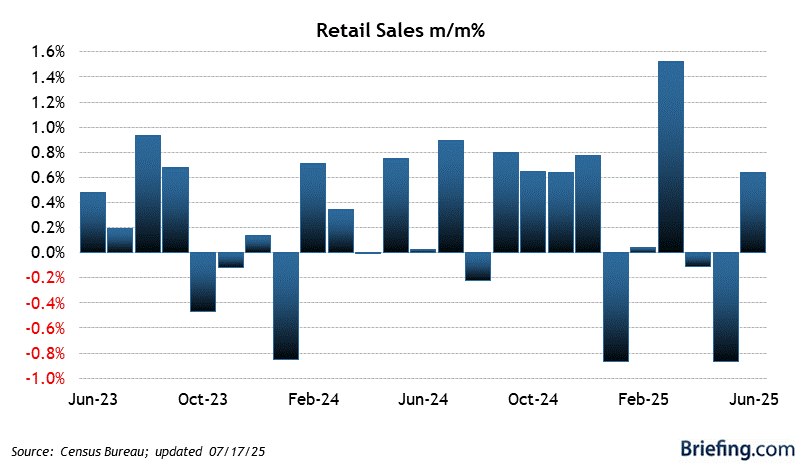
First, let's take a look at a chart of the percent of increase/decrease from month-over-month for retail sales (which is a component of personal consumption expenditures).
 From this graphic, you can see retail sales fell by nearly a full percentage point in December. In the prior two months, which rounds out the fourth quarter, month-over-month increases were both less than 1/2 percent each. In essence, retail sales for the fourth quarter, when averaged, were actually down slightly. So, if consumer spending at the cash register was so weak, how is it that overall consumption was able to come in at an increase of 4.2% from the previous quarter? Well, the only real explanation is that all the other consumables that don't make up retail sales -- like healthcare and insurance on your house and car -- had to have seen some serious inflation in the fourth quarter. But, that too is in conflict with this statement on inflation in the same GDP report:
Then, there's the durable goods order increase of 7.4%. So you understand, durable goods are things we or companies buy that last a long time. Things like aircraft and appliances like refrigerators or stoves. But, again, this huge increase doesn't jive with individual monthly reports on durable goods orders growth.

As you can easily see, every monthly change in durable goods orders was negative from August through December. Call me crazy, but it is a little hard to add up a bunch of negatives and get a positive 7.4%.
In my mind, the only reason that this report wasn't negative for GDP growth was because of the hard-to-believe strength in personal consumption and durable goods ordering. Now, the people who put this report together have 3 more months to revise their data. Could it be that this report was purposely "adjusted" this first time around so as not to embarrass their boss, Barack Obama, after he made such a big thing of the economy in the State of the Union address? We'll see if future revisions are downward.
References:
US economy cools in fourth quarter, but consumer spending shines: http://www.reuters.com/article/2015/01/30/us-usa-economy-idUSKBN0L30BC20150130
Gross Domestic Product: Fourth Quarter and Annual 2014 (Advance Estimate): http://www.bea.gov/newsreleases/national/gdp/gdpnewsrelease.htm
Obama heralds economic recovery in State of the Union: http://www.msnbc.com/msnbc/obama-heralds-economic-recovery-state-the-union-address
What that headline refers to is these two sentences regarding consumer spending from the summary section of the fourth quarter Gross Domestic Product (GDP) report for the last quarter of 2014:
Real personal consumption expenditures increased 4.3 percent in the fourth quarter, compared with an increase of 3.2 percent in the third. Durable goods increased 7.4 percent, compared with an increase of 9.2 percent.I have difficulty understanding where all this growth came from in personal consumption and durable goods purchases. That's because separate monthly reports on retail sales and durable good orders tell a completely different story.
First, let's take a look at a chart of the percent of increase/decrease from month-over-month for retail sales (which is a component of personal consumption expenditures).
The price index for gross domestic purchases, which measures prices paid by U.S. residents, decreased 0.3 percent in the fourth quarter, in contrast to an increase of 1.4 percent in the third.As the report states, there was no inflation because gross prices actually fell; and, that fact alone makes is even harder to explain the 4.2% increase in consumption.
Then, there's the durable goods order increase of 7.4%. So you understand, durable goods are things we or companies buy that last a long time. Things like aircraft and appliances like refrigerators or stoves. But, again, this huge increase doesn't jive with individual monthly reports on durable goods orders growth.
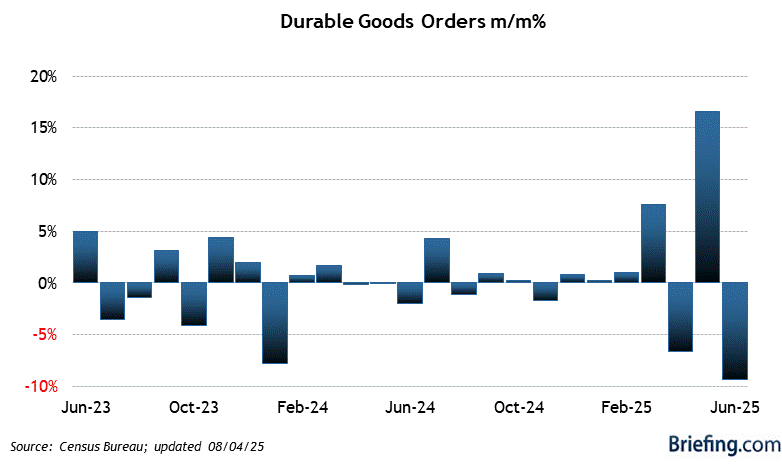
As you can easily see, every monthly change in durable goods orders was negative from August through December. Call me crazy, but it is a little hard to add up a bunch of negatives and get a positive 7.4%.
In my mind, the only reason that this report wasn't negative for GDP growth was because of the hard-to-believe strength in personal consumption and durable goods ordering. Now, the people who put this report together have 3 more months to revise their data. Could it be that this report was purposely "adjusted" this first time around so as not to embarrass their boss, Barack Obama, after he made such a big thing of the economy in the State of the Union address? We'll see if future revisions are downward.
References:
US economy cools in fourth quarter, but consumer spending shines: http://www.reuters.com/article/2015/01/30/us-usa-economy-idUSKBN0L30BC20150130
Gross Domestic Product: Fourth Quarter and Annual 2014 (Advance Estimate): http://www.bea.gov/newsreleases/national/gdp/gdpnewsrelease.htm
Obama heralds economic recovery in State of the Union: http://www.msnbc.com/msnbc/obama-heralds-economic-recovery-state-the-union-address
Wednesday, December 24, 2014
Really? The Fastest Growth In GDP Since 2003?
In the latest iteration of Gross Domestic Product (GDP), we were told that the economy grew at 5% in the third quarter of this year. This coupled with a 4.6% growth in the second quarter apparently gives us the fastest economic growth since 2003.
But, let me ask you this. Do you feel like, financially, you are living in the best of times in the last 11 years? Probably, not.
So, why does the GDP growth look so good? The answer is simple. Nearly a half trillion dollars in extra growth is being added to the GDP numbers each quarter that wasn't being counted in 2003. That's because, beginning with the 2nd quarter of last year, the folks who calculate the GDP each quarter, the Bureau of Economic Analysis, started adding in the value of intellectual property -- the costs of research and development of new products, and the costs of buying copyrighted material such a movie scripts, books, songs, etc. Previously, those costs were merely counted as intermediate business expenses that were ultimately rolled up into the final cost of the product and not counted as part of the GDP.
To understand that this is a significant change, let me use the example of a fictional publishing company who spends $100,000 to buy the rights to print an author's book. In the past, that $100,000 was just written off as a business expense and the real value of it was enumerated in the GDP when the book was sold. Today, under the new and creative accounting for intellectual property, that $100,000 cost is added to the GDP up front. Then, subsequently, the book's sales are also added to the GDP when they occur. This sure seems like some kind of double counting. Doesn't it?
Many believe this trickery adds a full one percent to the GDP growth each quarter. So, last quarter's growth was probably only 4% -- not 5% -- when the old method of accounting was used. Similarly, the 4.6% growth in the second quarter would have been 3.6%. However, this new method of calculating the GDP certainly gives President Obama bragging rights regarding the growth of the economy being the fastest since 2003.
Lastly, in my opinion, the best measure of the health of the economy is what you and I are spending. And, last quarter, Americans only spent at an increased rate of 2.5%; well behind a supposed overall growth of 5%. What's worse is that the consumer is taking on record amounts of credit debt while increasing their spending. Not a good thing. What really drove the growth in GDP was a 9.9% growth in government spending and 8.9% increase in business investment (which includes intellectual property).
References:
The U.S. economy grew at its quickest pace in 11 years in the third quarter, the strongest sign yet that growth has decisively shifted into higher gear: http://www.cnbc.com/id/102291457
GDP: Does Lady Gaga Count?: http://www.econlife.com/gdp-does-lady-gaga-count/
GDP Revisions Make Recovery Look Better, Recession Not as Bad: http://blogs.wsj.com/economics/2013/07/31/gdp-revisions-make-recovery-look-better-recession-not-as-bad/
U.S. consumer credit up a record amount in July: http://blogs.marketwatch.com/capitolreport/2014/09/08/u-s-consumer-credit-up-a-record-amount-in-july/
With GDP growing strongly, Republicans' economic dilemma gets more complicated: http://www.washingtonpost.com/blogs/plum-line/wp/2014/12/23/with-gdp-growing-strongly-republicans-economic-dilemma-gets-more-complicated/
pb
But, let me ask you this. Do you feel like, financially, you are living in the best of times in the last 11 years? Probably, not.
So, why does the GDP growth look so good? The answer is simple. Nearly a half trillion dollars in extra growth is being added to the GDP numbers each quarter that wasn't being counted in 2003. That's because, beginning with the 2nd quarter of last year, the folks who calculate the GDP each quarter, the Bureau of Economic Analysis, started adding in the value of intellectual property -- the costs of research and development of new products, and the costs of buying copyrighted material such a movie scripts, books, songs, etc. Previously, those costs were merely counted as intermediate business expenses that were ultimately rolled up into the final cost of the product and not counted as part of the GDP.
To understand that this is a significant change, let me use the example of a fictional publishing company who spends $100,000 to buy the rights to print an author's book. In the past, that $100,000 was just written off as a business expense and the real value of it was enumerated in the GDP when the book was sold. Today, under the new and creative accounting for intellectual property, that $100,000 cost is added to the GDP up front. Then, subsequently, the book's sales are also added to the GDP when they occur. This sure seems like some kind of double counting. Doesn't it?
Many believe this trickery adds a full one percent to the GDP growth each quarter. So, last quarter's growth was probably only 4% -- not 5% -- when the old method of accounting was used. Similarly, the 4.6% growth in the second quarter would have been 3.6%. However, this new method of calculating the GDP certainly gives President Obama bragging rights regarding the growth of the economy being the fastest since 2003.
Lastly, in my opinion, the best measure of the health of the economy is what you and I are spending. And, last quarter, Americans only spent at an increased rate of 2.5%; well behind a supposed overall growth of 5%. What's worse is that the consumer is taking on record amounts of credit debt while increasing their spending. Not a good thing. What really drove the growth in GDP was a 9.9% growth in government spending and 8.9% increase in business investment (which includes intellectual property).
References:
The U.S. economy grew at its quickest pace in 11 years in the third quarter, the strongest sign yet that growth has decisively shifted into higher gear: http://www.cnbc.com/id/102291457
GDP: Does Lady Gaga Count?: http://www.econlife.com/gdp-does-lady-gaga-count/
GDP Revisions Make Recovery Look Better, Recession Not as Bad: http://blogs.wsj.com/economics/2013/07/31/gdp-revisions-make-recovery-look-better-recession-not-as-bad/
U.S. consumer credit up a record amount in July: http://blogs.marketwatch.com/capitolreport/2014/09/08/u-s-consumer-credit-up-a-record-amount-in-july/
With GDP growing strongly, Republicans' economic dilemma gets more complicated: http://www.washingtonpost.com/blogs/plum-line/wp/2014/12/23/with-gdp-growing-strongly-republicans-economic-dilemma-gets-more-complicated/
pb
Wednesday, September 17, 2014
Are We Really Better Off Since Obama Took Office?
In front of adoring crowds at one of his all-too-many campaign style events, President Obama has claimed that "By almost any measure, we are better off since I took office" or that America is stronger under his watch.
The problem with such statements is that they are factually untrue when looking at the broader state of our union.
Sure, the President can claim that overall unemployment is down from where it was when he took over the reins of government in January 2009. But, to get there, overall unemployment rose to a rate of 10% in the first year-and-a-half of his presidency. Something that the so-called "stimulus" was supposed to avoid by promising that the unemployment rate wouldn't go above 8%. Even now, 5 years passed the end of the official end of the recession, this country still has an unemployment rate that is a full point above pre-recession levels.
Our major cities have extraordinarily high unemployment rates. Chicago, Obama's home town, is still at 8.0%; and, that's just recently down from a January 2014 rate of 9.6%. Detroit, now in bankruptcy, had an unemployment rate of 17.7% in July. A city like Atlantic City, that depends heavily on Americans spending leisure-time money, is suffering from cash-strapped tourists unable to indulge in what they have to offer. The casinos are closing and the unemployment rate sits at 13.7%. More worrisome is the fact that our three largest cities -- Los Angeles, New York, and Chicago -- are dangerously close to following Detroit into bankruptcy.
The Gross Domestic Product (GDP) is stuck at a 5-year growth rate of about 2%. This is, at least, the worst recovery since World War II and, some say in the history of the United States when using alternate methods of calculating GDP.
Then there's the overall economic health of America. For 5 straight years the median incomes of this country have fallen and income inequality has risen to a record high. Half the jobs created under this President's watch were low income/low paying. When he took office, only 30 million Americans were on food stamps. Today, that number is 47 million; a 56% increase. Similarly, only 38 million Americans were living in poverty. Today, that number is a record 47 million and has stood at 15 percent of the population for the last 2 years. Thus, as the population grows, so does the amount of people left in poverty.
Of course, the real elephant in the room is the amount of debt that Obama has left us with; a number that only gets worse by the day. At the beginning of his first term, the federal debt was $10.6 trillion. Today, it is closing in on $18 trillion; just $250 billion from the current number (as of this writing) of $17.756 trillion. A number that, for the first time in this nation's history, is greater than the total annual economic output of the country. Of those advanced economies in the world, only Portugal, Italy, Ireland, Greece and Spain can claim debt levels above their economic output. All of which are near bankruptcy and on the brink of bringing the European Union to its knees.
When we see people standing behind President Obama and nodding in agreement that things are better, you have to wonder what planet they're from. Most other Americans (74% in one poll) still think that we never recovered from the recession. And, in so many ways, they're right.
References:
By almost any measure, we are better off since I took office: http://www.realclearpolitics.com/video/2014/07/10/obama_by_almost_every_measure_we_are_better_off_than_when_i_took_office.html
Obama claims US is 'stronger' than 'when I first came into office' as economy weakens, debt soars, America loses global influence and border crisis deepens: http://www.dailymail.co.uk/news/article-2722926/Obama-claims-US-stronger-I-came-office-economy-weakens-debt-soars-America-loses-global-influence-illegal-immigrants-flood-border.html
Half Of The Jobs Created During The Recovery Were Low-Paying: http://thinkprogress.org/economy/2013/05/14/2008591/jobs-recovery-low-paying-minimum-wage/
Chicago Unemployment Rate Falls to 8.0%: http://www.worldbusinesschicago.com/news/chicago-unemployment-rate-jul2014
Detroit Unemployment Rates: https://ycharts.com/indicators/detroit_mi_unemployment_rate
Unemployment rises in most US states in July: http://www.detroitnews.com/article/20140818/BIZ/308180072
Another Atlantic City Bust: Trump Plaza Closes: http://abcnews.go.com/US/wireStory/trump-plaza-4th-atlantic-city-casino-shutdown-25528499
3 huge cities flirting with bankruptcy: http://money.msn.com/investing/post--3-huge-cities-flirting-with-bankruptcy
Obama’s economic recovery: officially the worst in US history: http://poorrichardsnews.com/post/41366829334/obamas-economic-recovery-officially-the-worst-in-us
Median Income Falls For 5th Year, Inequality At Record High: http://www.huffingtonpost.com/2013/09/17/median-income-falls-inequality_n_3941514.html
47 million Americans on food stamps: http://img.washingtonpost.com/blogs/wonkblog/files/2013/09/SNAP-participants.jpg
That’s rich: Poverty level under Obama breaks 50-year record: http://www.washingtontimes.com/news/2014/jan/7/obamas-rhetoric-on-fighting-poverty-doesnt-match-h/?page=all
America's Poverty Rate Stuck At 15 Percent For Second Straight Year: http://www.huffingtonpost.com/2013/09/17/poverty-america-census_n_3940812.html
74% said we are still in a recession: http://patch.com/new-hampshire/concord-nh/is-the-recession-over-yet#.VBR1qmNAVLU
U.S. Federal Debt Exceeds GDP: http://jamesviser.com/?p=995
The problem with such statements is that they are factually untrue when looking at the broader state of our union.
Sure, the President can claim that overall unemployment is down from where it was when he took over the reins of government in January 2009. But, to get there, overall unemployment rose to a rate of 10% in the first year-and-a-half of his presidency. Something that the so-called "stimulus" was supposed to avoid by promising that the unemployment rate wouldn't go above 8%. Even now, 5 years passed the end of the official end of the recession, this country still has an unemployment rate that is a full point above pre-recession levels.
Our major cities have extraordinarily high unemployment rates. Chicago, Obama's home town, is still at 8.0%; and, that's just recently down from a January 2014 rate of 9.6%. Detroit, now in bankruptcy, had an unemployment rate of 17.7% in July. A city like Atlantic City, that depends heavily on Americans spending leisure-time money, is suffering from cash-strapped tourists unable to indulge in what they have to offer. The casinos are closing and the unemployment rate sits at 13.7%. More worrisome is the fact that our three largest cities -- Los Angeles, New York, and Chicago -- are dangerously close to following Detroit into bankruptcy.
The Gross Domestic Product (GDP) is stuck at a 5-year growth rate of about 2%. This is, at least, the worst recovery since World War II and, some say in the history of the United States when using alternate methods of calculating GDP.
Then there's the overall economic health of America. For 5 straight years the median incomes of this country have fallen and income inequality has risen to a record high. Half the jobs created under this President's watch were low income/low paying. When he took office, only 30 million Americans were on food stamps. Today, that number is 47 million; a 56% increase. Similarly, only 38 million Americans were living in poverty. Today, that number is a record 47 million and has stood at 15 percent of the population for the last 2 years. Thus, as the population grows, so does the amount of people left in poverty.
Of course, the real elephant in the room is the amount of debt that Obama has left us with; a number that only gets worse by the day. At the beginning of his first term, the federal debt was $10.6 trillion. Today, it is closing in on $18 trillion; just $250 billion from the current number (as of this writing) of $17.756 trillion. A number that, for the first time in this nation's history, is greater than the total annual economic output of the country. Of those advanced economies in the world, only Portugal, Italy, Ireland, Greece and Spain can claim debt levels above their economic output. All of which are near bankruptcy and on the brink of bringing the European Union to its knees.
When we see people standing behind President Obama and nodding in agreement that things are better, you have to wonder what planet they're from. Most other Americans (74% in one poll) still think that we never recovered from the recession. And, in so many ways, they're right.
References:
By almost any measure, we are better off since I took office: http://www.realclearpolitics.com/video/2014/07/10/obama_by_almost_every_measure_we_are_better_off_than_when_i_took_office.html
Obama claims US is 'stronger' than 'when I first came into office' as economy weakens, debt soars, America loses global influence and border crisis deepens: http://www.dailymail.co.uk/news/article-2722926/Obama-claims-US-stronger-I-came-office-economy-weakens-debt-soars-America-loses-global-influence-illegal-immigrants-flood-border.html
Half Of The Jobs Created During The Recovery Were Low-Paying: http://thinkprogress.org/economy/2013/05/14/2008591/jobs-recovery-low-paying-minimum-wage/
Chicago Unemployment Rate Falls to 8.0%: http://www.worldbusinesschicago.com/news/chicago-unemployment-rate-jul2014
Detroit Unemployment Rates: https://ycharts.com/indicators/detroit_mi_unemployment_rate
Unemployment rises in most US states in July: http://www.detroitnews.com/article/20140818/BIZ/308180072
Another Atlantic City Bust: Trump Plaza Closes: http://abcnews.go.com/US/wireStory/trump-plaza-4th-atlantic-city-casino-shutdown-25528499
3 huge cities flirting with bankruptcy: http://money.msn.com/investing/post--3-huge-cities-flirting-with-bankruptcy
Obama’s economic recovery: officially the worst in US history: http://poorrichardsnews.com/post/41366829334/obamas-economic-recovery-officially-the-worst-in-us
Median Income Falls For 5th Year, Inequality At Record High: http://www.huffingtonpost.com/2013/09/17/median-income-falls-inequality_n_3941514.html
47 million Americans on food stamps: http://img.washingtonpost.com/blogs/wonkblog/files/2013/09/SNAP-participants.jpg
That’s rich: Poverty level under Obama breaks 50-year record: http://www.washingtontimes.com/news/2014/jan/7/obamas-rhetoric-on-fighting-poverty-doesnt-match-h/?page=all
America's Poverty Rate Stuck At 15 Percent For Second Straight Year: http://www.huffingtonpost.com/2013/09/17/poverty-america-census_n_3940812.html
74% said we are still in a recession: http://patch.com/new-hampshire/concord-nh/is-the-recession-over-yet#.VBR1qmNAVLU
U.S. Federal Debt Exceeds GDP: http://jamesviser.com/?p=995
Saturday, June 28, 2014
Despite Huge Drop in GDP, Economists Still See Better Days. Really?
When it was reported that the economy shrank nearly 3% in the first quarter, most economists -- the same ones who were completely caught off guard by the downward revised 3% number -- seem
to think its still on track to be positive; claiming that the first quarter was a one-off anomaly due to weather, lower healthcare spending, and a decline in exports.
The problem with this thinking is that, just one day after the dismal first quarter GDP was announced, another disappointing number, consumer spending, signaled even more trouble in the 2nd quarter. In May, the second month of the 2nd quarter, consumer spending came in at half of what those same economists were predicting, at an abysmal 0.2% percent growth. This after, April had literally shown no growth. Since consumer spending makes up 70% of the calculated GDP number, its hard to believe that the 2nd quarter GDP will be anything but lackluster or, worst case, another negative number; thus, signalling a recession. If that happens, the weather can't be blamed for the lack of consumers being holed-up in their homes, not buying products or seeing their doctors.
Unless spending comes in like gang busters in June, this economy is showing the clear signs that the consumer has reached a tipping point and incomes have not kept up with inflation. As a result, people may be putting off buying big ticket items, spending less on leisure, entertainment, other discretionary items, or even seeing their doctors less regularly because they are simply so cash-strapped that they can't afford to pay the deductibles. As history has proven time and time again, the lack of consumer spending is a primary reasons for recession.
Therefore, should anyone believe all those "happy times" economists who now seem to think that the first quarter was just a fluke?
References:
Economists brush off dire GDP: ‘This is a blip’: http://thehill.com/policy/finance/210563-economists-brush-off-dire-gdp-this-is-a-blip
Consumer Spending in May Was Disappointingly Weak: http://abcnews.go.com/Business/wireStory/consumer-spending-02-percent-24313555
What is Economic Recession? - Definition, Causes & Effects: http://education-portal.com/academy/lesson/what-is-economic-recession-definition-causes-effects.html#lesson
Cutting Through The Fog: The Economy Shrinks By 2.9%: Recession Is Now A Statistical Possibility: http://cuttingthroughthefog.blogspot.com/2014/06/the-economy-shinks-by-29-recession-is.html
to think its still on track to be positive; claiming that the first quarter was a one-off anomaly due to weather, lower healthcare spending, and a decline in exports.
The problem with this thinking is that, just one day after the dismal first quarter GDP was announced, another disappointing number, consumer spending, signaled even more trouble in the 2nd quarter. In May, the second month of the 2nd quarter, consumer spending came in at half of what those same economists were predicting, at an abysmal 0.2% percent growth. This after, April had literally shown no growth. Since consumer spending makes up 70% of the calculated GDP number, its hard to believe that the 2nd quarter GDP will be anything but lackluster or, worst case, another negative number; thus, signalling a recession. If that happens, the weather can't be blamed for the lack of consumers being holed-up in their homes, not buying products or seeing their doctors.
Unless spending comes in like gang busters in June, this economy is showing the clear signs that the consumer has reached a tipping point and incomes have not kept up with inflation. As a result, people may be putting off buying big ticket items, spending less on leisure, entertainment, other discretionary items, or even seeing their doctors less regularly because they are simply so cash-strapped that they can't afford to pay the deductibles. As history has proven time and time again, the lack of consumer spending is a primary reasons for recession.
Therefore, should anyone believe all those "happy times" economists who now seem to think that the first quarter was just a fluke?
References:
Economists brush off dire GDP: ‘This is a blip’: http://thehill.com/policy/finance/210563-economists-brush-off-dire-gdp-this-is-a-blip
Consumer Spending in May Was Disappointingly Weak: http://abcnews.go.com/Business/wireStory/consumer-spending-02-percent-24313555
What is Economic Recession? - Definition, Causes & Effects: http://education-portal.com/academy/lesson/what-is-economic-recession-definition-causes-effects.html#lesson
Cutting Through The Fog: The Economy Shrinks By 2.9%: Recession Is Now A Statistical Possibility: http://cuttingthroughthefog.blogspot.com/2014/06/the-economy-shinks-by-29-recession-is.html
Thursday, June 26, 2014
The Economy Shrinks By 2.9%: Recession Is Now A Statistical Possibility
Yesterday, the Bureau of Economic Analysis announced a shocking contraction of the economy -- as measured by Gross Domestic Product (GDP). In this latest revision, the economy "shrank" at an annualized rate of 2.9%. This was the third revision of the first quarter economic activity that was originally predicted to "grow" by 2.5%.
Never in the history of the U.S. has a contraction this large been outside the realm of a full-blown economic recession. So, it is hard to believe that the second quarter of this year will snap back enough -- growing by at least 3% -- to avoid putting us into the technical definition of recession: Two consecutive quarters of economic contraction.
In this blog, I have predicted that ObamaCare would push us into recession in 2014. I have also noted that retailers are signalling economic woes for 2014. And, now, we have some additional evidence that the consumer might have to further pull back on any discretionary spending that would otherwise drive the economy. In May, consumer prices grew at the highest rate in 15 months at 0.4%. This despite the fact that wages are stagnant. More importantly, essential consumables were up even higher. Electricity rates were up 2.3% in May. Food was up 1/2 of a percent. And, if the drought continues in the Southwest, food prices will continue to soar. Further, Obama's crackdown on coal will force electricity providers to further raise rates in order to be compliant with his latest EPA mandates.
The bottom line is that Obama's constant meddling in the economy is now rearing its ugly head in what could be a potential recession. Things like forcing employers to pay overtime for salaried workers only results in higher costs to consumers and, consequently, consumer's wallets shrink and they can't spend as much on the discretionary items that would otherwise drive our economy. When someone has to pay more for something they need to live such as electricity, other optional things, like dining out, are cut and the economy starts to contract.
Right now, I just can't see the country avoiding another recession.
References:
U.S. Economy Shrinks by Most in Five Years: Final Revision for 1st-Quarter GDP Shows 2.9% Contraction: http://online.wsj.com/articles/u-s-gdp-contracted-at-2-9-pace-in-first-quarter-1403699600
GDP Disaster: Final Q1 GDP Crashes To -2.9%, Lowest Since 2009, Far Below The Worst Expectations: http://www.zerohedge.com/news/2014-06-25/gdp-disaster-final-q1-gdp-crashes-29-worst-2009-far-below-worst-expectations
Cutting Through The Fog: Will ObamaCare Push Us Into Another Recession In 2014?: http://cuttingthroughthefog.blogspot.com/2014/01/will-obamacare-push-us-into-another.html
Cutting Through The Fog: Retailers Are Signalling Economic Woes For 2014: http://cuttingthroughthefog.blogspot.com/2014/05/retailers-are-signalling-economic-woes.html
Consumer prices rise sharply in May: http://www.usatoday.com/story/money/business/2014/06/17/consumer-prices-may/10642375/
Weak Wages Pose Threat to Liftoff for Economy: http://online.wsj.com/articles/consumer-spending-fell-0-1-in-april-1401453354
Obama to order businesses to hike overtime pay for salary workers: http://www.washingtontimes.com/news/2014/mar/12/obama-order-businesses-hike-overtime-pay-salary-wo/
pb
Never in the history of the U.S. has a contraction this large been outside the realm of a full-blown economic recession. So, it is hard to believe that the second quarter of this year will snap back enough -- growing by at least 3% -- to avoid putting us into the technical definition of recession: Two consecutive quarters of economic contraction.
In this blog, I have predicted that ObamaCare would push us into recession in 2014. I have also noted that retailers are signalling economic woes for 2014. And, now, we have some additional evidence that the consumer might have to further pull back on any discretionary spending that would otherwise drive the economy. In May, consumer prices grew at the highest rate in 15 months at 0.4%. This despite the fact that wages are stagnant. More importantly, essential consumables were up even higher. Electricity rates were up 2.3% in May. Food was up 1/2 of a percent. And, if the drought continues in the Southwest, food prices will continue to soar. Further, Obama's crackdown on coal will force electricity providers to further raise rates in order to be compliant with his latest EPA mandates.
The bottom line is that Obama's constant meddling in the economy is now rearing its ugly head in what could be a potential recession. Things like forcing employers to pay overtime for salaried workers only results in higher costs to consumers and, consequently, consumer's wallets shrink and they can't spend as much on the discretionary items that would otherwise drive our economy. When someone has to pay more for something they need to live such as electricity, other optional things, like dining out, are cut and the economy starts to contract.
Right now, I just can't see the country avoiding another recession.
References:
U.S. Economy Shrinks by Most in Five Years: Final Revision for 1st-Quarter GDP Shows 2.9% Contraction: http://online.wsj.com/articles/u-s-gdp-contracted-at-2-9-pace-in-first-quarter-1403699600
GDP Disaster: Final Q1 GDP Crashes To -2.9%, Lowest Since 2009, Far Below The Worst Expectations: http://www.zerohedge.com/news/2014-06-25/gdp-disaster-final-q1-gdp-crashes-29-worst-2009-far-below-worst-expectations
Cutting Through The Fog: Will ObamaCare Push Us Into Another Recession In 2014?: http://cuttingthroughthefog.blogspot.com/2014/01/will-obamacare-push-us-into-another.html
Cutting Through The Fog: Retailers Are Signalling Economic Woes For 2014: http://cuttingthroughthefog.blogspot.com/2014/05/retailers-are-signalling-economic-woes.html
Consumer prices rise sharply in May: http://www.usatoday.com/story/money/business/2014/06/17/consumer-prices-may/10642375/
Weak Wages Pose Threat to Liftoff for Economy: http://online.wsj.com/articles/consumer-spending-fell-0-1-in-april-1401453354
Obama to order businesses to hike overtime pay for salary workers: http://www.washingtontimes.com/news/2014/mar/12/obama-order-businesses-hike-overtime-pay-salary-wo/
pb
Monday, June 16, 2014
French Toast: Hollande's Piketty-Like Tax-The-Rich-Scheme Fails Miserably.
Two years ago, France's socialist President Francois Hollande increased his country's Value Added Tax (VAT) on consumer purchases; upped the corporate tax rate; and, imposed a 75% income tax on euro-millionaires. All of this was supposed to increase revenues by 30 billion euros per year.
However, the score card is in and roughly half of that 30 billion was actually achieved.
This was all too predictable and is a perfect example of why the "tax-the-rich" French economist, Thomas Piketty, is wrong.
The French consumer, faced with higher VAT taxes, simply cannot afford to buy as many new things as they otherwise would, and, as a result, business profits fell and so did tax revenues. That's just human nature and, something that socialists (or Democrats in our country) never seem to add into the equation when planning to raise taxes. Nor do they understand that, corporations, faced with increased taxes on themselves, are more inclined to raise prices which, in turn, further lowers consumer activity and again results in lowered taxable business incomes. Lastly, that 75% tax on the rich only caused some of them to leave France; thus, again reducing tax revenues.
The simple fact is that Hollande's tax strategy is hurting France. Unemployment recently hit a record high of 11%; although its coming down now. We, in the U.S., didn't even see that level of unemployment when we were at the height of our Great Recession. Their economy is stagnant, with the last 2 quarters either being at barely measurable or at dead zero. And, the rich, who pay a hefty amount in taxes, are continuing to leave along with their valuable talent and their equally valuable taxable income.
References:
Thomas Piketty: Capital in the Twenty-First Century: http://en.wikipedia.org/wiki/Capital_in_the_Twenty-First_Century
France in 14bn-euro tax black hole: http://www.bbc.com/news/business-27602312
French unemployment at record high: http://www.bbc.com/news/business-25922231
France GDP Growth Rate: http://www.tradingeconomics.com/france/gdp-growth
France's Reckoning: Rich, Young Flee Welfare State: http://www.cbn.com/cbnnews/world/2014/February/Frances-Reckoning-Rich-Young-Flee-Welfare-State/
However, the score card is in and roughly half of that 30 billion was actually achieved.
This was all too predictable and is a perfect example of why the "tax-the-rich" French economist, Thomas Piketty, is wrong.
The French consumer, faced with higher VAT taxes, simply cannot afford to buy as many new things as they otherwise would, and, as a result, business profits fell and so did tax revenues. That's just human nature and, something that socialists (or Democrats in our country) never seem to add into the equation when planning to raise taxes. Nor do they understand that, corporations, faced with increased taxes on themselves, are more inclined to raise prices which, in turn, further lowers consumer activity and again results in lowered taxable business incomes. Lastly, that 75% tax on the rich only caused some of them to leave France; thus, again reducing tax revenues.
The simple fact is that Hollande's tax strategy is hurting France. Unemployment recently hit a record high of 11%; although its coming down now. We, in the U.S., didn't even see that level of unemployment when we were at the height of our Great Recession. Their economy is stagnant, with the last 2 quarters either being at barely measurable or at dead zero. And, the rich, who pay a hefty amount in taxes, are continuing to leave along with their valuable talent and their equally valuable taxable income.
References:
Thomas Piketty: Capital in the Twenty-First Century: http://en.wikipedia.org/wiki/Capital_in_the_Twenty-First_Century
France in 14bn-euro tax black hole: http://www.bbc.com/news/business-27602312
French unemployment at record high: http://www.bbc.com/news/business-25922231
France GDP Growth Rate: http://www.tradingeconomics.com/france/gdp-growth
France's Reckoning: Rich, Young Flee Welfare State: http://www.cbn.com/cbnnews/world/2014/February/Frances-Reckoning-Rich-Young-Flee-Welfare-State/
Monday, June 2, 2014
Ominous Consumer Spending Problems In the First Quarter GDP Numbers?
According to some supposedly expert economists and the White House, the economy contracted by 1% in the first quarter of 2014 because of the severe weather in those three months. Thus, keeping consumers huddled in their homes. Not buying the things that would have otherwise driven the economy.
But, consumers didn't stop buying in the first quarter. Spending was actually up 3.1%. Albeit, this was down from what CNBC said was "brisk" spending of 3.3 percent in the previous quarter. So, its a little hard to believe that the consumer was absent due to weather.
What the report does show is something that I warned about in a previous post, Retailers Are Signalling Economic Woes For 2014. Despite the fact that consumer spending was up, corporate profits declined by $213 billion dollars in the same quarter. What these contradictory facts show is that the consumer is being forced to pay higher prices for essential items like food, clothing, energy, and, especially, healthcare; thus reducing the amount of discretionary spending that would have normally driven corporate profits.
Thus, the consumer is at a recessionary tipping point where he or she can't afford to buy the kind of items that would cause the economy to expand. This is what happens when you have a combination of stagnated wages and soaring prices for essential items like food and energy. That is why I believe that weather had nothing to do with the first quarter slowdown of the economy, and, that is why I also believe that the second quarter will also contract; thus sending us into recession.
References:
Frigid winter takes toll as US GDP contracts for first time in 3 years: http://www.cnbc.com/id/101713801
National Income and Product Accounts Gross Domestic Product: First Quarter 2014 (Second Estimate) Corporate Profits: First Quarter 2014 (Preliminary Estimate): http://www.bea.gov/newsreleases/national/gdp/gdpnewsrelease.htm
Food prices soar as incomes stand still: http://www.cbsnews.com/news/food-prices-soar-as-incomes-stand-still/
Electricity Price Index Soars to New Record at Start of 2014; U.S. Electricity Production Declining: http://cnsnews.com/news/article/terence-p-jeffrey/electricity-price-index-soars-new-record-start-2014-us-electricity
Will ObamaCare Push Us Into Another Recession In 2014?: http://cuttingthroughthefog.blogspot.com/2014/01/will-obamacare-push-us-into-another.html
But, consumers didn't stop buying in the first quarter. Spending was actually up 3.1%. Albeit, this was down from what CNBC said was "brisk" spending of 3.3 percent in the previous quarter. So, its a little hard to believe that the consumer was absent due to weather.
What the report does show is something that I warned about in a previous post, Retailers Are Signalling Economic Woes For 2014. Despite the fact that consumer spending was up, corporate profits declined by $213 billion dollars in the same quarter. What these contradictory facts show is that the consumer is being forced to pay higher prices for essential items like food, clothing, energy, and, especially, healthcare; thus reducing the amount of discretionary spending that would have normally driven corporate profits.
Thus, the consumer is at a recessionary tipping point where he or she can't afford to buy the kind of items that would cause the economy to expand. This is what happens when you have a combination of stagnated wages and soaring prices for essential items like food and energy. That is why I believe that weather had nothing to do with the first quarter slowdown of the economy, and, that is why I also believe that the second quarter will also contract; thus sending us into recession.
References:
Frigid winter takes toll as US GDP contracts for first time in 3 years: http://www.cnbc.com/id/101713801
National Income and Product Accounts Gross Domestic Product: First Quarter 2014 (Second Estimate) Corporate Profits: First Quarter 2014 (Preliminary Estimate): http://www.bea.gov/newsreleases/national/gdp/gdpnewsrelease.htm
Food prices soar as incomes stand still: http://www.cbsnews.com/news/food-prices-soar-as-incomes-stand-still/
Electricity Price Index Soars to New Record at Start of 2014; U.S. Electricity Production Declining: http://cnsnews.com/news/article/terence-p-jeffrey/electricity-price-index-soars-new-record-start-2014-us-electricity
Will ObamaCare Push Us Into Another Recession In 2014?: http://cuttingthroughthefog.blogspot.com/2014/01/will-obamacare-push-us-into-another.html
Wednesday, May 21, 2014
Retailers Are Signalling Economic Woes For 2014
In the first quarter of this year, the nation's economy, as measured by Gross Domestic Product (GDP), grew at a barely measurable rate of one-tenth of one percent. That was a 93% miss from the 1.5% that the economists were originally projecting. In defense of this horrible number, the Obama Administration blamed the lack of economic growth on low consumer spending; all because of the bad weather in the Northeast and Midwest in January through March of this year.
However, having lived in the Midwest for many years, the forecast of a bad storm actually forces store shelves to be emptied. People buy things they otherwise might not buy; like snow blowers, generators, space heaters and a whole host of other products. They stock up on food and water. And, after the storm has passed, consumers replenish what they used and typically buy the things they weren't able to during the storm. So, typically, the economic impact is not that significant; especially since most of the rest of the country is unaffected by any regional activity.
The problem with the "bad weather" excuse is that it ignores a deeper problem that is hurting our economy. That problem that consumers aren't buying like they used to. The major retailers such as Wal-Mart, Kroger, Target and Macy's are all seeing changes in buying habits. People aren't splurging on non-essential products. In fact, they also aren't buying as much food. Wal-Mart, despite having lower grocery pricing than their competitors, has consistently seen a drop in grocery revenues. Last quarter, grocery sales, among all the stores that were in operation a year or more, dropped nearly 1%.
Going forward, every retailer is warning that their earnings are at risk this year due to a slow down in consumer spending. Since consumer spending makes up 70% of GDP, any drop could cause the economy to stall and, as a result, fall into another recession. If the next revision of the current GDP growth of 0.1% goes negative in a couple of weeks, it could signal the first of two quarters of negative growth which, by definition, is a recession.
References:
Target echoes warnings about cautious consumer patterns: http://www.ktvu.com/videos/business/economy/target-echoes-warnings-about-cautious-consumer/v9dRG/
Wal-Mart is hurting for shoppers: Wal-Mart woes deeper than winter snow: http://money.cnn.com/2014/05/15/investing/wal-mart-weather-earnings/
Wal-Mart's biggest problem: Its customers: http://www.cnbc.com/id/101680657
Kroger...cautious in its earnings guidance for the year, citing uncertainty around the economy: http://supermarketnews.com/retail-amp-financial/kroger-marks-10-years-positive-comps
First-Quarter U.S. Economic Slump Looking Uglier by the Day: http://www.bloomberg.com/news/2014-05-06/first-quarter-u-s-economic-slump-looking-uglier-by-the-day.html
However, having lived in the Midwest for many years, the forecast of a bad storm actually forces store shelves to be emptied. People buy things they otherwise might not buy; like snow blowers, generators, space heaters and a whole host of other products. They stock up on food and water. And, after the storm has passed, consumers replenish what they used and typically buy the things they weren't able to during the storm. So, typically, the economic impact is not that significant; especially since most of the rest of the country is unaffected by any regional activity.
The problem with the "bad weather" excuse is that it ignores a deeper problem that is hurting our economy. That problem that consumers aren't buying like they used to. The major retailers such as Wal-Mart, Kroger, Target and Macy's are all seeing changes in buying habits. People aren't splurging on non-essential products. In fact, they also aren't buying as much food. Wal-Mart, despite having lower grocery pricing than their competitors, has consistently seen a drop in grocery revenues. Last quarter, grocery sales, among all the stores that were in operation a year or more, dropped nearly 1%.
Going forward, every retailer is warning that their earnings are at risk this year due to a slow down in consumer spending. Since consumer spending makes up 70% of GDP, any drop could cause the economy to stall and, as a result, fall into another recession. If the next revision of the current GDP growth of 0.1% goes negative in a couple of weeks, it could signal the first of two quarters of negative growth which, by definition, is a recession.
References:
Target echoes warnings about cautious consumer patterns: http://www.ktvu.com/videos/business/economy/target-echoes-warnings-about-cautious-consumer/v9dRG/
Wal-Mart is hurting for shoppers: Wal-Mart woes deeper than winter snow: http://money.cnn.com/2014/05/15/investing/wal-mart-weather-earnings/
Wal-Mart's biggest problem: Its customers: http://www.cnbc.com/id/101680657
Kroger...cautious in its earnings guidance for the year, citing uncertainty around the economy: http://supermarketnews.com/retail-amp-financial/kroger-marks-10-years-positive-comps
First-Quarter U.S. Economic Slump Looking Uglier by the Day: http://www.bloomberg.com/news/2014-05-06/first-quarter-u-s-economic-slump-looking-uglier-by-the-day.html
Tuesday, May 13, 2014
Our Debt-to-GDP Ratio Is Less Important Than Amounts Needed To Service the Debt
A few weeks ago, the head of the Congressional Budget Office told the Senate Budget Committee that our debt, as a percent of Gross Domestic Product (GDP), is already too high by historical standards. His department's work showed that our debt will be 74% of GDP by the end of this year and 79% by the end of 2021. He then went on to say that the current trajectory of increases is pushing us toward a fiscal crisis whereby investors would require increasingly more interest to service our increased debt.
The problem I have with simply measuring debt as a percent of GDP is that it doesn't tell the whole story. In my opinion, a more serious issue is whether or not a country has to borrow money to pay down the interest on the debt that it has already accumulated. This, in much the same way that a consumer gets into trouble when they continue to use their credit card while only being able to pay the minimum amount due each month.
Sadly, the U.S. is already in this economic death spiral; regardless of what our debt-to-GDP ratio is. To that point, I present the following table that extracted its data from the President's own Office of Management and Budget (OMB) report:
What this simply shows is that from 2010 to 2017, the Federal government expects to take in $1.8 trillion in new revenues. At the same time, it will spend $2.6 trillion paying down the interest on the debt. Therefore, the Federal government will borrow nearly another $833 billion so that it can merely pay off the interest. Also make note of the fact that the borrowing grows exponentially, starting in 2015, as the spiraling debt accumulation takes effect.
One last important point. All these numbers assume that interest rates will remain historically low with the Federal Reserve holding them between zero and one-quarter percent; and, the Fed will continue to keep those rates low as long as inflation is tame. However, if they are forced to start raising rates because of rising inflation, then the interest on the debt payments will simply explode. That's when this country gets into real trouble.
References:
President's Office Of Management and Budget: Revenues (Table 1.1) and Interest on the Debt (Table 2.1): http://www.whitehouse.gov/sites/default/files/omb/budget/fy2013/assets/hist.pdf
U.S. on ‘unsustainable’ budget course: CBO: http://www.marketwatch.com/story/cbo-issues-fresh-long-term-debt-warning-2013-09-17
Debt: Elemendorf comments to Senate Budget Committee: https://www.youtube.com/watch?v=Pz-3cQBDJ_w
The problem I have with simply measuring debt as a percent of GDP is that it doesn't tell the whole story. In my opinion, a more serious issue is whether or not a country has to borrow money to pay down the interest on the debt that it has already accumulated. This, in much the same way that a consumer gets into trouble when they continue to use their credit card while only being able to pay the minimum amount due each month.
Sadly, the U.S. is already in this economic death spiral; regardless of what our debt-to-GDP ratio is. To that point, I present the following table that extracted its data from the President's own Office of Management and Budget (OMB) report:
 |
| * OMB Estimated in Billions of Dollars |
What this simply shows is that from 2010 to 2017, the Federal government expects to take in $1.8 trillion in new revenues. At the same time, it will spend $2.6 trillion paying down the interest on the debt. Therefore, the Federal government will borrow nearly another $833 billion so that it can merely pay off the interest. Also make note of the fact that the borrowing grows exponentially, starting in 2015, as the spiraling debt accumulation takes effect.
One last important point. All these numbers assume that interest rates will remain historically low with the Federal Reserve holding them between zero and one-quarter percent; and, the Fed will continue to keep those rates low as long as inflation is tame. However, if they are forced to start raising rates because of rising inflation, then the interest on the debt payments will simply explode. That's when this country gets into real trouble.
References:
President's Office Of Management and Budget: Revenues (Table 1.1) and Interest on the Debt (Table 2.1): http://www.whitehouse.gov/sites/default/files/omb/budget/fy2013/assets/hist.pdf
U.S. on ‘unsustainable’ budget course: CBO: http://www.marketwatch.com/story/cbo-issues-fresh-long-term-debt-warning-2013-09-17
Debt: Elemendorf comments to Senate Budget Committee: https://www.youtube.com/watch?v=Pz-3cQBDJ_w
"CBO estimates that federal debt held by the public will equal 74 percent of GDP at the end of this year and 79 percent in 2024 (the end of the current 10-year projection period). Such large and growing federal debt could have serious negative consequences, including restraining economic growth in the long term, giving policymakers less flexibility to respond to unexpected challenges, and eventually increasing the risk of a fiscal crisis (in which investors would demand high interest rates to buy the government’s debt). - See more at: http://cnsnews.com/news/article/susan-jones/cbo-director-large-and-growing-federal-debt-could-produce-fiscal-crisis#sthash.4KYAwfJi.dpuf
"CBO estimates that federal debt held by the public will equal 74 percent of GDP at the end of this year and 79 percent in 2024 (the end of the current 10-year projection period). Such large and growing federal debt could have serious negative consequences, including restraining economic growth in the long term, giving policymakers less flexibility to respond to unexpected challenges, and eventually increasing the risk of a fiscal crisis (in which investors would demand high interest rates to buy the government’s debt). - See more at: http://cnsnews.com/news/article/susan-jones/cbo-director-large-and-growing-federal-debt-could-produce-fiscal-crisis#sthash.4KYAwfJi.dpuf
Thursday, May 1, 2014
On The Minimum Wage Hike: Timing Is Everything
On the very day that the Senate Democrats are planning to make a show of voting for a $10.10 minimum wage, it was reported that the economy in the first quarter only grew by one-tenth of one percent. Just a tenth of a percent above dead stalled.
Yet, the Democrats feel obliged to further damage this already-fragile situation by hiking the minimum wage and, in so doing, force higher prices for a consumer base that has already seen its income decline for 5 straight years.
This, so 1/2 of one percent of our population or 1.6 million workers, can see their salary kicked up 41%. With this, the Democrats think they can stir up their political base as they approach the Fall elections. And the economy be damned as they ignore how complicit the last minimum wage increase was in making this the worst recovery ever.
Now, ask yourself this. Are you going to get a 41% wage hike so you can afford the inflationary prices caused by this latest increase? Are the working poor, those on welfare assistance, and those on fixed incomes going to benefit from it? No. This will only create further income inequality by weighing down those already at the bottom.
References:
April 30: $10.10 Wage Bill Set To Die In The Senate: http://thehill.com/homenews/senate/204766-1010-wage-bill-set-to-die
April 30: US economy slowed to 0.1 percent growth rate in Q1:
http://apnews.myway.com//article/20140430/us-economy-gdp-09b1567225.html
Median Income Falls For 5th Year, Inequality At Record High: http://www.huffingtonpost.com/2013/09/17/median-income-falls-inequality_n_3941514.html
Characteristics of a minimum wage worker: http://www.bls.gov/cps/minwage2012.htm
Yet, the Democrats feel obliged to further damage this already-fragile situation by hiking the minimum wage and, in so doing, force higher prices for a consumer base that has already seen its income decline for 5 straight years.
This, so 1/2 of one percent of our population or 1.6 million workers, can see their salary kicked up 41%. With this, the Democrats think they can stir up their political base as they approach the Fall elections. And the economy be damned as they ignore how complicit the last minimum wage increase was in making this the worst recovery ever.
Now, ask yourself this. Are you going to get a 41% wage hike so you can afford the inflationary prices caused by this latest increase? Are the working poor, those on welfare assistance, and those on fixed incomes going to benefit from it? No. This will only create further income inequality by weighing down those already at the bottom.
References:
April 30: $10.10 Wage Bill Set To Die In The Senate: http://thehill.com/homenews/senate/204766-1010-wage-bill-set-to-die
April 30: US economy slowed to 0.1 percent growth rate in Q1:
http://apnews.myway.com//article/20140430/us-economy-gdp-09b1567225.html
Median Income Falls For 5th Year, Inequality At Record High: http://www.huffingtonpost.com/2013/09/17/median-income-falls-inequality_n_3941514.html
Characteristics of a minimum wage worker: http://www.bls.gov/cps/minwage2012.htm
Monday, February 24, 2014
Five Years Later...Why the Stimulus And Keynesian Economics Failed
Remember this chart:

The plain fact is that real unemployment did even worse than Obama's "Without Recovery Plan" with the peak unemployment rate hitting 10.1% in 2010. Today, when it should be at 5%, we are still struggling at 6.6%. When Obama took office there were 155.2 million workers in the labor force. Despite the fact that nearly 7.5 million new workers should have entered the workforce over the last 5 years, the number has only inched up to 155.4 million. That 7.5 million, euphemistically called discouraged workers, have just given up looking for work. As a result, they are no longer counted as being in the workforce. So much for "real" job creation.
And, GDP? Well, its seen the worst recovery since the Great Depression with an average of about 1.97% growth per year since the recession ended in 2009. Normally, growth should be 50% greater than that; at 3% or higher. Obviously, the stimulus didn't work as promised; and, even today, three-quarters of Americans still think we are in a recession.
While there are several reasons why Obama's Keynesian-Style Stimulus Package failed, the primary reason lies in the false belief that, when the economy slips into recession as a result of slack consumer spending, that lack of spending can be made up by increasing government expenditures. But, this is just ridiculous. The simple fact is that consumers don't spend like governments. They don't build roads or bridges and they don't spend their money fixing them. So, instead of stimulating the existing parts of our economy that are in the process of dying off, the Keynesian stimulus winds up stimulating a subset of the economy that had nothing to do with the reason that the economy faltered in the first place. What's worse, most of these projects have a low labor cost to materials and equipment costs ratios. That is why you wind up with statistics that show that, at the very least, it cost the taxpayers $185,000 for each job that was supposedly created.
Another problem with using federal and state construction projects as a means of trying to stimulate the economy is the fact that any spending and job creation will always be short lived. If the project is 1 month long or 3 years long, that part of the economy that is being stimulated will only benefit as long as the project is still alive. Once its over, so are the jobs and so is the spending.
Lastly, there's the argument by the Democrats that every dollar spent returns $1.50 in economic activity. To some extent that's true, but $1.50 is an average. Depending on how labor intensive the effort is, the returns will range between 70 cents (a loss) and $1.90. Heavy construction projects are more towards 70 cents than anywhere near $1.50 because the labor costs are so low relative to the overall cost of the project. Thus, the potential for any true economic expansion is lost. More importantly, the stimulus is a drag on everyone's wallet because deficit spending devalues all the dollars that are in the economy. This weak dollar effect means that things will cost more; especially imported items. For example, oil, which is priced worldwide on the basis of the strength or weakness of the U.S. dollar, has dramatically risen since 2009. The result has been that gasoline prices rose from $1.74/gallon in 2009 to the current rate of $3.63. This is despite the fact we are now awash in new, domestic oil as a result of fracking and other new technologies. In contrast, natural gas, which is not traded in terms of the value of the dollar, has seen its prices fall from $12.49 a cubic ton to $9.40 from 2009 to 2012. All because of fracking.
Despite whatever spin the White House puts on the stimulus results, it was nothing but a failure and, I think, definitive proof that Keynesian economics is simply another tool for left-wing politicians to grow the government and redistribute wealth.
References:
The Worst Four Years Of GDP Growth In History: Yes, We Should Be Worried: http://www.forbes.com/sites/realspin/2013/04/12/the-worst-four-years-of-gdp-growth-in-history-yes-we-should-be-worried/
As Obama starts sixth year, 74 percent say US still in recession: http://www.foxnews.com/politics/2014/01/22/fox-news-poll-as-obama-starts-sixth-year-74-percent-say-us-still-in-recession/
White House Says The Stimulus Cost Per Job is $185,000; not $278,000: http://www.nationalreview.com/campaign-spot/271107/white-house-nuh-uh-stimulus-jobs-only-cost-185k-each
Politifact: Every Dollar of Spending Returns Between $0.70 & $1.90 in Increase Economic Activity: http://www.politifact.com/truth-o-meter/statements/2010/jul/27/jeanne-shaheen/lawmaker-claims-unemployment-benefits-boost-econom/
A Scorecard on the economy under Obama: http://www.politifact.com/truth-o-meter/article/2012/jun/01/scorecard-economy-obama/
Sunday, December 29, 2013
Obama's Predictions On The Sequester Never Came True
Back in February, our big-government and big-spending President predicted dire consequences if the $85.4 billion in Sequester spending cuts went into effect on March 1. He said it would cost jobs and could harm our fragile economy. Despite his warnings, the Sequester automatically kicked in because Congress could not come up with an alternative budget agreement.
So, the President, in order to prove how right he was, decided to make the cuts as obvious and painful to Americans as possible while completely laying the blame at the feet of the Republicans. He shut down the White House tours. He closed federal parks. The Blue Angels and Thunderbirds were grounded. Even tax refund checks were delayed; and, the list goes on.
But what has really happened since sequestration?
Well, the economy has grown at the fastest pace in 2 years with Gross Domestic Product (GDP) moving from a snail's pace of 1.8% in the first quarter of 2013; to 2.5% in the 2nd quarter; then, galloped to 4.1% in the 3rd quarter. In another measure of economic growth, Federal tax revenues hit a record high of $2.47 trillion this year; up $285 billion from the prior year. Then, contrary to the Obama prediction, the unemployment rate fell from 7.7% in February to 7% in November. This was the lowest rate since March of 2009.
Lastly, the very same President who condemned the Sequester spending cuts back in February, has now decided to take credit for those same spending reductions and the resulting deficit reduction. On July 24th, in front of an adoring crowd at Knoxville College in Illinois, he proudly proclaimed: "Our deficits are falling at the fastest rate in 60 years."
You see, with Barack Obama, everything is either a shading of the truth, a half-truth, or an out-and-out lie. The fact is that the Sequester cuts were a mere pin-prick against the massive spending levels that he has created. They were not going to have some enormous impact on the economy or on unemployment. Also, the idea of the Sequester, itself, originated out of Obama's White House. No way could the Republicans be blamed for it. And, to take credit for the reduction in the deficit is just plain hypocrisy.
So, the President, in order to prove how right he was, decided to make the cuts as obvious and painful to Americans as possible while completely laying the blame at the feet of the Republicans. He shut down the White House tours. He closed federal parks. The Blue Angels and Thunderbirds were grounded. Even tax refund checks were delayed; and, the list goes on.
But what has really happened since sequestration?
Well, the economy has grown at the fastest pace in 2 years with Gross Domestic Product (GDP) moving from a snail's pace of 1.8% in the first quarter of 2013; to 2.5% in the 2nd quarter; then, galloped to 4.1% in the 3rd quarter. In another measure of economic growth, Federal tax revenues hit a record high of $2.47 trillion this year; up $285 billion from the prior year. Then, contrary to the Obama prediction, the unemployment rate fell from 7.7% in February to 7% in November. This was the lowest rate since March of 2009.
Lastly, the very same President who condemned the Sequester spending cuts back in February, has now decided to take credit for those same spending reductions and the resulting deficit reduction. On July 24th, in front of an adoring crowd at Knoxville College in Illinois, he proudly proclaimed: "Our deficits are falling at the fastest rate in 60 years."
You see, with Barack Obama, everything is either a shading of the truth, a half-truth, or an out-and-out lie. The fact is that the Sequester cuts were a mere pin-prick against the massive spending levels that he has created. They were not going to have some enormous impact on the economy or on unemployment. Also, the idea of the Sequester, itself, originated out of Obama's White House. No way could the Republicans be blamed for it. And, to take credit for the reduction in the deficit is just plain hypocrisy.
Subscribe to:
Posts (Atom)


 Posts
Posts