Since the latest jobs report was released yesterday morning, more than a few economists are touting a strengthening jobs market because the unemployment rate rose from 5.4% to 5.5%. Oddly enough, this would normally be true since the official and publicly announced unemployment rate is calculated without including workers who have given up looking for a job but still want to work. Sensing a better chance of employment, many of those are once again attempting a job search. Add some of those people back into the workforce and it is natural for the unemployment rate to go up. That is as long as the number of workers rejoining the workforce is greater than the number of jobs being created. Superficially that was the case. The size of the workforce grew by 397,000 and 280,000 jobs were created; resulting in an increase of unemployed by 125,000 and an increased unemployment rate.
However, if this was really true, we should have seen a corresponding reduction in the number of people not looking for work. We didn't. Instead the U-6 number of Table A-15 -- the Alternative measures of labor underutilization -- stayed the same at 10.8%.
Also, if the job market was truly improving, the number of people who are long term unemployed should be going down. But, again from Table A-15, the U-1 percent for those people out of work for more than 15 weeks rose from 2.3% (in the prior month) to 2.4%. At the same time, job losers (the U-2 report of the same table) rose from 2.6% to 2.7%; month-over-month.
I guess I'm tired of economists simply looking at the top line numbers and ignoring the details and coming up with the false conclusion that this report shows a strengthening job market.
References:
THE EMPLOYMENT SITUATION—MAY 2015 - Bureau of Labor Statistics: http://www.bls.gov/news.release/pdf/empsit.pdf
Economists agree that the May jobs report was good all around: http://www.businessinsider.com/why-the-unemployment-rate-rose-2015-6
pb
Showing posts with label employment. Show all posts
Showing posts with label employment. Show all posts
Saturday, June 6, 2015

Saturday, June 7, 2014
Only a Third of Americans Work Full Time
In the latest employment report, it was stated that only 119 million people are working full time. That is only about one third of the nearly 320 million people making up the country's population.
While this is up from a low of 116 million in January, it is still a very sad statement on the jobs situation. It means that too few of our people are paying all the taxes necessary to support the multitude of government programs such as Medicare and Social Security, which depend on income taxes collected from those full-time workers. This is why these two programs are destined to run out of money faster than previously thought.
References:
The Good And The Not- So-Good News About US Jobs In One Chart: http://www.zerohedge.com/news/2014-06-06/good-and-not-so-good-news-about-us-jobs-one-chart
May Employment (Situation) Report: http://www.bls.gov/news.release/empsit.toc.htm
Monthly number of full-time employees in the United States from May 2013 to May 2014 (in millions, unadjusted): http://www.statista.com/statistics/192361/unadjusted-monthly-number-of-full-time-employees-in-the-us/
Monday, April 7, 2014
March's Employment Report Finally Exposes Obama's Poor Job Creation Record
In the latest employment summary, it was reported that 192,000 jobs were created in March. Additionally, the jobs numbers of both January and February were revised upwards to 144,000 and 197,000; respectively. So, in three months 533,000 jobs were added to the economy. Yet, the unemployment rate actually went up from from 6.6% to 6.7%. This simple contradiction exposes a clear flaw in how we measure unemployment as a nation and how Obama has benefited from it and has been able to make the claim of 49 consecutive months of job creation.
For over 4 years, the Obama Administration -- not the country -- has benefited from the fact that millions of able-bodied unemployed workers have just stopped looking for work out of sheer frustration. Quite simply, when a job seeker gives up, our government no longer considers them part of the unemployed or part of the workforce. Thus it appears there is job creation and a lowering of the rate of unemployment when there really wasn't. Proof of this comes from the fact that, from January through March, the number of unemployed workers rose from 10.236 million to 10.486 million. This was despite a supposed job creation of over half a million jobs. Logically, you can't have job creation when job losses are increasing. Thus the flaw in our system of measuring this important number.
The reality is that we still have record numbers of sidelined workers who have given up; and, that is the only reason why Obama's job creation record, is as good as it is. But, if one looks at the U6 accounting of the unemployment rate, which doesn't exclude those no longer job hunting, we have an unemployment rate that is still at 12.7%; well above the officially high rate of 10% in 2010. The simple fact is that, for every job Obama says he created, two unemployed workers just gave up looking for work.
References:
March Employment Situation Summary: http://www.bls.gov/news.release/empsit.nr0.htm
March Household Survey Data: http://www.bls.gov/news.release/empsit.a.htm
March Alternative Measures Of Labor Utilization (U1 through U6): http://www.bls.gov/news.release/empsit.t15.htm
49 Consecutive Months Of Private Sector Job Growth: http://www.dpcc.senate.gov/?p=blog&id=172
Wednesday, March 26, 2014
On Raising The Minimum Wage, More Than 500 Economists Say No
In this blog I have published several entries explaining why raising the minimum wage would hurt businesses, the economy, youth employment, and not reduce poverty but, instead, deepen it.
Now, more than 500 economists from universities and colleges from all over the country -- of which three are Nobel Laureates -- have written an open "Statement to Federal Policy Makers" saying basically the same thing. This excerpt essentially summarizes their concern:
The link to read the letter and see its signatories: http://economistletter.com/
Story: More than 500 Economists Denounce Minimum Wage Hike in Letter to Washington: http://www.maciverinstitute.com/2014/03/more-than-500-economists-denounce-minimum-wage-hike-in-letter-to-washington/
Now, more than 500 economists from universities and colleges from all over the country -- of which three are Nobel Laureates -- have written an open "Statement to Federal Policy Makers" saying basically the same thing. This excerpt essentially summarizes their concern:
"As economists, we understand the fragile nature of this recovery and the dire financial realities of the nearly 50 million Americans living in poverty. To alleviate these burdens for families and improve our local, regional, and national economies, we need a mix of solutions that encourage employment, business creation, and boost earnings rather than across-the-board mandates that raise the cost of labor."I would hope that "all" our representatives in Washington take heed of what these economists are saying. To increase the minimum wage at the expense of so many millions and our economy -- just to garner votes -- is not just insane but a dereliction of duty. These warnings are quite clear.
The link to read the letter and see its signatories: http://economistletter.com/
Story: More than 500 Economists Denounce Minimum Wage Hike in Letter to Washington: http://www.maciverinstitute.com/2014/03/more-than-500-economists-denounce-minimum-wage-hike-in-letter-to-washington/
Monday, February 24, 2014
Five Years Later...Why the Stimulus And Keynesian Economics Failed
Remember this chart:

The plain fact is that real unemployment did even worse than Obama's "Without Recovery Plan" with the peak unemployment rate hitting 10.1% in 2010. Today, when it should be at 5%, we are still struggling at 6.6%. When Obama took office there were 155.2 million workers in the labor force. Despite the fact that nearly 7.5 million new workers should have entered the workforce over the last 5 years, the number has only inched up to 155.4 million. That 7.5 million, euphemistically called discouraged workers, have just given up looking for work. As a result, they are no longer counted as being in the workforce. So much for "real" job creation.
And, GDP? Well, its seen the worst recovery since the Great Depression with an average of about 1.97% growth per year since the recession ended in 2009. Normally, growth should be 50% greater than that; at 3% or higher. Obviously, the stimulus didn't work as promised; and, even today, three-quarters of Americans still think we are in a recession.
While there are several reasons why Obama's Keynesian-Style Stimulus Package failed, the primary reason lies in the false belief that, when the economy slips into recession as a result of slack consumer spending, that lack of spending can be made up by increasing government expenditures. But, this is just ridiculous. The simple fact is that consumers don't spend like governments. They don't build roads or bridges and they don't spend their money fixing them. So, instead of stimulating the existing parts of our economy that are in the process of dying off, the Keynesian stimulus winds up stimulating a subset of the economy that had nothing to do with the reason that the economy faltered in the first place. What's worse, most of these projects have a low labor cost to materials and equipment costs ratios. That is why you wind up with statistics that show that, at the very least, it cost the taxpayers $185,000 for each job that was supposedly created.
Another problem with using federal and state construction projects as a means of trying to stimulate the economy is the fact that any spending and job creation will always be short lived. If the project is 1 month long or 3 years long, that part of the economy that is being stimulated will only benefit as long as the project is still alive. Once its over, so are the jobs and so is the spending.
Lastly, there's the argument by the Democrats that every dollar spent returns $1.50 in economic activity. To some extent that's true, but $1.50 is an average. Depending on how labor intensive the effort is, the returns will range between 70 cents (a loss) and $1.90. Heavy construction projects are more towards 70 cents than anywhere near $1.50 because the labor costs are so low relative to the overall cost of the project. Thus, the potential for any true economic expansion is lost. More importantly, the stimulus is a drag on everyone's wallet because deficit spending devalues all the dollars that are in the economy. This weak dollar effect means that things will cost more; especially imported items. For example, oil, which is priced worldwide on the basis of the strength or weakness of the U.S. dollar, has dramatically risen since 2009. The result has been that gasoline prices rose from $1.74/gallon in 2009 to the current rate of $3.63. This is despite the fact we are now awash in new, domestic oil as a result of fracking and other new technologies. In contrast, natural gas, which is not traded in terms of the value of the dollar, has seen its prices fall from $12.49 a cubic ton to $9.40 from 2009 to 2012. All because of fracking.
Despite whatever spin the White House puts on the stimulus results, it was nothing but a failure and, I think, definitive proof that Keynesian economics is simply another tool for left-wing politicians to grow the government and redistribute wealth.
References:
The Worst Four Years Of GDP Growth In History: Yes, We Should Be Worried: http://www.forbes.com/sites/realspin/2013/04/12/the-worst-four-years-of-gdp-growth-in-history-yes-we-should-be-worried/
As Obama starts sixth year, 74 percent say US still in recession: http://www.foxnews.com/politics/2014/01/22/fox-news-poll-as-obama-starts-sixth-year-74-percent-say-us-still-in-recession/
White House Says The Stimulus Cost Per Job is $185,000; not $278,000: http://www.nationalreview.com/campaign-spot/271107/white-house-nuh-uh-stimulus-jobs-only-cost-185k-each
Politifact: Every Dollar of Spending Returns Between $0.70 & $1.90 in Increase Economic Activity: http://www.politifact.com/truth-o-meter/statements/2010/jul/27/jeanne-shaheen/lawmaker-claims-unemployment-benefits-boost-econom/
A Scorecard on the economy under Obama: http://www.politifact.com/truth-o-meter/article/2012/jun/01/scorecard-economy-obama/
Saturday, February 8, 2014
The Real Employment Numbers That Never See Headlines
When the employment report is issued each month, most people and, certainly the media, are only interested in two numbers: (1) the number of jobs created or lost in that month and (2) the resulting unemployment rate. But, those two numbers are a result of some pretty heavy-handed massaging in what the Bureau of Labor Statistics calls "seasonal adjustments". Seasonal adjustments have always come under fire, especially lately, from a lot of well-respected economists, because the "adjustments" seem to be very large and, thus, questionably accurate.
Take, for example, the latest jobs report. The headline says that 113,000 jobs were created with a resulting drop in the unemployment rate from 6.7% to 6.6%. Now, to any logical observer, this makes perfect sense in that a falling unemployment rate must mean that some number of jobs had to have been created to lower the rate. But, if you dig deeper into the January jobs report, you would see a completely different picture when it comes to the unadjusted numbers.
According to the raw data in Table A-2, whites, which make up 79% of the workforce, saw their unemployment rate go up in January by 9%; from 5.7% to 6.2%. Yet, after seasonal adjustment, whites remained the same at 5.7% as in December. The raw data also said that blacks also saw their rate go up by 9%; from 11.6% to 12.6%. After adjustment, their final number was 12.1%. While there is no adjustment data available for Asians, their unemployment rate went up 17% from 4.1% to 4.8%. All three groups added together represent 96% of the workforce and all saw substantial losses in employment. Yet, the final employment number says jobs were created and the unemployment rate fell.
Lastly, I would be remiss if I didn't include an absolutely horrendous fact that our President wouldn't want you to know when he's out there touting the lowest unemployment rate during his presidency. That fact is that teen unemployment among blacks now sits at 39% (raw) or 38% after adjustment. In the city of Chicago, the President's hometown, black male teens are at a unbelievable 92% unemployment rate. Maybe that's why gang membership has risen 40% since Obama became President.
References:
Has The Fed Been Fooled By Phony Jobs Numbers?: http://www.bloomberg.com/news/2013-09-24/has-the-fed-been-fooled-by-phony-jobs-numbers-.html
Table A: January Employment Situation Report: Seasonally Adjusted Results: http://www.bls.gov/news.release/empsit.a.htm
Table A-2: January Employment Situation Report: Raw And Seasonally Adjusted Numbers by Race, Age, and Sex: http://www.bls.gov/news.release/empsit.t02.htm
New Urban League study finds 92 percent of African American male teens are unemployed: http://www.myfoxchicago.com/story/24486694/new-study-finds-92-percent-of-african-american-male-teens-are-unemployed
FBI: Gang Membership Up 40% Since 2009: http://www.thegatewaypundit.com/2013/07/confirmed-gang-membership-up-40-under-obama-violent-attacks-on-whites-up-18/
Tuesday, December 31, 2013
Raising The Minimum Wage Hurts America's Youth
If you listen to President Obama, raising the minimum wage is nothing but a win-win situation. It will pull people out of poverty and strengthen the middle class. But, whenever the Federal government injects itself into business activities, there are many more losers than there are winners in the process. And, when it comes to raising the minimum wage, one of the biggest losers is youth employment.
The reason for this is simple. A higher minimum wage results in unemployed adults (those age 24 and above) being more willing to compete with unemployed youths (those16 to 24 years of age) for entry-level job openings. In turn, employers are more likely to hire adults with proven work records versus young people with little or no work experience.
To prove my point, you need only look at a couple of charts. The first chart is that of the Civilian Unemployment rate for the years 2007 through and including all of 2011. (Note: the chart and its data are extracted from FRED - the Federal Reserve's economic database. The red notations are mine.).

In the world of economics, the measurement of unemployment rates is considered a "lagging" indicator. This means that, when there is an economic downturn, like a recession, it takes a few months into the recession before employers actually realize that their businesses are being hurt and they need to start laying people off. Then, when a recession ends, there is a similar lag before employers start rehiring again and the unemployment rate declines. On this chart, I have noted these "lags" in red. But, there's something odd about this chart. In May of 2007, the unemployment rate uncharacteristically rose prior to the recession; moving from a low of 4.4% to 5% before leveling off in late 2007.
To understand what was happening in 2007, you need to look at a similar chart of youth unemployment; which is a subset of the above chart.

Now, unlike the prior chart, I've included 2006 data to show just how flat the Youth Unemployment Rate was in the year prior to 2007. But, in 2007, there was a dramatic increase; months before the recession hit. The sole reason behind this was the passage and implementation of the Fair Minimum Wage Act of 2007 where the minimum wage went from $5.15 an hour to $5.85 in 2007; upped again to $6.55 an hour in 2008; and, again, in 2009 to the current rate of $7.25/hour.
Further proof that adults have been literally "stealing" entry-level jobs away from our nation's youth comes from how slow youth unemployment has recovered in comparison to overall unemployment. In 2010, both youth unemployment and overall unemployment rates topped out. Since then, general unemployment has been lowered to a 7% rate from its high of 10.1%; a 31% improvement. On the other hand, youth unemployment has only moved downward from a height of 18.4% to the current rate of 16.5%; a mere 10.3% improvement.
The problem with sustained high youth unemployment is the fact that society, in general, is jeopardized. For one, idle youths due to high unemployment rates have resulted in a 40% rise in gang membership in the period 2009 to 2012; as reported by the FBI. And, I'm quite sure that trend didn't abate in 2013.
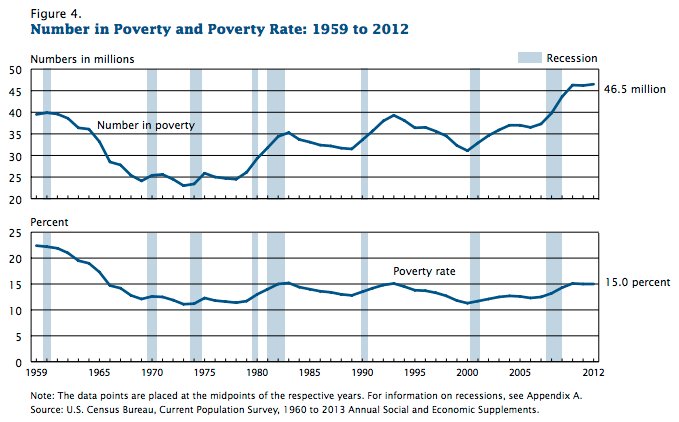
Additionally, social programs like Social Security and Medicare are highly dependent on a broad base of younger workers paying into these systems in order to support the high cost of retiring workers. Without younger workers in the workforce, the two programs could go bankrupt a lot earlier than projected. More importantly, the increase in the minimum wage and, the sustained high rate of youth unemployment, may be creating a permanent underclass of marginally employable workers or totally unemployable workers who will be stuck in poverty for their whole lives. Just the opposite of Obama's belief that raising the minimum wage will pull people out of poverty. To that point, the high youth unemployment rate may be one of the primary reasons why the record high number of people in poverty, 46.5 million, hasn't come down one iota since 2010. This at a time when general unemployment has improved by more than 30%:
 Besides what I've shown above, there have been dozens of research studies that have proven that raising the minimum wage costs jobs and hurts the economy; but, liberals like the President, and other activists, continue to ignore the truth.
The reason for this is simple. A higher minimum wage results in unemployed adults (those age 24 and above) being more willing to compete with unemployed youths (those16 to 24 years of age) for entry-level job openings. In turn, employers are more likely to hire adults with proven work records versus young people with little or no work experience.
To prove my point, you need only look at a couple of charts. The first chart is that of the Civilian Unemployment rate for the years 2007 through and including all of 2011. (Note: the chart and its data are extracted from FRED - the Federal Reserve's economic database. The red notations are mine.).

In the world of economics, the measurement of unemployment rates is considered a "lagging" indicator. This means that, when there is an economic downturn, like a recession, it takes a few months into the recession before employers actually realize that their businesses are being hurt and they need to start laying people off. Then, when a recession ends, there is a similar lag before employers start rehiring again and the unemployment rate declines. On this chart, I have noted these "lags" in red. But, there's something odd about this chart. In May of 2007, the unemployment rate uncharacteristically rose prior to the recession; moving from a low of 4.4% to 5% before leveling off in late 2007.
To understand what was happening in 2007, you need to look at a similar chart of youth unemployment; which is a subset of the above chart.

Now, unlike the prior chart, I've included 2006 data to show just how flat the Youth Unemployment Rate was in the year prior to 2007. But, in 2007, there was a dramatic increase; months before the recession hit. The sole reason behind this was the passage and implementation of the Fair Minimum Wage Act of 2007 where the minimum wage went from $5.15 an hour to $5.85 in 2007; upped again to $6.55 an hour in 2008; and, again, in 2009 to the current rate of $7.25/hour.
Further proof that adults have been literally "stealing" entry-level jobs away from our nation's youth comes from how slow youth unemployment has recovered in comparison to overall unemployment. In 2010, both youth unemployment and overall unemployment rates topped out. Since then, general unemployment has been lowered to a 7% rate from its high of 10.1%; a 31% improvement. On the other hand, youth unemployment has only moved downward from a height of 18.4% to the current rate of 16.5%; a mere 10.3% improvement.
The problem with sustained high youth unemployment is the fact that society, in general, is jeopardized. For one, idle youths due to high unemployment rates have resulted in a 40% rise in gang membership in the period 2009 to 2012; as reported by the FBI. And, I'm quite sure that trend didn't abate in 2013.
Additionally, social programs like Social Security and Medicare are highly dependent on a broad base of younger workers paying into these systems in order to support the high cost of retiring workers. Without younger workers in the workforce, the two programs could go bankrupt a lot earlier than projected. More importantly, the increase in the minimum wage and, the sustained high rate of youth unemployment, may be creating a permanent underclass of marginally employable workers or totally unemployable workers who will be stuck in poverty for their whole lives. Just the opposite of Obama's belief that raising the minimum wage will pull people out of poverty. To that point, the high youth unemployment rate may be one of the primary reasons why the record high number of people in poverty, 46.5 million, hasn't come down one iota since 2010. This at a time when general unemployment has improved by more than 30%:
Saturday, July 7, 2012
A Jobs Number That Obama Can't Spin
Every month, coincidental with the release of the Employment Report, the Bureau of Labor Statistics provides a single statistic that most economists believe to be the best indicator of the current and past employment situations. That statistic is the Employment-to-Population ratio (EPR). Simply speaking, it is the percentage of how many working age people -- ages 16 to 64 -- have jobs. Unlike the workforce participation rate, it doesn't muddy up the water with people who are too young or too old to be in the workforce; while still accounting for population growth. And, for sure, its a better number than the highly manipulated unemployment rate and the number jobs that are supposedly added each month.
Prior to the recession, the EPR was above 63. When Obama took office in January of 2009, the ratio was 60.6. By the end of 2009, it had fallen to 58.2; with the ratio only bouncing back to 58.7 in both April and May of 2010. But, since then, the ratio has never again reached 58.7. When you look at the chart of the EPR over the last 10 years, you see a pronounced drop; beginning in 2007. After finally bottoming out in late 2009, the "trend" has been almost straight-line sideways ever since.

Prior to the recession, the EPR was above 63. When Obama took office in January of 2009, the ratio was 60.6. By the end of 2009, it had fallen to 58.2; with the ratio only bouncing back to 58.7 in both April and May of 2010. But, since then, the ratio has never again reached 58.7. When you look at the chart of the EPR over the last 10 years, you see a pronounced drop; beginning in 2007. After finally bottoming out in late 2009, the "trend" has been almost straight-line sideways ever since.

No matter how many times Obama claims to have created 4.3 million jobs, the EPR tells a much different story. Certainly, a much truer story. And, that story is that Obama has done nothing in the last 3-1/2 years to improve the employment situation for the work-capable segment of our population.
Finally, like every summer since 2007, I would expect the EPR to start falling again. Certainly, Friday's lousy employment report only reinforced that belief.
Note: The month-by-month data and the chart can be found at: http://data.bls.gov/timeseries/LNS12300000
Thursday, September 10, 2009
JOLTS Says The Unemployed Are Being Squeezed Dry
You may or may not know it but, those same people that keep track of our unemployment rate, the Bureau of Labor and Statistics, also keeps track of our national "job postings" in something that is called the "Job Opening and Labor Turnover Survey; also knows as the JOLTS report.
The reason that this report is so important is because it tells us whether or not companies are hiring. Unfortunately for the 15+ million who don't have jobs in America, the news is not good. Once again, the number of listed job openings in the nation has fallen (Click to See Full Story: "Job openings down 50% from the peak in 2007"). Statistically, that report now shows that there are about 6.5 unemployed persons who could be vying for each new job opening.
This information coincides with the constantly rising number of people who remain on unemployment compensation rolls each month. Worse than that, it also means that many unemployed workers have little hope of getting another job. No matter how many jobs this Administration says it has saved or created, this is a very painful situation that only keeps getting worse for a lot of American families.
Subscribe to:
Posts (Atom)


 Posts